
Short answer
What should I check before building a laterite stone wall? Laterite stone is soft when freshly quarried and hardens after exposure. IS 3620 covers laterite blocks for walls and partitions, and it asks that the blocks be free of cracks and flaws. IS 1597 Part 1 covers rubble stone masonry, with rules on wetting, pointing and curing. IS 3620's one rain rule is that blocks should be kept out of rain while they season, and neither standard gives a laterite rule for coastal or monsoon exposure, so the engineer decides the wall for your site.
On this page (9)
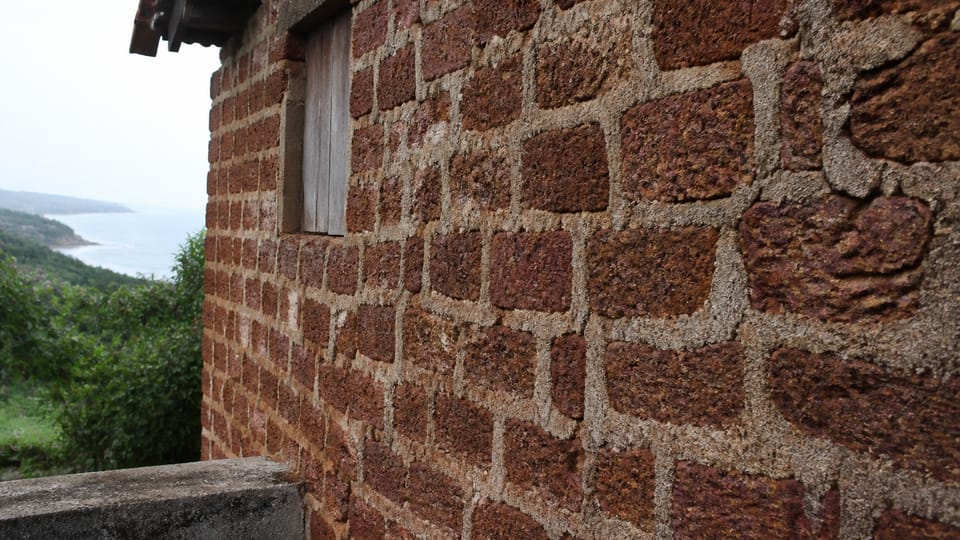
Laterite is a reddish stone found along the west coast of India, and many houses in Kerala, Goa and the Konkan have walls built from it. Laterite is soft and porous when it is first dug out, and it hardens after exposure to air. This guide explains what the Indian standards say about laterite blocks and stone masonry, what they leave out, and what to check on site. This guide gives no strength, absorption or mix figures. Both standards set minimum properties for laterite, and they do not give the same figures, so the supplier’s tests and the engineer’s design decide the wall.
What does IS 3620 cover?
IS 3620 is the standard for laterite stone blocks for masonry. It “lays down the requirements for dimensions, physical properties, and workmanship of rectangular blocks made from laterite stone, used in the construction of walls and partitions” (clause 1.1).
The foreword explains the stone. It says that laterite “is mainly used as building blocks for construction of masonry in building” (clause 0.2). It also says that “Freshly quarried laterite is soft and porous but when exposed to atmospheric conditions it hardens and makes a very tough material” (clause 0.3).
The standard says that the stone’s properties “vary considerably from place to place” (clause 0.3). The foreword names Kerala, Goa and Maharashtra among the regions where laterite is found (clause 0.2). It does not name Konkan, so the Konkan stone should be checked on its own properties.
How should the blocks be prepared?
The standard says that the blocks should be “exposed preferably for a period of three months before being used in the construction of masonry to ensure adequate stabilization” (clause 2.2). It adds that “exposure to rains should be avoided”. The period is the standard’s own word, and the engineer decides whether the job follows it.
The blocks must be free of defects. The standard says that “The stone blocks shall be without any soft veins, cracks, cavities, flaws and similar imperfections” (clause 2.1). The blocks should be of uniform shape, with straight edges at right angles (clause 5.1).
The standard allows the blocks to carry a manufacturer’s mark, but makes it optional. It says that the blocks “may be marked in a suitable manner” (clause 6.1). Ask the supplier how the lot is identified.
What does IS 1597 say about the wall?
IS 1597 Part 1 covers the construction of rubble stone masonry. It gives no laterite wall rule. Its Table 1 lists laterite’s minimum crushing strength, and its other rules apply to stone in general. Four of its rules matter for a laterite wall:
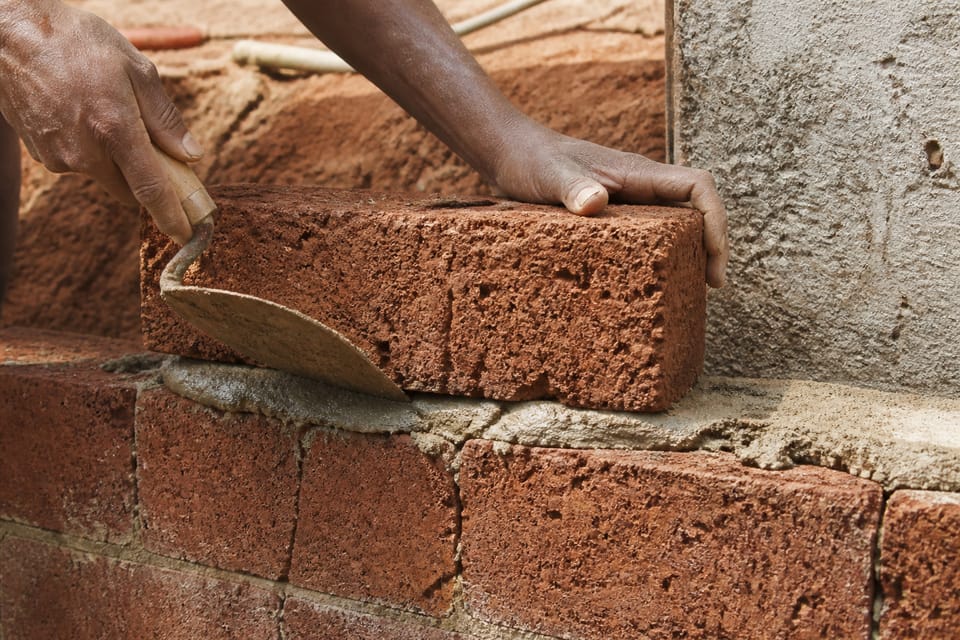
- Wetting. “Stones shall be sufficiently wetted before laying to prevent absorption of water from mortar” (clause 8.6).
- Mortar. “The choice of mortar shall essentially be based on local experience and practice for use with the stone selected and the climatic conditions prevailing” (clause 7.4). The standard gives no mix for laterite.
- Pointing. “Pointing shall be avoided as far as possible” (clause 8.10). Where the joints are pointed, the standard sets a maximum joint thickness that depends on the type of rubble (clause 8.10).
- Curing. With cement or composite mortar, the masonry is “kept constantly moist on all the faces for a minimum period of seven days” (clause 8.11). With lime mortar, curing starts two days after laying and runs for seven days.
The standard also says that “Vertical joints shall be staggered as far as possible” (clause 8.7.4), and that rain penetration depends on “the rate of absorption of water by stone or by the mortar and also the extent of cracks present in the masonry” (clause 7.3).
What is not in the standards?
IS 3620’s only rain rule is that blocks should be kept out of rain while they season (clause 2.2). The standards give no laterite-specific rule for rain in service, for the coast or for the monsoon. They give no wall height, storey limit or load limit for laterite walls. They give no plinth detail and no mortar mix for laterite. So the wall, its plaster and its waterproofing are for the engineer to decide for your site. The rain and the exposure matter, because the standard ties rain penetration to the absorption of the stone and to cracks.
What should I check?
This section is practice, not a code rule.
- The blocks are from one quarry, and the supplier can show the lot’s dimensions and their condition.
- The blocks are free of cracks, soft veins and cavities, and were stored out of the rain before use.
- The blocks are wetted before they are laid.
- The joints are kept thin and the vertical joints are staggered.
- The wall is kept moist for the curing period the engineer asks for.
- The engineer has decided the plaster, the render and the waterproofing for the wall’s exposure.
What mistakes should I avoid?
This section is practice.
- Laying dry blocks, which take water out of the mortar.
- Stacking the blocks in the open where the rain can soak them before use.
- Using a thick joint and then filling it with a coarse pointing.
- Letting the wall dry out in the first days after it is built.
- Using a stone from one quarry for another without checking its condition.
Frequently asked questions
Is a laterite wall strong enough for a house?
This guide gives no strength value. The standards set minimum properties for laterite, and they differ between the two standards. The supplier’s test results and the engineer’s design decide the wall.
Do laterite walls need plaster?
IS 1597 Table 3 gives general guidance for rubble walls: solid walls are recommended for rendering in sheltered and moderate exposure. Whether that applies to dressed laterite blocks is for the engineer. Ask the engineer and the painter.
Can I use laterite in a coastal house?
Ask the engineer. The standards give no coastal rule for laterite, and the local stone and exposure decide the wall.
Related guides
This guide is general information. Read the disclaimer. Your engineer decides the stone, the mortar and the finish for your wall.
Sources
- IS 3620:1979, Laterite stone block for masonry. Clauses 1.1, 2.1, 2.2, 5.1, 6.1 and Table 2, and the Foreword clauses 0.2 and 0.3, read from a public copy checked on page images. The scan shows the standard reaffirmed in 2003; the BIS validity date was not checked.
- IS 1597 (Part 1):1992, Construction of stone masonry: code of practice, Part 1 rubble stone masonry. Clauses 1.1, 7.3, 7.4, 8.6, 8.7.4, 8.10, 8.11, Table 1 and Table 3 read from a public copy checked on page images. The standard covers rubble stone masonry in general, not laterite specifically. The scan shows the standard reaffirmed in 2002; the BIS validity date was not checked.
Change log
- : Added Related guides link(s) to newly published article(s): Stone masonry for plinths and walls: random rubble vs coursed rubble. No other text changed.
General information only. It is not a structural design or professional advice. Ask a licensed structural engineer or architect to check your plans and site.