
Short answer
What is the difference between random rubble and coursed rubble stone masonry? Random rubble is built from stones as they come from the quarry, placed to get a good bond, and sometimes roughly levelled into courses. Coursed rubble uses stones squared to roughly the same height in each course. IS 1597 (Part 1) asks for full joints, no hollow spaces and staggered vertical joints. The mortar is chosen from local experience and IS 2250. Your engineer decides the wall for your site.
On this page (8)
Stone is one of the oldest building materials in India, and a stone wall can last a long time when it is built well. The difference between a sound stone wall and a weak one lies in how the stones are laid, how well they are bonded, and what mortar holds them. This page explains the two common forms of rubble masonry, what IS 1597 (Part 1) asks for, and what an owner should check. It gives no mortar mixes, no joint sizes, no wall thicknesses and no prices. Those are for the engineer and the mason.
What are the two types?
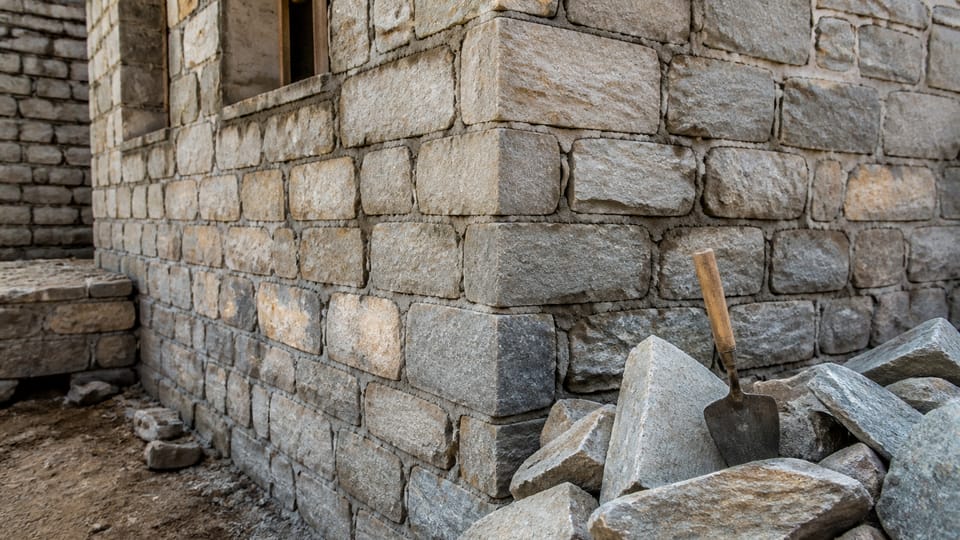
IS 1597 (Part 1) covers the design and construction of rubble stone masonry, and it covers only the construction practices generally met with in India (clauses 1.1 and 1.2). It describes rubble walling as built of stones that are irregular in shape as quarried, or squared and only hammer-dressed, with comparatively thick joints (clause 3.29).
Random rubble is built in two forms:
- Uncoursed random rubble. The stones are used as they come from the quarry. The mason selects blocks of all shapes and sizes, more or less at random, and places them to get a good bond (clause 7.1.1 a).
- Random rubble brought to courses. This is like uncoursed random rubble, except that the work is roughly levelled up to courses at intervals (clause 7.1.1 b).
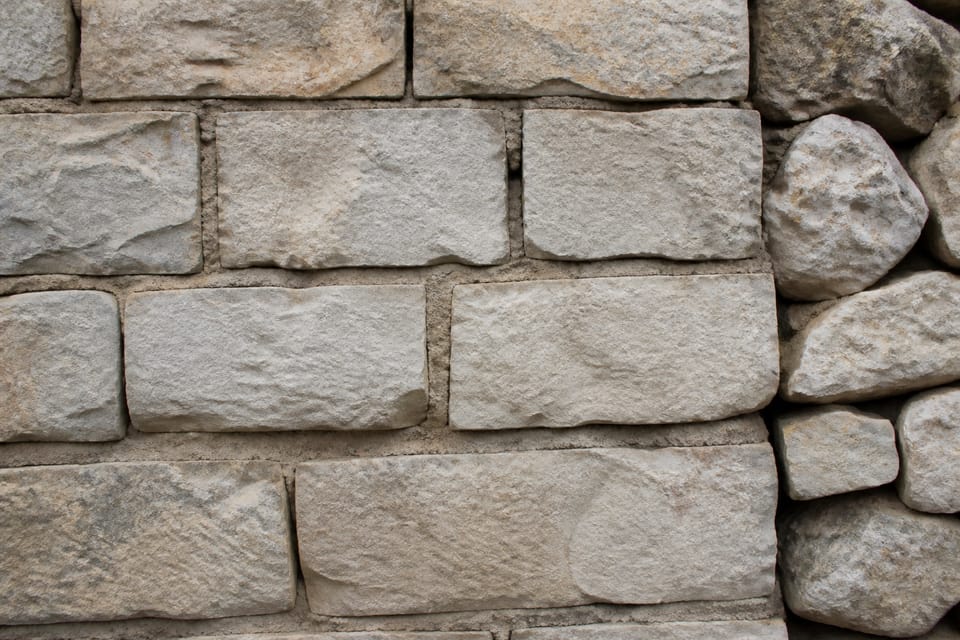
Coursed rubble is built from squared stones laid in courses. The stones in any one course are roughly squared to the same height, and their faces may be pitched to give a rock-face look or dressed smooth (clause 7.1.2 c).
The difference is in the regularity of the layers. Coursed work has more regular layers, while random rubble is rougher. IS 1597 does not rank the two types for bond or strength. The choice depends on the stone available, the building and the engineer.
How is the mortar chosen?
IS 1597 (Part 1) says mortar for stone masonry may be a mix of cement and fine aggregate, cement, lime and fine aggregate, or lime and fine aggregate of limestone pozzolana and fine aggregate. It refers to IS 2250 for the proportions and the factors that affect the choice (clause 5.2).
The code says the choice of mortar shall essentially be based on local experience and practice for the stone used and the climate. It also says the mortar must stiffen up quickly as the rubble is laid, adhere strongly to the stone, and develop enough compressive strength (clause 7.4). This page gives no mix. Ask your engineer and mason which mortar suits your stone and your site.
What does the code ask of the work itself?
| Requirement | What the code says | Clause |
|---|---|---|
| Full joints | All joints shall be full of mortar, and pointing should be avoided as far as possible | 8.10 |
| No hollow spaces | The masonry must have no hollow spaces anywhere. Chips should not be used below the hearting stones. | 9.1.2 |
| Solid hearting | The hearting stones are carefully laid, hammered down and solidly bedded in mortar | 9.1.3 |
| Bond stones | Enough transverse bonds are provided by bond stones that run from the front to the back of the wall. Bell-shaped bond stones or headers shall not be used. | 8.7.7, 8.7.5 |
| No thin faces | Masonry with too thin faces, tied up with occasional through stones or filled with dry packing or small aggregate, is prohibited | 8.7.10 |
| Staggered vertical joints | Vertical joints are staggered as far as possible | 8.7.4 |
| Courses | In coursed rubble, if the heights of the courses vary, the largest stone is placed in the lowest course | 8.7.3 |
What should an owner check?
These are practice points, drawn from the code above and from common site faults:
- Ask which type of rubble the drawing shows, random or coursed, and whether the walls are load-bearing.
- Look at the joints: are they full of mortar, or are there gaps the eye can see?
- Look at the faces: are the outside stones the thick ones, and are the inner spaces filled solidly?
- Check that the vertical joints in one course do not line up with those in the course below.
- Ask the mason how the mortar was chosen, and how the new masonry is kept moist and protected from rain. IS 1597 (Part 1) clause 8.11 asks for masonry and cement or composite mortar to be kept constantly moist on all faces for a minimum period set by the code. Ask your mason how this is done and for how long.
- Keep the stone work free from loose chips and dust before the next layer goes on.
What mistakes should I avoid?
These are practice points, not code rules:
- Filling the centre of a wall with loose stones and dry packing.
- Using very thin outer stones that do not bond to the core.
- Pointing over gaps in the joints, instead of filling them when the wall is built.
- Using a mix chosen from a seller’s table rather than the engineer’s specification.
- Leaving a stone wall to dry without protection from the weather during curing.
Frequently asked questions
Is a stone house always strong?
No. A stone house is only as sound as its wall. The code asks for full joints, solid hearting, bond stones and no thin faces. A wall built without these can be weak, and the engineer should check it before the walls are closed.
Which is better, random rubble or coursed rubble?
Coursed rubble has more regular layers. IS 1597 does not rank the two types for bond or strength. The engineer chooses the type for the drawing and the site.
Can I use cement mortar for a stone wall?
IS 1597 (Part 1) allows cement mortars and lime mortars, and says the choice is based on local experience and the climate. It refers to IS 2250 for the detail. Ask your engineer which mortar suits your stone.
Does the code give the wall thickness or the plinth width?
This page gives none. The thickness and the plinth are set by the engineer for the load and the site. For the plinth height against floods, see flood-resistant house: raising the plinth and other measures.
These answers are practice guidance, not code quotes.
This guide is general information. Read the disclaimer. Your engineer decides the wall type, the mortar and the thickness for your house.
Related guides
- Laterite stone walls in Kerala, Goa and Konkan: what to check
- Mortar ratio for brick walls: 1:4, 1:5 or 1:6?
- Renovate or rebuild an old house? How to decide
- Brick vs stone masonry: materials, bond, mortar and use
Sources
Change log
- : Added Related guides link to newly published article(s): brick-vs-stone-masonry-materials-bond-mortar-and-use. No other text changed. Approved by the reviewing engineer (owner report, 2026-10-31).
General information only. It is not a structural design or professional advice. Ask a licensed structural engineer or architect to check your plans and site.