
Short answer
What are rough-cast, pebble-dash and scraped exterior finishes, and where do they suit? These are textured outside finishes made on a plaster coat. IS 2402 describes scraped, roughcast and dry-dash (pebble-dash) finishes. The standard says roughcast and pebble-dash are particularly suitable for severe exposure, and that each coat must be kept damp. It does not give a sand-faced finish by name, so ask the plasterer what the finish is made of.
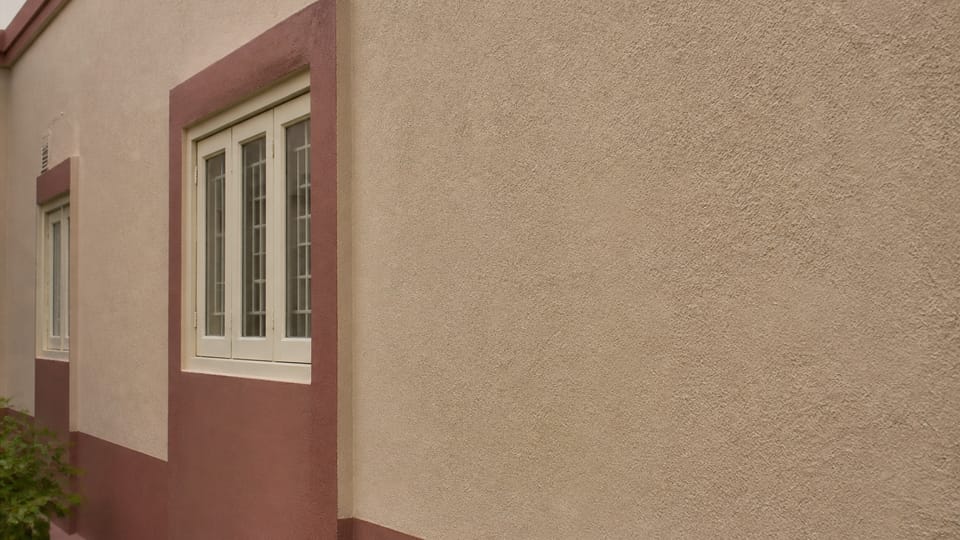
On this page (9)
Plaster on the outside of a house can be left smooth, or it can be textured. The texture is made by how the final coat is thrown, scraped or dashed, and each finish suits a different wall and exposure. This guide explains the rough-cast, pebble-dash and scraped finishes that the Indian code IS 2402 describes, how each is made, where each suits, and the curing the standard asks for. It gives no mix, no thickness and no cost. Those depend on the plaster and the plasterer’s job.
What finishes does IS 2402 describe?
The standard covers “the application of external rendered finishes for all normal types of backgrounds” (clause 1.1). Its foreword says that “different textures and finishes can be adopted, such as scraped, roughcast, pebble-dash, etc.” (foreword 0.2).
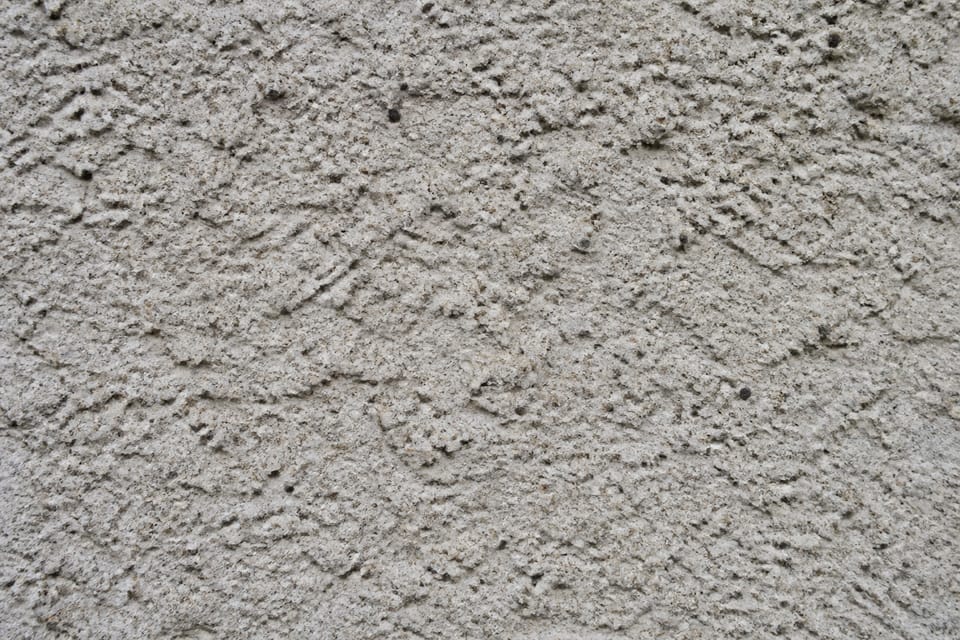
The standard defines the pebble-dash, or dry-dash, finish as “A rough finish in which small pebbles or crushed stones of suitable size (generally from 10 to 20 mm) are thrown on to a freshly applied final coat of mortar, and left exposed” (clause 2.3). It defines roughcast as a final coat that “containing a proportion of fairly coarse aggregate” thrown on “as a wet mix” and left rough. Scraped and textured finishes are also defined (clause 2.3).
The term sand-faced does not appear in IS 2402. If your plasterer calls the finish sand-faced, ask what the surface is made of and how it is finished, and check it against the standard’s description of the finish.
How is each finish made?
For roughcast, the code says the final coat “shall be quite wet and plastic, is thrown on by means of a trowel or scoop” (clause 8.6). For roughcast, clause 4.3.1 says crushed stone or fine gravel up to 12 mm maximum “may be used in the finishing coat”, and clause 2.3 gives the coarse aggregate as generally 6 to 12 mm.
For dry-dash, the undercoat is first laid, then the aggregate is thrown on while the coat is still plastic. The code says that “The aggregate used for dashing shall be well washed and drained and thrown wet on to this coat while it is still plastic” (clause 8.7.1). It may be “lightly tapped into the mortar with a wood float or the flat of a trowel” (clause 8.7.2).
For a scraped finish, the final coat is levelled, allowed to stiffen for a few hours, and then scraped to remove the surface skin (clauses 2.3 and 8.5). For a plain finish the code warns that “A steel trowel shall not be used and overworking shall be avoided” (clause 8.4).
The sand for the mortar must meet IS 1542:1992, and for white or coloured renderings the code says “only quartz or silica sand shall be used” (clause 4.2).
Where does each finish suit?
The standard’s table on exposure says that pebble-dash and roughcast are “Particularly suitable for severe conditions” and “for situations subjected to heavy rainfall and strong winds”, and, for pebble-dash and roughcast, that they are “Not suitable on weak types of brick or lightweight concrete” (Table I). Coarser scraped and textured finishes are “less suitable in the dirtier urban atmosphere” (Table I). The code also says that under severe conditions of exposure, “these are more satisfactory” than the plain and the scraped or textured finishes in clauses 6.2.1 and 6.2.2, and it names hand-thrown, roughcast and dry-dash finishes (clause 6.2.3).
A rough surface also helps the water run off. The code says that “A rough surface, on the other hand, will break up the flow and so avoid the concentration of water at any one point” (clause 6.4.2).
The standard says that external rendering “may be painted satisfactorily with various types of paints, such as cement paints, emulsion paints” (clause 11.4.2). For lime-sand renderings exposed to rain, it asks for “a coating of paint or other protective material” (clause 6.5.3.2).
How is the finish cured?
The code asks that “Each coat shall be kept damp continuously for at least two days” and that “the surface shall be kept wet for at least seven days” (clauses 9.1 and 9.2). The water is applied “by using a fine fog-spray” (clause 9.1). These are the standard’s own periods for rendering, and the plasterer should follow them. Clause 8.1.1 also asks that a newly cement-rendered surface be kept continuously moist for at least four days.
For a dry-dash or textured finish, the code also says that “it is essential for the final coat to remain plastic for a longer time than normal” (clause 8.1.4). So the timing of the dashing matters.
What should I check?
This section is practice, not a code rule.
- The finish is named on the drawing or the plasterer’s quote, and what it is made of is written down.
- The background is wet before rendering, as the standard asks (clause 8.1.1), so it does not take the water from the mortar.
- The aggregate for the dash is washed and wet when it is thrown on.
- The wall is kept damp for the curing period the standard gives.
- The paint, if any, is one the plaster and the finish can take.
What mistakes should I avoid?
This section is practice.
- Choosing a textured finish for a weak brick wall where the standard says it is not suitable.
- Letting the coat dry before dashing, so that the aggregate does not stick.
- Overworking the final coat with a steel trowel.
- Stopping the curing after the first days.
- Using a coloured sand that is not silica or quartz for a white or coloured finish.
Frequently asked questions
Which finish is the most durable?
The standard says roughcast and pebble-dash are particularly suitable for severe conditions. It does not rank them against other finishes, and it gives no life span.
Can I paint a rough-cast wall?
The standard says external rendering may be painted with various paints, including cement and emulsion paints (clause 11.4.2). Ask the painter which paint suits the finish.
Does the standard give a cost?
No. The cost depends on the plaster, the labour and the site, and the plasterer’s quote decides it.
Related guides
This guide is general information. Read the disclaimer. Your plasterer and engineer decide the finish for your house.
Sources
General information only. It is not a structural design or professional advice. Ask a licensed structural engineer or architect to check your plans and site.