
Short answer
What water is fit for concrete and curing in India? IS 456 says water for mixing and curing must be clean and free from harmful amounts of oils, acids, salts, sugar and organic matter. Drinking-quality water is generally satisfactory. If the source is unknown, get a lab test. Sea water is not recommended, and it may be used only in plain concrete with no steel, and only in unavoidable cases. Curing water must meet the same standard as mixing water.
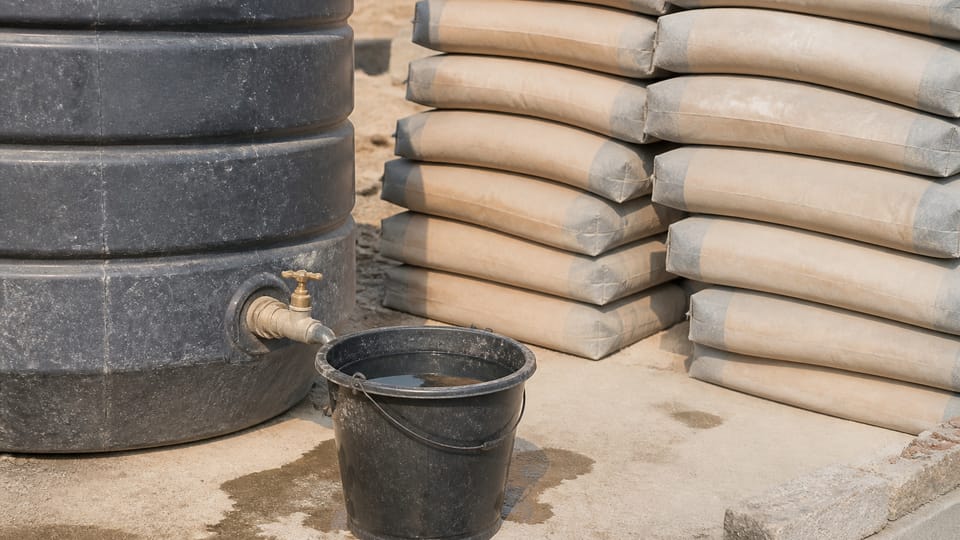
On this page (10)
Concrete is mostly water and cement, so the water matters as much as the cement. Bad water can weaken the concrete, stop it setting properly, stain the surface and rust the steel inside. This guide sets out what IS 456 asks for, what the code does not say, and what to ask your contractor. It gives no prices and no mix proportions. Your engineer decides whether a water source is fit for your slab.
What does the code say about water?
IS 456:2000 clause 5.4 is the Indian code’s main rule on water. It says water used for mixing and curing shall be clean and free from injurious amounts of oils, acids, alkalis, salts, sugar, organic materials or other substances that may be deleterious to the concrete or the steel. The 2013 amendment adds that the water may be natural or treated.
The code also says potable water (drinking-quality water) is generally considered satisfactory for mixing concrete. “Generally” is the key word. Potable water is a good starting point, not a guarantee. If you do not know where the water comes from, ask for a test.
Does the same water work for curing?
Yes, the code treats the two the same. Clause 5.4.4 says water found satisfactory for mixing is also suitable for curing concrete. It adds two points for curing:
- Curing water should not leave a stain or an ugly deposit on the surface.
- Tannic acid and iron compounds in the water are objectionable.
So the water you use to keep the slab wet for the curing period must be as clean as the water you mix with. The curing guide covers how long and how.
What limits does IS 456 give?
Clause 5.4 says the limits in Table 1 are a guide to the maximum permissible values. They are not a list of pass or fail tests for every site, but they are the figures to check a lab report against.
| What is tested | IS 456 limit (mg per litre, maximum) | Notes |
|---|---|---|
| Organic solids | 200 | |
| Inorganic solids | 3,000 | |
| Sulphates, as SO3 | 400 | |
| Chlorides, concrete without embedded steel | 2,000 | Plain concrete |
| Chlorides, reinforced concrete | 500 | Lower limit for reinforced work (chloride can corrode the steel; practice note) |
| Suspended matter | 2,000 |
The table gives guide values for the water. The pH limit is a minimum of 6 (clause 5.4.2). IS 456 gives no upper pH limit.
The code also has two simple neutralisation tests in clause 5.4(a) and (b). A 100 ml sample should need no more than 5 ml of 0.02 normal sodium hydroxide, using phenolphthalein, and no more than 25 ml of 0.02 normal sulphuric acid, using a mixed indicator. These are lab tests, not site tests.
Note that the chloride limit is lower for reinforced concrete. This is because chloride attacks the steel bars. The code also limits the total chloride in the finished concrete, which includes the water, the sand and the aggregate. It sets 0.4, 0.6 and 3.0 kg per cubic metre of concrete for three cases (clause 8.2.5.2, Table 7). Those are limits for the concrete, not for the water.
When is a test needed?
If there is doubt about strength development, clause 5.4.1 says the water’s suitability must be ascertained by two tests:
- Strength test (clause 5.4.1.2). Three 150 mm cubes are made with the water to be used and three with distilled water. The 28-day average strength of the first set must be at least 90 percent of the second set, with the cubes made, cured and tested to IS 516.
- Setting time test (clause 5.4.1.3). The initial setting time of a test block made with the water must be at least 30 minutes, and must not differ by more than 30 minutes from a block made with distilled water (IS 4031 Part 5).
These are lab tests. Smell and clarity are weak checks. A clear water can still carry salts or sugar, and a lab test is the only way to know.
Can sea water be used?
No, not as a rule. The current wording of IS 456 clause 5.4.3, after Amendment 4 (2013), says sea water shall not be used for mixing or curing concrete, because of harmful salts. The 2000 text said it was not recommended.
The code allows one exception. Under unavoidable circumstances, sea water may be used for mixing or curing plain concrete with no steel in it, after careful thought about the risks and precautions, including a suitable cement system. This exception does not cover reinforced concrete. Your engineer must decide if it applies at all. For a house slab, the usual answer is to find another water source.
What should I ask the contractor?
These are practice points, based on the code’s rules:
- Where does the water come from: municipal supply, borewell, tanker or river?
- Is there a lab report against the IS 456 limits, and how old is it?
- Is the same water used for curing as for mixing?
- If the source is doubtful, will the test be done before work starts?
- Is any sea, brackish or drain water in use?
- How often is the water tested during the work?
What mistakes should I avoid?
- Assuming that water that looks clear is safe. Salts, sugar and some chemicals do not show.
- Using a tanker or a borewell without a test, when the source is unknown.
- Using sea water for reinforced work (practice and clause 5.4.3).
- Using different water for curing that does not meet the same standard (clause 5.4.4).
- Treating the test as a one-off, when the source can change through the year (practice).
Frequently asked questions
Is drinking water always fine for concrete?
It is generally satisfactory under IS 456. If you are not sure of the source, get a lab test against the code’s limits.
Can I use river water?
Not without a test. River water can carry silt, salts and organic matter. The river sand guide explains the sand side of the same problem.
Does wet curing water need a test?
The same quality applies to curing water as to mixing water (clause 5.4.4). If the source is doubtful, test it.
Does salty water cause white marks on walls?
Salts can cause efflorescence, the white powder on new walls. The damp walls guide covers that on the wall side.
Related guides
- How many days to cure concrete slab
- Concrete grades M15 to M25 explained
- Cold weather concreting for a slab in winter
This guide is general information. Read the disclaimer. Your engineer decides whether a water source is fit for your concrete and curing.
Sources
- IS 456:2000, Plain and Reinforced Concrete: Code of Practice (fourth revision; BIS listing shows it in force, valid to 2030). Clauses 5.4, 5.4.1 to 5.4.4 and Table 1, and clauses 8.2.5.2 and 8.2.5.3 read. Amendment No. 4 (2013) read for the cl 5.4 and 5.4.3 changes. Amendments 1 to 3 not checked.
- IS 456 Amendment No. 4 (May 2013), the change to clause 5.4 (natural or treated water) and clause 5.4.3 (sea water). Read as text on a manufacturer-hosted copy; the BIS copy is the authoritative one.
- IS 3025 test methods for water, current revisions named only (Parts 17, 18, 22, 23, 24 and 32). Test methods not read for this page.
General information only. It is not a structural design or professional advice. Ask a licensed structural engineer or architect to check your plans and site.