
Short answer
Why does steel rust inside concrete? Concrete is strongly alkaline, and that keeps embedded steel protected. Carbon dioxide from the air can lower the alkalinity over time, and chlorides can break the protection even in alkaline concrete. With water and oxygen, the steel then rusts. Rust takes up more space than steel, so the concrete cracks along the bar and later falls off. Stop the water and call a structural engineer.
On this page (11)
- How does concrete protect steel?
- Why does the steel start to rust?
- Why does rust break the concrete?
- What are the signs of corrosion in a house?
- How do the codes guard against corrosion?
- What should I do if I see these signs?
- Why does plaster over a rust patch not work?
- What mistakes should I avoid?
- Frequently asked questions
- Related guides
- Sources
A brown stain on the ceiling, a crack along a chajja edge, or a piece of concrete on the floor with a rusty bar above it: these worry owners, and they should be looked at. This page explains why steel can rust once it is inside concrete, what the Indian codes do to prevent it, and what you should do if you see the signs. It is about steel already cast in concrete. For surface rust on bars lying on site, see rust on TMT bars. The page gives no cover values, no concrete grades, no repair steps and no prices. Those belong to your drawing and your engineer.
How does concrete protect steel?
Concrete protects steel in two ways: its chemistry and its thickness. IS 9077, the Indian code on corrosion protection of reinforcement, says concrete is highly alkaline and that this keeps the steel “in a passive condition”. Passive means a thin protective layer stops the steel from rusting. The CPWD Handbook on repairs adds the second layer of protection, the concrete cover over the bar, which keeps the outside world away.
IS 456, the main concrete code, puts it in one sentence: “The protection of the steel in concrete against corrosion depends upon an adequate thickness of good quality concrete.” Both parts matter. SP 25 says carbonation leads to corrosion when concrete is permeable or when cover is inadequate.
Why does the steel start to rust?
The protection can be lost in two main ways. Then water and oxygen do the rest.
| What happens | How it works | Where it comes from |
|---|---|---|
| Carbonation | Carbon dioxide from the air moves in through porous cover and lowers the alkalinity. IS 516 says the pore water falls from a pH of about 12.5 to 13.5 to around 8 to 9 | The air, over time. Worse where concrete is porous or cover is too small |
| Chlorides | Chloride can break the protective layer even while the concrete stays alkaline (CPWD Handbook) | Ingredients, or from outside, such as salty air and sea water |
| Water and oxygen | Moisture is “a precondition for corrosion” (SP 25). CPWD says repeated wetting and drying, as from rain or a toilet leak, is the most favourable condition | Leaks, rain, damp walls |
IS 456 itself does not explain the chemistry. It has no text on the pH of concrete or the protective layer, and it uses the word carbonation only in Amendment 6 of 2024. It does name the things that travel through permeable concrete: “water, oxygen, carbon dioxide, chloride, sulphate”. The explanation above comes from IS 516, IS 9077, SP 25 (the BIS handbook on cracks) and the CPWD Handbook. IS 9077 and SP 25 are old, so we use them for the mechanism and general guidance, and not for their numbers.
Why does rust break the concrete?
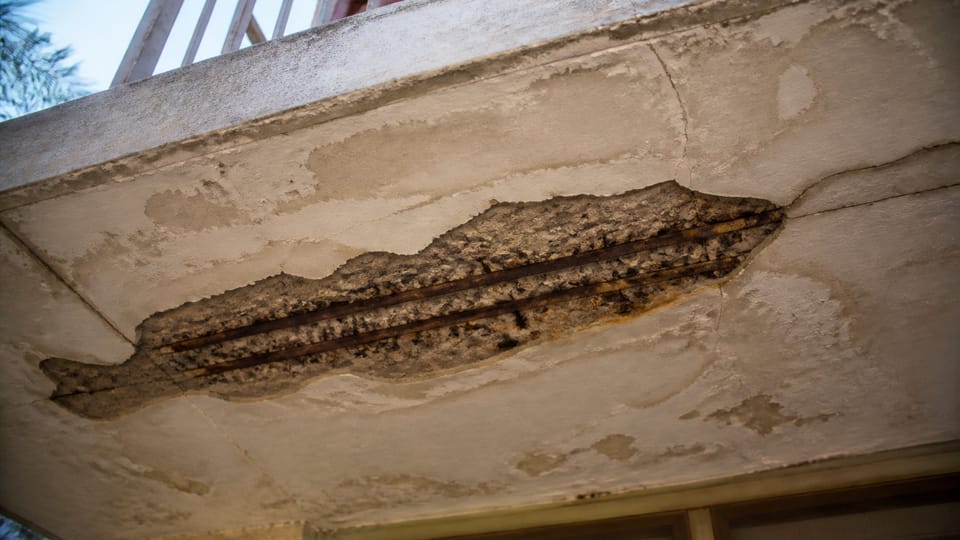
Rust needs more room than the steel it came from. IS 9077 says rust “occupies a much larger volume than the steel from which it is formed”, and that this pressure causes cracks and spalling. Spalling means pieces of concrete break away. The cracks then let in more moisture and air, so corrosion speeds up. SP 25 describes the pattern: it “first causes cracks in line with the direction of reinforcement and later causes spalling of concrete”.
The bar also gets thinner as it rusts. At an advanced stage, CPWD says, rust behind a bar can push it outward until it buckles and fails in compression. That is why this is a safety matter and not a paint matter.
What are the signs of corrosion in a house?
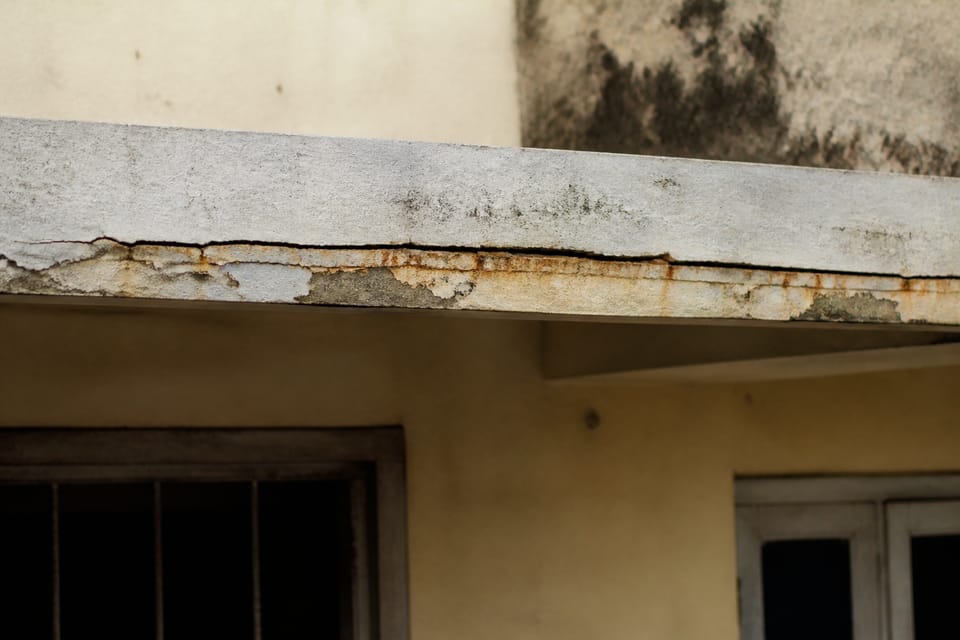
The usual signs are rust stains, cracks that follow a bar line, and concrete that has fallen off. Rust stains can appear with or without cracks.
| What you see | What it may mean | What to do |
|---|---|---|
| Brown or rust-coloured stain on a slab, beam or chajja | Possible rusting steel, or a wet patch carrying rust from elsewhere | Find the water. Ask an engineer to look |
| Straight crack along the line of a bar | CPWD says corrosion cracks run along the reinforcement | Engineer’s inspection |
| Concrete fallen off, bar visible | Spalling | Keep people clear. Call a structural engineer |
| Crack at right angles to the main bars | CPWD says these are generally linked to structural deficiency | Structural engineer |
These signs do not prove the cause. A stain is a reason to look, not a diagnosis. Our guide to types of cracks explains why an engineer must judge cracks.
The CPWD Handbook gives an indicative order for where damage shows first: wet outside areas, then thin parts such as chajjas, terrace slabs, inner wet areas, and later beams and columns. IS 456 also says thin sections are more vulnerable, and SP 25 names sunshades as prone to early cracking. The CPWD Maintenance Manual, written for government buildings, says thin members, exposed members and members affected by leakage should be inspected. So do not ignore a cracked chajja because it looks minor.
Some damage is hidden. The CPWD Handbook warns that false ceilings, fresh paint and patch plaster can hide it, and that dampness on a terrace may go unnoticed until cover spalls. If plaster is falling, check whether it is only plaster: see plastering a ceiling.
How do the codes guard against corrosion?
IS 456 guards against it by asking for dense, well-made concrete, enough cover, and low chloride. Here is what it asks in words. The numbers belong to the design.
| Guard | What IS 456 says | Clause |
|---|---|---|
| Low permeability | Adequate cement content, low free water-cement ratio, complete compaction and adequate curing | 8.1.1 |
| Cover | “indicated in the drawings” | 26.4.1 |
| Compaction | Full compaction matters near reinforcement | 8.2.7 |
| Chlorides | “All constituents may contain chlorides”, and the concrete has a limit when placed | 8.2.5.2 |
| Sea water | “shall not be used for mixing or curing” of reinforced concrete | 5.4.3, Amendment 4 |
| Admixtures | Must not increase the risk of corrosion | 5.5.2 |
| Water on the surface | Exposed structures should drain well and avoid “standing pools”; minimise cracks that collect or carry water | 8.2.1 |
| At the sea-coast | Protect bars from saline air during storage, fabrication and use | 8.2.8.4 |
| Maintenance | It plays “an important role in sustained durability” | 8.1.1, Amendment 5 |
Older BIS text adds more. IS 9077 says that sea sand should not normally be used in RCC work, and that calcium chloride should be avoided as far as possible. It also says “Evenness of the cover” matters. IS 456 clause 12.2 asks that bars be kept in the position shown in the drawings by cover blocks, spacers and supporting bars. A bar that sags on site loses the cover shown on the drawing (our example, not code text).
Extra water at the site works against all of this, and our guide to the water-cement ratio explains why. Honeycombed concrete is porous, so air and water can reach the steel more easily. The CPWD Handbook says it could lead to severe rusting later: see honeycombing.
Coated bars are not the first answer. IS 456 says coating may be needed “in exceptional cases and for rehabilitation of structures”, and Amendment 3 says any reduction in bond strength must be looked into. That is a design decision.
What should I do if I see these signs?
These steps are our advice, not a code rule.
- Keep people away from the area under loose concrete.
- Do not hammer or chip it yourself, and do not cut or clean any bar.
- Photograph the damage and note when you first saw it.
- Find and stop the water, if it is a simple plumbing or drainage fix. See terrace leakage and bathroom leaks into the ceiling.
- Call a structural engineer. Do this quickly if a slab, beam or column has exposed steel, cracks along a bar, or any sagging.
CPWD expects the engineer to advise on any immediate safety measures needed, at the first visit. The engineer may then order tests such as a carbonation depth test, chloride test, cover survey or half-cell survey. IS 516 says a half-cell test “usually indicates the level of possibility” of corrosion. Even with resistivity readings it cannot confirm corrosion or its extent, though the standard calls the pair the most effective non-destructive approach now available. These are specialist tests, so results need an engineer to read them. Our IS 516 guide lists the test parts.
Ask the engineer these questions:
- What is the cause, and where is the water coming from?
- How much steel has been lost, and does the member need a design check?
- Does this area need propping before any work?
- What is the written scope of repair, and how will you check it?
Why does plaster over a rust patch not work?
Plaster hides the damage, and the rust goes on. The CPWD Handbook warns that repairs which miss the main cause may fail again in a short time, and that defects hidden under finishes give a false sense of safety. It says chloride-driven corrosion is harder still to stop. The fault is plastering over active damage, not plaster itself.
What mistakes should I avoid?
These are practice points, except where a code is named.
- Painting or plastering over a stain without finding the cause.
- Leaving a roof, bathroom or tank leak running.
- Patching only the visible spot while loose concrete stays around it.
- Treating a rust converter or coating as the repair. The CPWD Handbook lists such products among repair materials, and IS 9077 says coatings may protect existing RCC in aggressive surroundings, but in the Handbook a coat is only one step of a full repair.
- Using salty sand or water in concrete. IS 456 bars sea water in reinforced work.
- Adding water to concrete at site. IS 456 cl 8.2.7 says not to add water to aid finishing.
- Trusting a “corrosion resistant” label instead of good concrete and cover.
Frequently asked questions
Is a rust stain on my ceiling dangerous?
It may or may not be. It is a sign to investigate, not a diagnosis. Find the water and ask an engineer to look at it, because the bar inside cannot be seen.
Does it happen faster near the sea?
The risk is higher. SP 25 says the high humidity of coastal areas causes rapid corrosion. IS 456 says warm moist conditions and chloride raise the risk, and that concrete can take in chlorides from outside. It also asks for bars to be protected from saline air at sea-coast sites.
Does PPC cement cause corrosion?
No text we read says PPC causes corrosion, but the picture is mixed. The CPWD Handbook says such cements have lower alkalinity and lower permeability, and warns that in bending members they may reduce durability against corrosion. IS 456 calls pozzolana cement advantageous in sea-water work. Amendment 6 says concrete with mineral admixtures “higher than that recommended” may increase carbonation. The choice of cement is for your engineer.
Is rust on bars before casting the same problem?
Not quite. IS 456 asks for bars free of loose rust, which is about bond. Our rust on TMT bars page covers that. IS 9077 adds that bars contaminated with salt or badly corroded make corrosion worse after casting.
Can old cracks lead to corrosion?
Yes, in time. SP 25 says even non-structural cracks may let in moisture, cause corrosion and make a structure unsafe. IS 456 asks to minimise cracks that collect or carry water.
Related guides
- Rust on TMT bars: what the codes say and how to store steel
- IS 456:2000 explained: what the concrete code covers
- Water for construction: what water is fit for concrete and curing
- Chhat dhalai: what happens on slab casting day, from batch to curing
This guide is general information. Read the disclaimer. A structural engineer who has inspected your building decides what is safe and how it is repaired.
Sources
- IS 456:2000, Plain and reinforced concrete, Code of practice: clauses 5.2.3.1, 5.4.3, 5.5.2, 5.6.1, 5.6.2, 8.1.1, 8.2.1, 8.2.3.1, 8.2.5.2, 8.2.7, 8.2.8, 12.2 and 26.4.1. Six amendments listed by BIS. Amendment 3 changes 5.6.2, Amendment 4 changes 5.4.3, Amendment 5 changes 8.1.1, and Amendment 6 of June 2024 adds 5.2.3.1 (read on the BIS site).
- IS 9077:1979, Code of practice for corrosion protection of steel reinforcement in RB and RCC construction: clauses 3.1, 4.1.1, 4.2, 5.1.1 and 5.3.1. Old text, still listed by BIS. BIS set up a working group in 2024 to revise it.
- SP 25:1984, Handbook on causes and prevention of cracks in buildings (BIS): clauses 1.2, 6.3.1, 6.4.1, 6.4.3 and 6.4.4.
- IS 516 (Part 5/Sec 3):2021, Non-destructive testing, Carbonation Depth Test: clause 2.1.
- IS 516 (Part 5/Sec 2):2021, Half-cell potentials of uncoated reinforcing steel in concrete: clause 1.
- CPWD, Handbook on Repairs and Rehabilitation of RCC Buildings, 2002: pages I-2, I-3, II-9, II-10, II-12, II-16, III-3, III-7 to III-9, III-13, V-7, V-8, V-23 and V-28 (read on a third-party copy; government guidance, not a BIS standard).
- CPWD Maintenance Manual 2019, chapter 7.2, periodical checks (copy on the NDMC website; written for government buildings).
General information only. It is not a structural design or professional advice. Ask a licensed structural engineer or architect to check your plans and site.