
Short answer
What are sand grading Zones I to IV? IS 383:2016 Table 9 gives four sets of sieve limits, Grading Zones I, II, III and IV, going from coarser to finer. A sand is placed in a zone by a sieve analysis to IS 2386 Part 1. The standard says a sand in any zone is suitable for concrete, and that Zone IV should not be used in reinforced concrete unless tests show the mix is suitable.
On this page (10)
A sand test report has a column of percentages and one word at the bottom, “Zone II” or “Zone III”. Owners are told it is the zone that matters and not told what it means. This page explains what the zone is in IS 383:2016, prints the sieve table it comes from, says what the standard says about the zones, and says what a sand test report can and cannot tell you. Zones belong to sand for concrete: plaster sand and masonry mortar sand have their own tables with no zones. It gives no mix design and no price. For silt in sand, see silt in sand: the lab test and a rough jar check.
What is a grading zone?
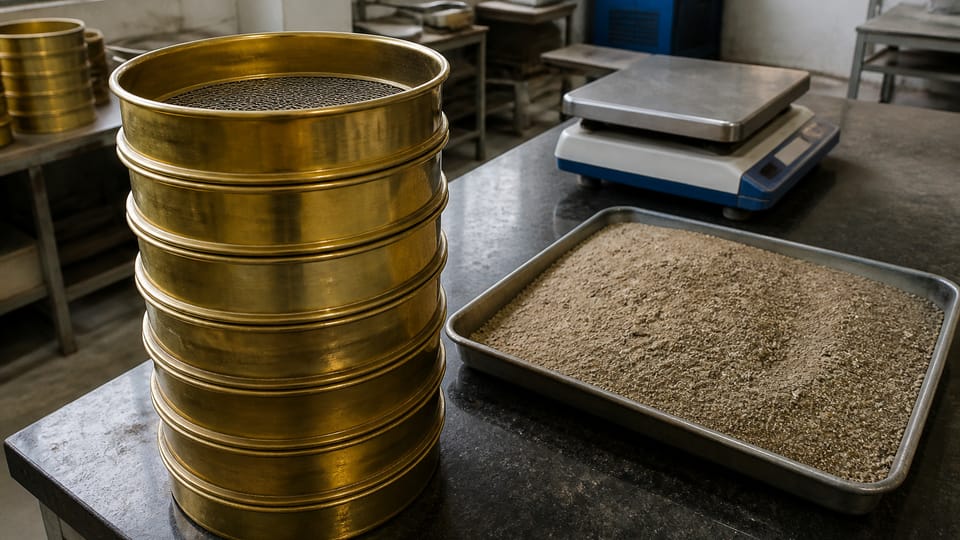
A grading zone is a band of sieve results. A dry sample of sand is passed through a stack of test sieves, from coarse to fine, and the percentage of the sample that passes each sieve is worked out. IS 383:2016 clause 6.3 says the grading of fine aggregate, determined as IS 2386 (Part 1) describes, “shall be within the limits given in Table 9 and shall be described as fine aggregate, Grading Zones I, II, III and IV”. IS 2386 (Part 1) reports the result as the cumulative percentage by weight of the total sample passing each sieve, and that column is what is compared with the table.
What does the table say?
IS 383:2016 Table 9, “Fine Aggregates”, gives percentage passing each IS sieve:
| IS sieve | Zone I | Zone II | Zone III | Zone IV |
|---|---|---|---|---|
| 10 mm | 100 | 100 | 100 | 100 |
| 4.75 mm | 90-100 | 90-100 | 90-100 | 95-100 |
| 2.36 mm | 60-95 | 75-100 | 85-100 | 95-100 |
| 1.18 mm | 30-70 | 55-90 | 75-100 | 90-100 |
| 600 micron | 15-34 | 35-59 | 60-79 | 80-100 |
| 300 micron | 5-20 | 8-30 | 12-40 | 15-50 |
| 150 micron | 0-10 | 0-10 | 0-10 | 0-15 |
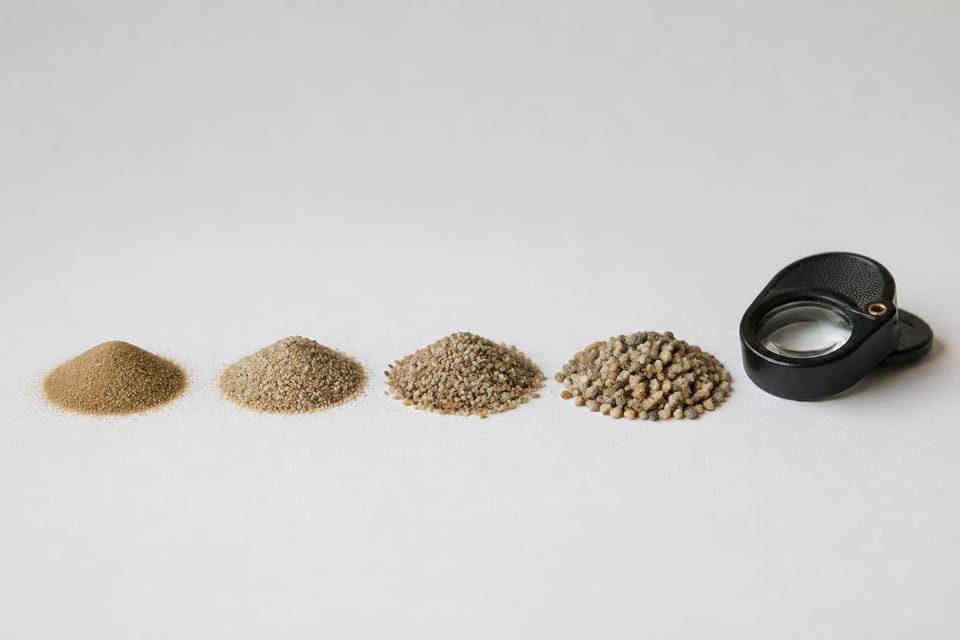
Read down a column: a sand in Zone I has less passing the fine sieves than a sand in Zone IV, so it is coarser. The standard’s Note 3 says “as the fine aggregate grading becomes progressively finer, that is, from Grading Zones I to IV”, the fine to coarse aggregate ratio should be progressively reduced, though the most suitable ratio depends on the actual grading, particle shape and surface texture of both. IS 383:2016 does not give a fineness modulus for any zone.
How is a sand placed in a zone?
Clause 6.3 gives a tolerance. Where the grading falls outside the limits of a zone on sieves other than 600 micron by not more than 5 percent for a sieve size, subject to a cumulative amount of 10 percent, it is regarded as within that zone. The tolerance is not applied to the 600 micron sieve, or to any sieve on the coarse limit of Zone I or the finer limit of Zone IV. Note 1 raises the permissible limit on the 150 micron sieve to 20 percent for crushed stone sands. Clause 10.1(m) asks that a consignment of fine aggregate be marked with its grading zone.
What does the standard say about suitability?
- Note 2: “Fine aggregate complying with the requirements of any grading zone in this table is suitable for concrete but the quality of concrete produced will depend upon a number of factors including proportions.” No zone is named best.
- Note 4: “It is recommended that fine aggregate conforming to Grading Zone IV should not be used in reinforced concrete unless tests have been made to ascertain the suitability of proposed mix proportions.” So Zone IV is a conditional caution, not a ban.
- IS 383 has no table of which zone for which job. Sand for plaster (IS 1542) and for masonry mortar (IS 2116) each have one grading table, with no zones.
What does a sand test report show?
IS 2386 Part 1 clause 2.6 says the sieve analysis is reported as the cumulative percentage passing each sieve. IS 383 does not define silt: the table of deleterious materials in clause 5.2.1 has a row for materials finer than 75 micron, tested by IS 2386 (Part 1), and a separate row for clay lumps, tested by IS 2386 (Part 2). So a report’s silt or fines line comes from a different test than the zone. For the limits and the difference between natural, crushed and manufactured sand, see M-sand vs river sand: which one for concrete, plaster, brickwork?.
What should I ask for on the report? (practice)
This is practice, apart from the clauses named.
- The sieve analysis with the cumulative percentage passing, and the zone.
- The silt or fines result, and the specific gravity and water absorption.
- The date, where the sample came from (the lot or the heap), and the signature of an accredited lab.
- Whether the sand is natural, crushed, mixed or manufactured.
- Which zone the engineer wants for each use, and how often the supplier tests.
What mistakes should I avoid? (practice)
- Judging sand by colour or feel. Only a sieve analysis gives the zone.
- Mixing two sources on site without testing the blend.
- Relying on one test for a supply that changes.
- Ignoring bulking when proportioning; see sand bulking: why damp sand gives you less sand.
- Treating Zone IV as banned, or as free to use: the standard asks for tests for reinforced concrete.
- Calling a zone good or bad without naming the use.
Frequently asked questions
Which sand zone is best for house construction?
IS 383 names none as best. Note 2 says a sand in any zone is suitable for concrete, and the quality depends on factors including proportions. The engineer decides for your mix.
Is Zone IV sand allowed?
IS 383 recommends it is not used in reinforced concrete unless tests show the proposed mix is suitable.
Does M-sand have a zone?
Yes, if it is fine aggregate for concrete. Clause 6.3 and Table 9 speak of fine aggregate and do not exempt any source, and Table 1 Note 4 says that where manufactured aggregate is used as part replacement for natural aggregate, the final grading must meet Table 9. Table 9 Note 1 (the 150 micron limit raised to 20 percent) applies only to crushed stone sands. Crusher dust that has not been processed cannot be called crushed sand under clause 3.1.2.
What is fineness modulus?
IS 383:2016 does not state one for any zone. Do not rely on a figure quoted for a zone unless it comes from the standard or the engineer.
Do plaster and brickwork sand have zones?
No. IS 1542 and IS 2116 each have a single grading table, and no zones.
Related guides
- Silt in sand: the lab test and a rough jar check
- M-sand vs river sand: which one for concrete, plaster, brickwork?
- Sand bulking: why damp sand gives you less sand
- IS 2116 and IS 1542: sand grading for masonry mortar and plaster
This guide is general information. Read the disclaimer. Your engineer decides the sand for your house.
Sources
- IS 383:2016, Coarse and Fine Aggregate for Concrete, Specification (third revision): clauses 3.1.2, 5.2.1, 6.3 and 10.1(m), Table 1 Note 4, Table 2 and Table 9 and its notes (page images read for clause 6.3 and Table 9). BIS lists it as in force, valid to 2030-07-12, with Amendment 1 of August 2017, which does not change grading. The NBCS 2026 lists a 2025 fourth revision as under revision; BIS shows only the 2016 edition.
- IS 2386 (Part 1):1963, Methods of Test for Aggregates for Concrete, Particle Size and Shape: clause 2.6 (text read). BIS lists it as in force, valid to 2031-03-27.
- IS 1542:1992, Sand for Plaster, Specification, and IS 2116:1980, Sand for Masonry Mortars, Specification: scopes and grading tables (text read, digits not read). BIS lists them as in force.
Change log
- : Added Related guides link to newly published article(s): sand-for-masonry-mortar-and-plaster-is-2116-and-is-1542-grading-tables. No other text changed. Approved by the reviewing engineer.
General information only. It is not a structural design or professional advice. Ask a licensed structural engineer or architect to check your plans and site.