
Short answer
How do I check silt in sand, and can a jar test on site tell me the standard figure? The Indian standards measure silt, clay and fine dust in a laboratory. The wash test in IS 2386 Part 1 is the one to ask for. A jar of sand and water on site gives only a rough idea. It cannot give a percentage you can compare with the code. The limits are in the sand guide, and only a lab test shows whether a sand meets them.
On this page (9)
Silt, clay and fine dust in sand cling to the grains. They weaken the bond between the sand and the cement, and they make the mix need more water. Most sand that causes trouble has too much fine mud in it, and the trouble often shows up later as cracks. So the question is real. But the answer you get depends on the test, and the Indian standards use a laboratory test. This guide explains what the standards measure, what the lab wash test does, and what a jar check on site can and cannot tell you. It gives no limits. The limits are in the M-sand and river sand guide, and the figures there are the ones to use.
What do the Indian standards measure?
Three things matter here:
- IS 2386 (Part 1) clause 3 finds the material finer than 75 micron by washing a dried sample. IS 383 refers to it for material finer than 75 micron. For clay, fine silt and fine dust, IS 1542 and IS 2116 refer to Part 2.
- IS 2386 (Part 2) covers the determination of clay, fine silt and fine dust by a sedimentation method, for particles down to about 20 micron (clause 1.1 and 3.1). Its apparatus is a glass jar rotated at a set speed, a pipette, a 1000 ml measuring cylinder and an oven (clause 3.2). It is laboratory equipment.
- IS 383 is the aggregate standard for concrete. It is current (2016 edition). Its limits, and the limits in the plaster and masonry sand standards, are set out in the M-sand guide.
Neither Part 1 nor Part 2 describes a field jar test for silt or clay, and neither sets a silt limit; both are test methods. So a jar result on site cannot be read against a standard limit.
| Test | Where it comes from | What it gives | Use on site? |
|---|---|---|---|
| Wash through 75 micron sieve | IS 2386 (Part 1), clause 3 | Fine material washed out, by weight | No: laboratory |
| Sedimentation | IS 2386 (Part 2), clauses 1.1 and 3 | Clay, fine silt and fine dust down to about 20 micron | No: laboratory |
| Jar settle (rough check) | Provincial septic-mound field guide; not an Indian standard | A layer of fine mud on top; no percentage | Yes, as a rough practice check |
How does the lab wash test work?
The wash test in IS 2386 Part 1 clause 3 is the standard way to find the fines. Put simply:
- Dry the sample at about 110 C until its weight stops changing.
- Cover it with water and agitate it vigorously.
- Pour off the water and repeat until the wash water runs clear. The standard says to avoid, as much as possible, decanting the coarse particles.
- Pass the wash water over a 75 micron sieve, dry the material caught, and weigh it.
The standard’s note says that clay which is dispersed by the wash water, and any water-soluble material, is removed in the test. So the result is a measure of the fine material the water can wash out, which is what the code wants to know.
What does a jar check on site show?
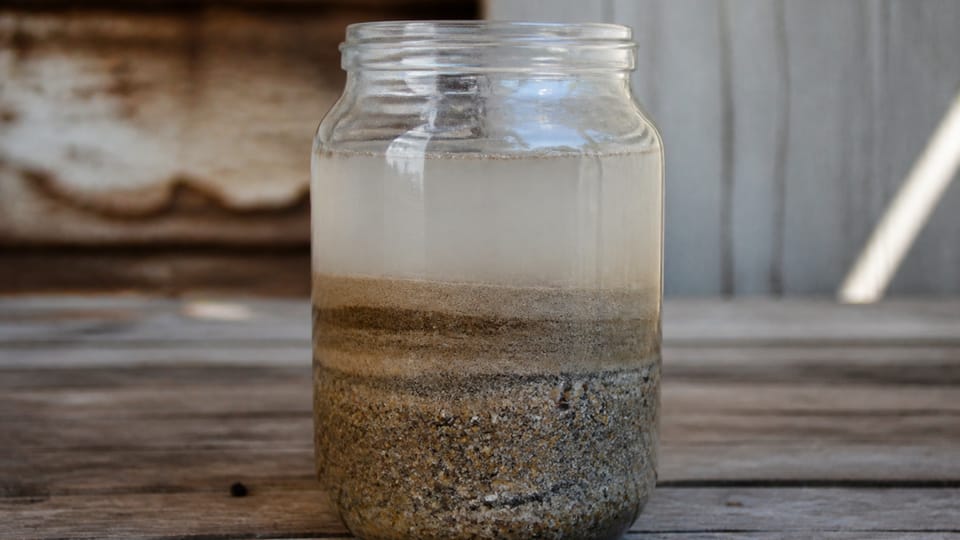
A jar check is a rough practice check, not a standard method. A provincial field guide for septic-mound sand describes it: put about two inches of sand in a quart jar, fill it with water, shake it, and let it settle for several hours. The guide says an eight-hour settle gives the best result, and that the jar test is not a replacement for sieve analysis. That guide is for septic systems, so use it only as a field idea.
Practice, from that method:
- After it settles, the sand forms layers, and a fine cloudy layer on top shows the fine mud in the sample.
- The layer tells you roughly how much fine material there is. It gives no reliable percentage, and it cannot be compared with a limit in the code.
- Read every sample the same way, after the same time, in the same jar, and compare samples side by side.
- A jar is most useful to spot a bad batch early. It does not prove a sand is good.
Do not confuse this with the measuring-jar test for bulking. That test, in the sand bulking guide, measures how much damp sand swells. It is a different test and a different answer.
What about crushed sand?
IS 383 allows more fines in crushed stone sand than in natural sand. The notes to IS 2116 clause 3.3 and IS 1542 clause 4.3 allow crushed stone sand with more fine dust to be accepted by agreement between supplier and purchaser. Practice: the fines in crushed sand can differ in nature, so a jar on crushed sand tells you less than a jar on river sand. Ask for the lab result, and read the M-sand guide before you accept a sample.
What should I ask the supplier?
These are practice points:
- A lab wash result for the material finer than 75 micron, with the test method named.
- The source of the sand, and whether it is river sand or crushed stone sand.
- Whether the sand has been washed, and how.
- The date of the test, and how old the sample is.
What mistakes should I avoid?
- Reading a jar layer as the standard figure, or comparing it with a limit.
- Accepting a sand because it looks clean in the jar.
- Washing the sand and assuming the job is done, without a new test.
- Using a bulking test to answer a silt question, or the other way round.
- Forgetting that the lab test is the one that counts for the engineer.
Frequently asked questions
Is the jar test accurate?
It is a rough guide. It can show a sand that is clearly too muddy. It cannot give you a percentage you can compare with the code.
Can I wash silty sand to fix it?
Washing removes some fines, but the result is what matters. Test the washed sand in the lab before you use it. Practice.
Who decides whether the sand is acceptable?
Your engineer, using the lab test. The sand guide sets out the limits. This page does not decide the sand for your slab.
Related guides
- M-sand and river sand: which to use
- Sand bulking: why the volume changes
- IS 2116 and IS 1542: sand grading for masonry mortar and plaster
This guide is general information. Read the disclaimer. Your engineer decides whether a sand is fit for your concrete, plaster or mortar.
Sources
- IS 2386 (Part 1):1963, Methods of Test for Aggregates for Concrete, Part I: Particle size and shape. Clause 3 (materials finer than 75 micron by washing) and its note read. BIS listing: not withdrawn (reaffirmed 2002 per cover).
- IS 2386 (Part 2):1963, Part II: Estimation of deleterious materials and organic impurities. Clauses 1.1, 3.1 and 3.2 read. BIS listing: not withdrawn (reaffirmed 2011 per cover).
- IS 383:2016, Coarse and fine aggregates for concrete (BIS listing: current). Its limits are in the linked sand guide; this page does not quote them.
- Provincial government field guide for septic-mound sand, OWMS Jar Test (revised 2010). Quoted for its jar procedure and its statement that the jar test does not replace sieve analysis. Not concrete guidance.
Change log
- : Added Related guides link to newly published article(s): sand-for-masonry-mortar-and-plaster-is-2116-and-is-1542-grading-tables. No other text changed. Approved by the reviewing engineer.
General information only. It is not a structural design or professional advice. Ask a licensed structural engineer or architect to check your plans and site.