
Short answer
What is the difference between IS 2116 and IS 1542 sand? IS 2116 covers sand for masonry mortar, and IS 1542 covers sand for plaster. Each has its own grading table, and plaster sand cannot be as coarse: at least 80 percent must pass the 600 micron sieve, against at least 40 percent for masonry. Both limit clay, fine silt and fine dust to 5 percent. IS 1542 also sets a minimum fineness modulus. Ask for a sieve report read against the right table.
On this page (11)
The sand on your site may carry a test report that says Zone II, Zone IV or “IS 1542”. Those labels do not all mean the same thing. This page puts the two Indian Standards for mortar and plaster sand side by side, shows how they differ from the concrete sand zones, and explains how to read a sieve report. It gives no mix ratios, supplier names or prices. For concrete sand, read sand grading zones I to IV.
What do IS 2116 and IS 1542 cover?
IS 2116:1980 covers sand for masonry mortars. IS 1542:1992 covers sand for plaster, for internal wall and ceiling plastering and for external plastering. Both accept natural sand, crushed stone sand, crushed gravel sand, or a mix of these. CPWD says the same split in one line: “Sand requiring use for mortar for plaster work shall conform to IS 1542 and for masonry work shall conform to IS 2116.”
What are the grading limits?
Grading means how much of the sand passes each sieve. These are the printed tables, in percent passing.
| IS sieve | IS 2116 (masonry mortar) | IS 1542 (plaster) |
|---|---|---|
| 10 mm | Not listed | 100 |
| 4.75 mm | 100 | 95 to 100 |
| 2.36 mm | 90 to 100 | 95 to 100 |
| 1.18 mm | 70 to 100 | 90 to 100 |
| 600 micron | 40 to 100 | 80 to 100 |
| 300 micron | 5 to 70 | 20 to 65 |
| 150 micron | 0 to 15 | 0 to 15, or 20 for crushed stone and crushed gravel sands |
The 600 micron line shows the main difference. Plaster sand has a much higher floor: at least 80 percent, where masonry sand may go down to 40. A fine sand can meet both tables.
Three IS 1542 rules have no match in IS 2116:
- A small allowance. Clause 5.1 says that where the grading falls outside the limits “of sieves other than 150, 300 and 600 micron IS Sieve by a total amount not exceeding 5 percent, it shall be regarded as falling within the grading.” So it applies only on the coarser sieves. The clause says “grading zones”, but in our reading it does not mean Zones I to IV. IS 1542 has one table.
- A fineness modulus. Clause 5.2 says it “shall be not less than 1.4 in case of crushed stone sands and crushed gravel sands and not less than 1.5 in case of naturally occurring sands.” The foreword says the table lets it “vary from 1.2 to 2.2”, but the standard sets a minimum only.
- The crushed sand note. The 20 percent on 150 micron is not in IS 2116.
IS 2116 has no such figures, but says “deviation in grading of sand given in 4.1 may be considered by the engineer-in-charge.” Both standards allow screening or blending to reach the grading.
How much silt is allowed?
Both standards say clay, fine silt and fine dust are limited to not more than 5 percent, unless further tests or performance satisfy the engineer. That figure comes from a laboratory method in IS 2386 (Part 2). It is not a jar test.
Both standards add a note. Crushed stone sand “with even higher proportions of fine dust” may be satisfactory, subject to agreement between supplier and purchaser. So a crushed sand may be supplied under such an agreement. In practice, get it in writing.
Do not mix this up with the 8 percent in the CPWD specification. CPWD says “The sand shall not contain more than 8% of silt as determined by field test with measuring cylinder”. That figure is the height of the silt layer as a percentage of the sand below. It is a different measure, so you cannot compare it with the 5 percent. Read silt in sand for the tests.
Is plaster sand the same as Zone IV?
Not quite. The zones belong to IS 383, the concrete aggregate standard. IS 1542 and Zone IV print the same limits, except at the 300 micron sieve, where IS 1542 has 20 to 65 and Zone IV has 15 to 50. So a “Zone IV” label does not prove the sand meets IS 1542. Read the numbers against the IS 1542 table.
The other zones cannot meet it as tested. Zones I, II and III stop at 34, 59 and 79 percent passing 600 micron. IS 1542 needs at least 80, and the allowance does not apply on that sieve. So “Zone II sand for plaster” is not an IS 1542 statement.
Zone I also falls short of IS 2116, which needs at least 40 percent passing 600 micron. Blending can change a sand, so these lines are about the sand as tested.
One older note does not fit. An IS 1661 note says that under coats should “as far as possible” use coarse sand of Zone II of the 1970 concrete standard. That sand cannot meet IS 1542 at 600 micron. The note is older, and it is a recommendation. No text we read settles this, so ask your engineer.
Why does grading matter?
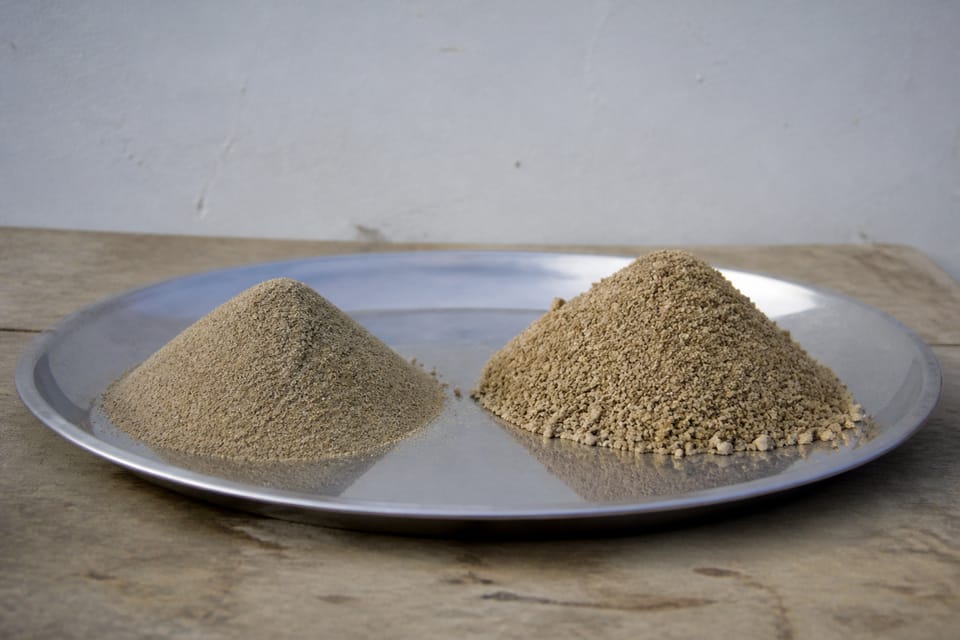
Good grading makes mortar easier to use. SP 20, the BIS masonry handbook, says: “A mortar made from well graded sand has better workability than one made from ungraded sand.” It adds that mortar with ungraded coarse sand “has poor workability, particularly when mix is lean and sand used is angular.”
Too much fine material brings its own risk. SP 25, the BIS crack handbook, says “concretes and mortars having excessive fines will have greater shrinkage than those having just adequate amount of fines needed for good grading.” IS 1661 adds that “The strength of plaster mix gets reduced with the reduction in the fineness modulus of sand.” These are handbook and code notes on the general behaviour. They do not put a number on your wall.
How do I read a sieve report?
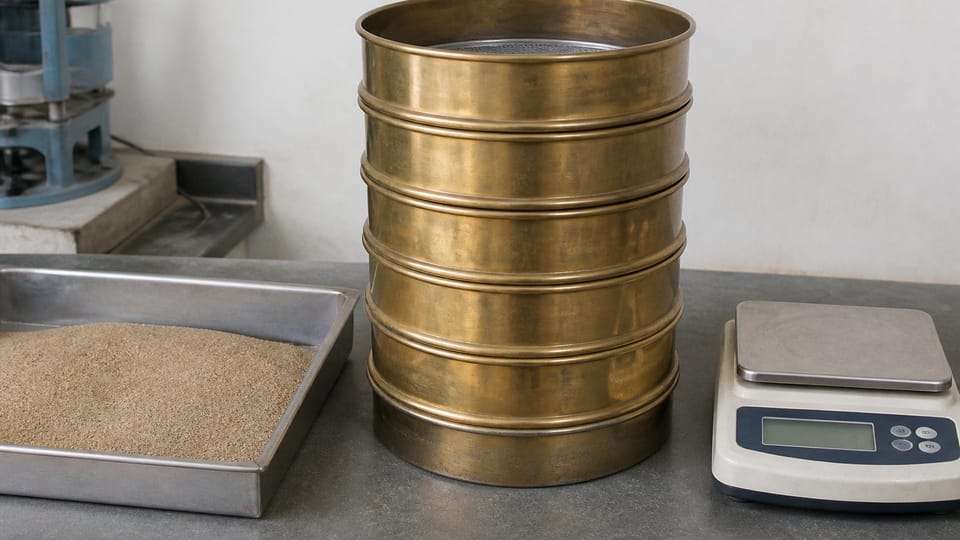
A laboratory shakes a dry sample through a stack of sieves, weighs what stays on each, and reports cumulative percent passing. IS 2386 (Part 1) asks for at least 0.2 kg for sand of 4.75 mm maximum size, and shaking “for a period of not less than two minutes”. Sand “shall not be forced through the sieve by hand pressure”.
Fineness modulus is the sum of the cumulative percent retained on the standard sieves down to 150 micron, divided by 100. All these sands pass the coarser sieves, so the sum starts at 4.75 mm.
Here are four made-up results to show the reading. They are examples, not real sands, and not a design.
| Example sand | Passing 4.75 / 2.36 / 1.18 mm / 600 / 300 / 150 micron | FM | Against IS 2116 | Against IS 1542 |
|---|---|---|---|---|
| A, natural | 100 / 97 / 92 / 84 / 40 / 8 | 1.79 | Within | Within |
| B, natural, coarse | 100 / 94 / 80 / 60 / 28 / 6 | 2.32 | Within | Outside: 60 at 600 micron, needs 80 |
| C, natural, very fine | 100 / 100 / 98 / 95 / 60 / 14 | 1.33 | Within | Table passes, but FM is below 1.5 |
| D, crushed, high fines | 100 / 98 / 93 / 82 / 48 / 22 | 1.57 | Outside: 22 at 150 micron, limit 15 | Outside: 22 at 150 micron, limit 20, no allowance there |
Sand B shows that a masonry pass is not a plaster pass. Sand C shows that a sand can pass the plaster table and still fail on fineness modulus. Grading also says nothing about silt, so check that result separately.
What can I ask the supplier for?
Clause 7.1 of both standards says that, when requested, the supplier shall provide the source of the sand, the rock type for manufactured sand, and the grading by IS 2386 (Part 1). IS 2116 also says the supplier shall give a certificate if requested, and that the test material is free of charge. If an independent test fails, the supplier bears its cost. If the sand complies, the purchaser does.
Neither standard sets how often to test. CPWD’s list, for its own works, gives particle size at every “40 cum or part thereof”, and silt at “Every 20 cum or part thereof or more frequently as decided by Engineer-in-Charge”. For a house, a practical rule is to test when the source changes or the sand looks different. This is practice, not a code rule.
What mistakes should I avoid?
These are practice points unless a standard is named.
- Asking for a “Zone II” report for plaster. Ask for sieve results against IS 1542 Table 1.
- Reading the masonry table for plaster sand, or the reverse.
- Using the 5 percent allowance on the 150, 300 or 600 micron sieves. IS 1542 clause 5.1 excludes them.
- Treating the CPWD 8 percent and the IS 5 percent as the same test.
- Using one heap for plaster, brickwork and concrete without checking each.
- Judging sand by feel alone.
Frequently asked questions
Which zone of sand is used for plastering?
IS 1542 does not use Zones I to IV. It has its own table. The nearest zone is Zone IV, which differs at 300 micron.
What is the fineness modulus of plaster sand?
IS 1542 sets a minimum: 1.5 for natural sand, and 1.4 for crushed stone and crushed gravel sands.
Can concrete sand be used for plaster?
Only if a sieve test shows it meets IS 1542. A sand of Zones I to III will not, as tested.
Can M-sand be used for plaster?
Yes, if it meets IS 1542, which accepts crushed stone sand. See M-sand vs river sand. Check the fine dust result as well as the grading.
Is the IS 1542 limit for silt 5 percent or 8 percent?
IS 1542 says 5 percent, by the laboratory method. The 8 percent is CPWD’s field test, and it is a different measure.
Related guides
- Sand grading zones I to IV: what they mean on a sand test report
- Mortar ratio for brick walls: 1:4, 1:5 or 1:6?
- Plastering terms: punning, screed, dubbing out, hacking and defects
This guide is general information. Read the disclaimer. Your engineer decides which sand is accepted for your mortar and plaster.
Sources
- IS 2116:1980, Sand for masonry mortars: clauses 1.1, 3.1, 3.3, 4.2, 6 and 7.1, and Table 1 (page images read). BIS shows validity to 31 January 2028.
- IS 1542:1992, Sand for plaster: Foreword, clauses 1.1, 4.1, 4.3, 5.1, 5.2, 5.4 and 7.1, and Table 1 with its Note (page images read). BIS shows validity to 28 February 2029.
- IS 383:2016, Coarse and fine aggregate for concrete: Table 9, used for comparison only. Zone II of the 1970 edition, named in IS 1661, had the same 600 micron band.
- IS 2386 (Part 1):1963, Methods of test for aggregates, particle size and shape: Table IV and clauses 2.4 and 2.6.
- IS 2386 (Part 2):1963, Methods of test for aggregates, deleterious materials: clause 3.
- IS 1661:1972, Application of cement and cement-lime plaster finishes: clause 2.5.2 and Table 2, Notes 1 and 2.
- SP 20(S&T):1991, Handbook on masonry design and construction: Part 2, 1.4.3.1. A handbook, not a code.
- SP 25(S&T):1984, Handbook on causes and prevention of cracks in buildings: clause 2.3.3. A handbook, not a code.
- CPWD Specifications 2019, Volume 1: clauses 3.1.3.2 and 3.1.3.3 Note 4, Appendix C and the list of mandatory tests. For CPWD works, used here as a reference.
General information only. It is not a structural design or professional advice. Ask a licensed structural engineer or architect to check your plans and site.