
Short answer
How do you regrout tiles? First find any leak and tap the tiles, because grout will not fix either problem. Then the old grout is raked out without chipping the tiles, the joints are cleaned, and new grout is mixed and pressed in as its pack says. The surplus is wiped off and the joint is protected for the time the pack gives. Regrouting does not repair waterproofing.
On this page (12)
- Is there a standard method for regrouting?
- Should I regrout, or is the problem something else?
- Does regrouting stop a bathroom leak?
- How is regrouting done?
- How deep should the old grout be raked out?
- Which tool should be used?
- What about corners and around the drain?
- When can I use the floor again?
- What mistakes should I avoid?
- Frequently asked questions
- Related guides
- Sources
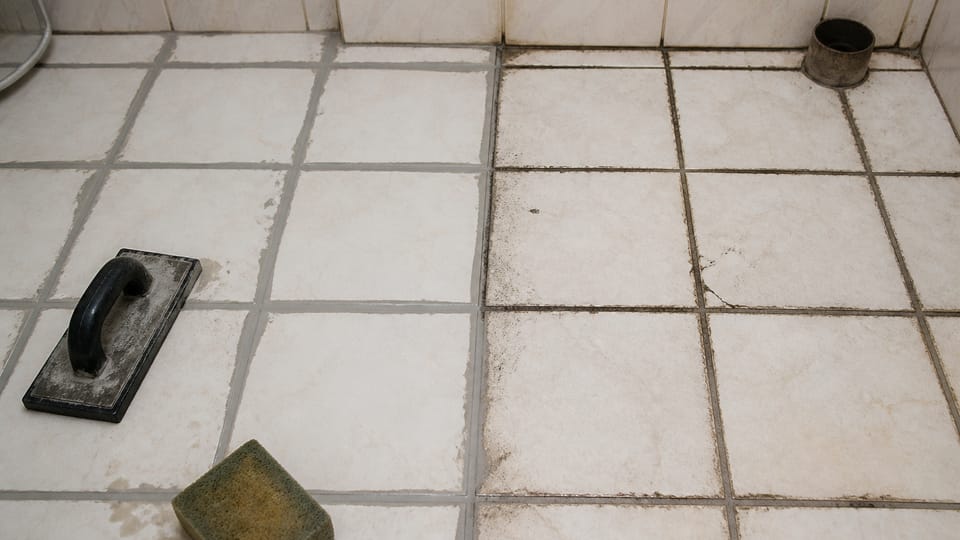
The grout between your tiles has gone dark, cracked or crumbled, and someone suggests regrouting. It is a real repair, but a small one. It renews the joint. It does not fix a leak, a loose tile or the waterproofing under the floor. This page explains when regrouting makes sense, what the job involves, and what to check when a tiler does it for you. It is written for owners supervising the work, because it is dusty, slow and easy to get wrong. It gives no prices and no brand advice. To choose a grout, see the tile grout guide.
Is there a standard method for regrouting?
We could not find one. The Indian texts we could read give no method for regrouting tiles with a grout product. IS 19752 (Part 2):2026, a BIS guideline on installation, inspection and maintenance of tile and stone systems, may cover it, but we could not read it. CPWD covers raking out and pointing joints with mortar, including old work, and it covers grouting new tile joints. It gives no method for regrouting old tile joints.
IS 17190, the Indian tile grout standard, specifies the product and its tests. It leaves surface preparation, mixing, application and cleaning to the maker’s instructions. The makers’ sheets we read describe new tile joints, and none of the Indian ones mentions old grout. So the steps below are adapted from those instructions. They are practice, not a code.
Should I regrout, or is the problem something else?
Check three things first, because grout hides them and does not cure them.
- Is there a leak? Find it first. Grout is one possible leak path among several. IS 13182, the wet area code, lists joints between floor tiles along with pipe junctions, concealed piping, poor slope and the floor trap. See bathroom leaking into the ceiling below.
- Are the tiles firm? Tap them gently. CPWD’s test for a finished floor is that it “shall not sound hollow when tapped with a wooden mallet”. A joint does not bond a hollow tile. See floor tiles popping up or cracking.
- Is the floor wet below? As practice, grout laid over a damp bed or a ponding floor tends to fail again.
Regrouting makes sense when tiles are firm, there is no active leak, and the grout itself is cracked, crumbling or missing, or will not come clean. Try cleaning first. One US maker’s sheet says stains become part of cement grout, so cleaning may not work. As practice, it is still worth trying, because it is much less work than raking.
Does regrouting stop a bathroom leak?
Not by itself. IS 13182 says “Grouted joints will often shrink, producing cracks that allow water to pass through”. That is why the waterproofing sits under the tile. Its list of waterproof materials does not include tile or grout. One maker’s sheet says tile grouts “are not designed as replacements for waterproof coating”.
Some makers call their grout waterproof. At best, that describes the joint. It does not replace a waterproofing layer. As practice, sound new grout may let less water in at the joints for a time, but it cannot repair a failed coat below. IS 13182 is written for new work, and it says a building in use needs a different approach. See bathroom waterproofing.
How is regrouting done?
These steps are practice, adapted from makers’ instructions for new joints. Your grout pack comes first.
- Protect the room. Cover the drain so debris cannot enter it. Clear and ventilate the room, and keep dust away from the rest of the house.
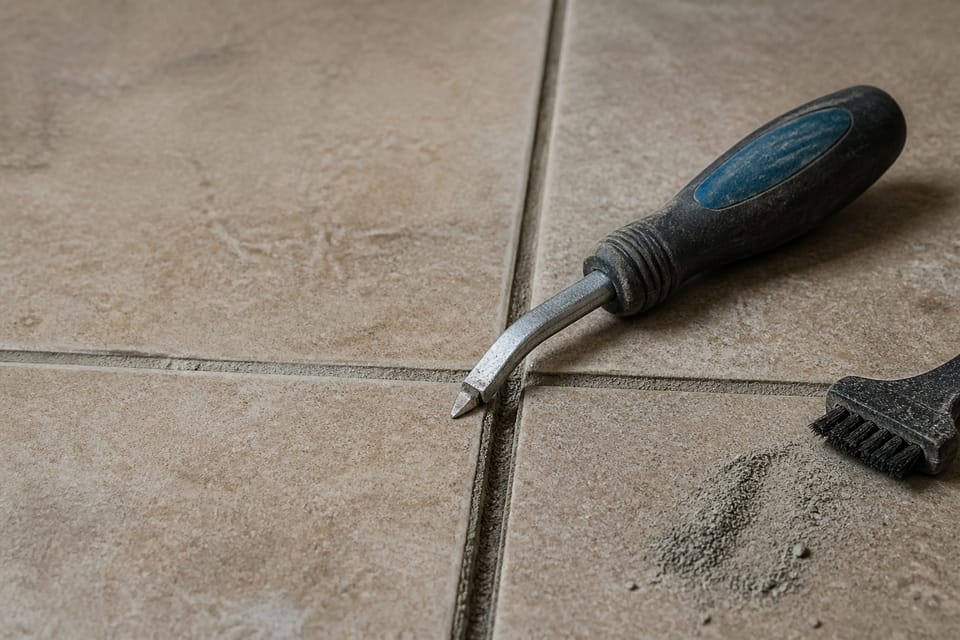
- Rake out the old grout. Work joint by joint without touching the tile edges. See the next section on depth and tools.
- Clean the joints. Remove dust, loose bits, soap and oil. Makers want joints clean and free of debris.
- Check the joint against the pack. Some cement grout sheets stop at 3 mm joints, and others go wider. Very fine joints need a look first, as explained below. Also check that the pack allows regrouting in a wet area.
- Dry or dampen the joint as the pack says. Most sheets want dry joints. One adds pre-dampening in hot conditions or on absorbent surfaces, and another says to dampen. The epoxy sheets that address it forbid damp joints. No sheet gives a drying time. Unless your pack says to dampen, wait until the joint is not damp to touch, and never leave water standing in it.
- Mix only as the pack says. Do not add extra water. Epoxy comes in parts. Sheets differ: one says to mix complete units and another says to mix only the quantity needed, so check before opening a pack for a small repair.
- Press the grout in. Use a rubber float, a pressing tool with a rubber face, or a rubber squeeze, and work it across the joint. Two sheets say to make sure the joint is filled and the grout “is not just sitting on top”.
- Clean off the surplus with a damp sponge at the time the pack gives. Sheets differ widely on when. Do not let grout harden on the tile face. For epoxy, CPWD uses a hard rubber squeeze and rubber gloves, and cleans the haze, the thin film left on the tile, with water or soap solution.
- Protect it. Keep off it for the time the pack gives, and see the section on use below.
How deep should the old grout be raked out?
No code we read sets a depth for this. CPWD clears new floor joints 2 to 3 mm deep before white cement pointing, but that is a different process and not a regrouting depth. Makers differ, and only the foreign sheets speak of regrouting.
| Sheet | What it asks | What it covers |
|---|---|---|
| JSW and Roff cement grouts | At least two-thirds of the tile thickness free | New laying |
| Asian Paints cement grout | About two-thirds of the tile depth available | New laying |
| Laticrete (US) | At least half the depth of the existing joint | Regrouting its own epoxy grout |
| Bostik (US) | All the old grout out | Regrouting with its product, but not showers or other wet areas |
The table is ours. Two-thirds is a useful target, not a regrouting rule. Note the last row: that sheet says not to use the product for regrouting showers or other wet areas, so check that your pack allows regrouting in a wet area.
Two limits are our own judgement. Stay within the tile thickness, because going deeper risks the bed, meaning the mortar or adhesive under the tile, and any coat below it. And do not leave only a thin skin of space, because no sheet we read supports a thin layer over old grout.
Watch for two other things:
- Very fine joints. CPWD requires vitrified tile joints of not more than 1 mm, and two epoxy sheets we read start at 2 mm. Raking such a joint may not be practical. Ask an experienced tiler to assess it.
- Unknown old filler. The old joint may be white cement, a bagged grout or epoxy. This affects how hard it is to remove, so ask the tiler to test a small length.
Which tool should be used?
This is practice. No Indian text we read covers it.
- Hand rake or grout saw. It is slower but gentler, and it is the safer choice for small areas.
- Powered blade or grinder. It is fast, but it can chip tile edges and cut too deep. Treat it as a skilled tiler’s tool, not a default. One US maker says great care is needed to avoid damage to tile surface and edges.
Dust. Raking can raise fine dust. UK guidance from HSE says raking mortar and chasing concrete can produce very high levels of silica dust. It asks for dust extraction on the tool with a stated class of extractor, plus an FFP3-class mask. That guidance is foreign and is about mortar and concrete, but one maker’s grout sheet lists quartz sand, so treat grout dust with care. Keep children and others out of the area.
What about corners and around the drain?
IS 17190 excludes movement joints and expansion joints from its definition of tile grout. IS 13182 says cracks at floor and wall junctions can be caused or enlarged by movement. So, as practice, floor-wall corners and edges are often finished with a flexible sealant, not rigid grout. IS 13182 says sealants should be waterproof, flexible, mould-resistant, compatible with adjacent materials and non-sagging. See expansion joints in a house.
The floor trap junction is a listed leak source. Do not treat grout or sealant around it as the repair. Ask a plumber or waterproofing contractor if you suspect it.
When can I use the floor again?
The pack decides. IS 17190 leaves service time to the maker, for traffic. For new tiling, the Indian sheets we read give about 24 hours for foot traffic, often light traffic only, and one gives 24 to 36 hours. Some give much longer for regular or full traffic: 7 days on two cement sheets and about 14 days on another. These are new-laying values, for those products.
No Indian sheet we read names a shower. One gives 24 hours before “normal service conditions”, without saying if that includes water. One says to protect fresh material from water, and it gives a long time before water immersion. Ask the maker in writing. CPWD says a new tile floor pointed with cement is kept wet for 7 days. That is not a rule for a bagged grout, so follow the pack.
What mistakes should I avoid?
These are practice points, except where a source is named above.
- Regrouting a floor that is still leaking.
- Grouting over hollow tiles.
- Spreading new grout over old with no raking.
- Chipping tile edges with a power tool.
- Grinding indoors with no dust control.
- Cleaning joints with acid. Several sheets say not to, and IS 1443 says to avoid soda and acid on polished cement concrete tile floors.
- Filling movement joints with rigid grout.
- Adding extra water to the mix.
- Using an unmarked bag. IS 17190 says what the pack must show, including type, pot life (how long the mix stays usable) and how to use it.
- Letting the bathroom be used before the pack’s time.
Frequently asked questions
Can I put new grout over old grout?
We found no Indian sheet that supports it. Two sheets ask for a joint filled so the grout is not just sitting on top, and the depth they ask for rules out a thin skim.
Do I have to remove all the old grout?
Makers differ. Indian sheets give a free depth for new laying, and foreign sheets range from half the depth to all of it. No code we read sets a rule.
Can I regrout this myself?
It is possible on a small area, but it is not a light job. Two cement grout sheets are marked “Limited to professional use only”. A tiler is safer for wet areas, fine joints and glazed or polished tiles.
Can I put epoxy grout over old cement grout?
No sheet we read covers this. Get the maker’s written answer before you start.
Should I seal new grout?
CPWD says that generally epoxy grouts need no additional sealer. None of the four Indian cement grout sheets we read calls for a sealer after grouting. A sealer is not waterproofing.
Will new grout match the old colour?
It may not. One sheet says colour cannot be fully guaranteed from batch to batch, and old grout has also changed with age. If you need more than one pack, two sheets say to blend the powders dry first. As practice, test a small area first or redo the whole room.
Related guides
- Tile grout: cement vs epoxy grout and what CG and RG mean
- Floor tiles popping up or cracking: causes, standards, fixes
- Bathroom leaking into the ceiling below: how to find the source
- Grout vs mortar: what each is made of and where each is used
This guide is general information. Read the disclaimer. A tiler or waterproofing contractor checks your floor, and an engineer decides if the cause is structural.
Sources
- IS 19752 (Part 2):2026, Floor and wall tiling, Guidelines, Part 2 Installation, inspection and maintenance of tile and stone systems: BIS record only. We could NOT read the text.
- IS 17190:2020, Grouts for filling of joints of tiles and stones, Specification: clauses 1, 3.17, 3.20 and 7.1 and the foreword.
- IS 13182:2020, Waterproofing and damp-proofing of wet areas in buildings, Recommendations (first revision): foreword and clauses 4.4.1, 4.6, 5.3.1 and B-2.
- CPWD Specifications 2019, Volume 1: clauses 11.15.5, 11.16.1, 11.29.1 and 11.29.3, read from a saved text copy. Copy hosted by IIT Bombay.
- CPWD Specifications 2019, Volume 2: clauses 13.13.2 and 13.13.6.7, on pointing, read from a saved text copy.
- IS 1443:2018, Laying and finishing of cement concrete tiles, Code of practice (second revision): clause 11.2.1. It covers cement concrete tiles only.
- Maker's data sheet, read for new tile joints, not a recommendation: JSW Tylfix Grout Cementitious.
- Maker's data sheet, read for new tile joints, not a recommendation: Roff Rainbow Tile Mate.
- Maker's data sheet, read for new tile joints, not a recommendation: Asian Paints SmartCare Tile Grout Cement Based, 2014 version.
- Maker's data sheet, read for new tile joints, not a recommendation: SikaCeram-638 Tile Grout, September 2025.
- Maker's data sheet, read for new tile joints, not a recommendation: UltraTech Tilefixo Style Epoxy Grout.
- Maker's data sheet, read for new tile joints, not a recommendation: JSW Tylfix Epoxy Grout.
- Maker's data sheet, read for new tile joints, not a recommendation: Asian Paints SmartCare Epoxy 3K Tile Grout.
- Foreign maker's sheet (US), Laticrete Grout Guide TDS 400, on removing that maker's epoxy grout, and on stains in cement grout.
- Foreign maker's sheet (US), Bostik Dimension, on re-grouting with that product.
- Foreign guidance (UK), HSE, Chasing concrete and raking mortar: on silica dust. It is about concrete and mortar, not tile grout.
General information only. It is not a structural design or professional advice. Ask a licensed structural engineer or architect to check your plans and site.