
Short answer
Why does my tank float valve not close, and how do I fix it? With water flowing in, lift the arm gently by hand. If the flow stops when you lift it, the level is set too high or the float is the problem. If water still runs, the washer, seat or grit is the likely cause. IS 2065 sets the water line at least 25 mm below the overflow, or one pipe bore if more. Do not plug the overflow.
On this page (10)
Water is dripping or running from the overflow pipe, or down the wall from the terrace. That usually means the float valve is not shutting off. This page gives a simple test to find the fault, explains how the water level is set, and tells you when to replace the valve. It also shows what the Indian Standards say and where they say nothing. It gives no prices and no brand advice. Work on a terrace tank only if you can reach it safely. If not, call a plumber.
What does a float valve do?
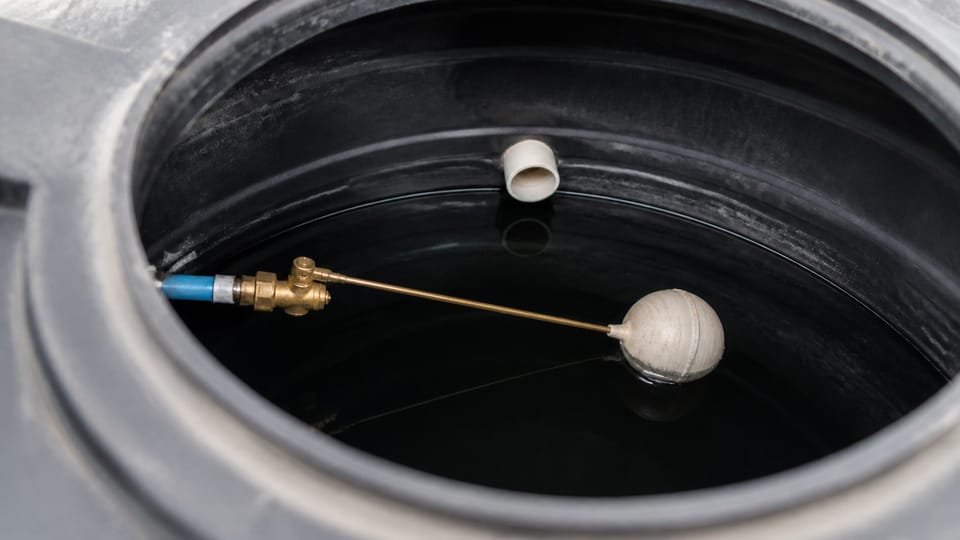
A float valve fills a tank and shuts off when the water reaches a set level. NBCS 2026 and IS 2065 define a float operated valve as “Ball valves or ball taps and equilibrium valves operated by means of a float.” So “ball valve” in these codes can mean the tank valve. It is not the same as the quarter-turn ball valve on a pipe line.
The float rises with the water, the arm lifts, and the arm pushes a washer or diaphragm against a seat. For where it sits among the other tank pipes, see overhead tank fittings.
Three Indian Standards cover most of these valves:
| Type | Standard | How the level is set |
|---|---|---|
| Brass horizontal plunger valve | IS 1703:2000 | Lever “shall be sufficiently ductile to be bent, without detriment, for the purpose of adjustment” (cl 7.7.2) |
| Plastic equilibrium valve | IS 12234:2021 | Design must have “a readily accessible method of adjusting water level without bending the arm” (cl 7.7) |
| Diaphragm valve with plastic body | IS 13049:1991 | “a positive, readily accessible method of adjustment and locking to set the water level in the cistern” (cl 7.5.2) |
So the answer to “should I bend the arm?” depends on the valve. A brass lever is made to be bent a little. A plastic valve should have its own adjuster, so use that.
Why does the water not stop? A simple test
No Indian Standard we read lists causes or a test. The causes below are practice, most from foreign makers’ fault pages. The lift test and the wrong-valve row are our own reasoning. None is a code rule.
Know how to stop the flow first. IS 2065 clause 11.5 asks for a stop valve on the inlet “to facilitate stopping of flow temporarily in the event of improper functioning of ball valve or for cleaning of storage tank”. With the tank nearly full and water still coming in, lift the arm gently by hand, and only briefly. If the tank is filled by a pump, keep someone at the pump switch, and switch the pump off as soon as the test is done.
| What you see | Likely cause | What to do |
|---|---|---|
| Flow stops when you lift the arm, but the tank still overflows | Level set too high, if the float and arm are sound (next two rows) | Lower the level (see the next section) |
| Float sits low, feels heavy or has water inside | Damaged or part-filled float | Replace the float |
| Arm or float rubs the tank wall, a pipe or the lid | Float cannot rise freely | Free it, or reposition the valve |
| Water still runs with the arm held up | Worn washer or diaphragm, grit on the seat, or mineral deposit | Clean the seat, change the washer, or replace the valve |
| A new valve leaks or will not shut | Wrong valve for the pressure, or grit from the pipe | On a brass valve, check the HP or LP mark. On a plastic valve, check the leaflet. Flush the line and ask your plumber |
Why a heavy float matters: the standards test the shut-off with the float half sunk (IS 12234 cl 8.1.2, IS 13049 cl 8.2), and IS 1703 cl 8.2 says not more than half. They also ask for a float that is “watertight and non-absorbing” (IS 12234 cl 7.9). Water inside the float gives it less lift, so by our reasoning the valve may shut late or not at all.
How do I set the water level?
IS 2065 gives the rule. Clause 11.4 says: “In every storage vessel, the water line shall be set below the overflowing level of the warning pipe, or of the overflow pipe if there is no warning pipe, at a distance of not less than 25 mm or of not less than the internal diameter of the pipe, whichever is greater.”
So set the level at least 25 mm below the overflow, or one pipe bore below if that is more. Clause 11.3 also says the valve must be placed so that “the body of the ball valve cannot become submerged when the cistern is full up to the water line”.
To adjust, keep these points in mind. They are practice, and your plumber can do this for you.
- Plastic valve. Use the adjuster screw or slide on the arm. Read the maker’s leaflet.
- Brass valve. Bending the float end of the arm slightly down lowers the water level. Bending it up raises the level. Hold the arm near the valve while you bend it, so that no force reaches the valve body.
- Change a little, then test. Let the tank fill and watch where it stops. No standard gives how far or how often you may bend a lever.
How do I change a washer or clean the seat?
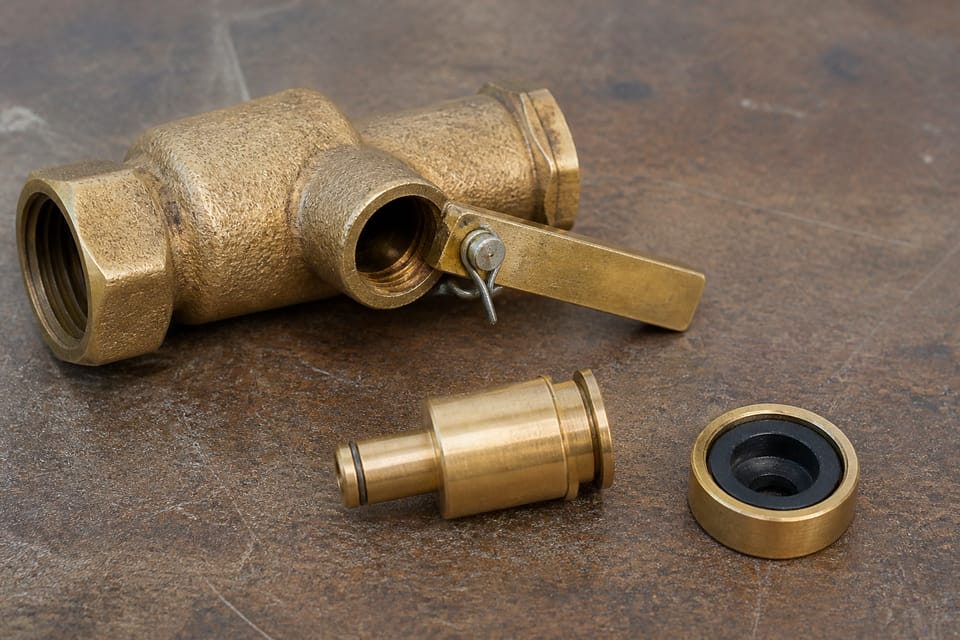
No Indian Standard we read gives the steps. IS 1703 clause 9.2 says each valve “shall be supplied with a leaflet containing manufacturer’s instructions for installation and maintenance”, so keep that leaflet. NBCS 4.18.5 sets the duty without a method: “All taps and ball valves shall be watertight, glands shall be made good, washers shall be replaced and the mechanism of spring operated taps and ball valves shall be repaired where required.”
In general site practice, the plumber switches off the pump if there is one, closes the stop valve, removes the arm and piston, cleans grit from the seat, fits a new washer, puts the parts back and tests the valve. Plastic valves use a diaphragm and differ by model, so follow the leaflet.
Should I repair or replace the valve?
No standard gives a rule, so this is our reasoning. In an IS 1703 brass valve, the seat is cast with the body “in one single unit”, so it is not a separate spare. A badly damaged seat usually means a new valve. A worn washer or a damaged float is a smaller repair.
When you buy a new valve, check three things:
- The class. IS 1703 valves are marked with size and class, HP (high pressure) or LP (low pressure). Its foreword says the high pressure type has a much smaller seat bore. By our reasoning, an LP valve on a higher-pressure line may not hold shut.
- The seat on a plastic valve. IS 13049 colour-codes detachable seats, red for HP and white for LP. Not every plastic valve has one, and the letters do not mark the same pressure range in IS 1703 and IS 13049.
- The fit in your tank. The arm and float need room to rise freely.
In practice, judge the type by the body and arm, not by the colour of the float, because brass and plastic valves can carry similar-looking floats.
Why does the overflow matter?
The overflow is doing its job when it runs. NBCS 4.4.4(c) asks for an overflow pipe “to act as a ‘Warning Pipe’ to indicate overflow conditions”. So water from it is the alarm, not the fault. NBCS 4.4.4(f) also says it must not connect “to any drain, gully trap or manhole”, and NBCS 4.18.6 says “All overflow pipes shall be examined and kept free from obstructions.”
If you plug it, the tank has nowhere to spill and you lose the warning. That is our advice, not a clause.
What mistakes should I avoid?
These are practice points unless a code is named.
- Plugging or capping the overflow to stop the drip.
- Tying the arm up with wire or a bottle. It hides the fault and does not fix it.
- Forcing the arm with no support near the valve.
- Bending the arm of a plastic valve when it has an adjuster.
- Replacing the valve without clearing grit from the line.
- Leaving a seized inlet stop valve. NBCS 4.18.4 says: “All valves shall periodically be operated to maintain free movement of the working parts.”
- Letting a tank cleaner handle the valve roughly. CPWD’s contract clause for tank cleaning makes the contractor replace a ball cock damaged during the work, which shows that it happens.
- Working on a high tank with no safe ladder or support.
If the water is not coming from the overflow, you may have a leak in the tank. See how to find a tank leak.
Frequently asked questions
How far below the overflow should the water stop?
IS 2065 clause 11.4 says at least 25 mm, or the inside diameter of the pipe if that is larger.
Which way do I bend the arm to lower the level?
Bend the float end of a brass arm slightly down. The valve shuts at a fixed arm angle, so a lower float reaches that angle at a lower water level. No Indian Standard gives the direction. This is plain mechanics, and your plumber should confirm it for your valve.
Why does my new float valve still overflow?
The usual suspects are a brass valve of the wrong class for the pressure, grit on the seat, an arm that rubs, or a level set too high. On a brass valve, read the marking, then run the test above.
Is a float valve the same as a float switch?
No. A float valve is a mechanical valve on the inlet pipe. A float switch is an electrical part that starts or stops a pump. This page covers the valve only.
Is a ball cock the same as a float valve?
Yes, in everyday use. Indian codes and plumbers use ball valve, ball cock and float valve for the tank valve. On a pipe line, a ball valve is a different fitting.
How often should I check the float valve?
The standards give no interval. A practical time is whenever the tank is cleaned. NBCS asks for tank cleaning at least once a year, as our tank cleaning guide explains.
Related guides
- Overhead tank fittings: inlet, outlet, overflow, washout and vent
- Ball valve vs gate valve: what the standards say about each
- Overhead tank vs pressure pump system: gravity and hydro-pneumatic
This guide is general information. Read the disclaimer. A licensed plumber should work on any tank you cannot reach safely.
Sources
- IS 2065:1983, Code of practice for water supply in buildings: clauses 2.32, 11.3, 11.4 and 11.5. BIS shows validity to 28 February 2027.
- IS 1703:2000, Copper alloy float valves (horizontal plunger type): Foreword, clauses 3.1, 7.2, 7.7.2, 8.2, 9.1 and 9.2 (page images read for the key clauses).
- IS 12234:2021, Plastic equilibrium float valves: clauses 7.7, 7.9 and 8.1.2. BIS shows validity to 30 December 2026.
- IS 13049:1991, Diaphragm type (plastic body) float operated valves: clauses 7.2.2, 7.5.2 and 8.2.
- SP 7:2026, National Building Construction Standards (NBCS) 2026, Part E Section 1, Water Supply: clauses 2.1.33, 4.4.4(c) and (f), 4.16.1, 4.18.4, 4.18.5 and 4.18.6. From an unofficial archive.org copy.
- CPWD Specifications 2019, Volume 2, clause 14.41.1.1 (ball cock damaged during tank cleaning). A contract clause, not a rule for private homes.
General information only. It is not a structural design or professional advice. Ask a licensed structural engineer or architect to check your plans and site.