
Short answer
What fittings does an overhead water tank need? NBCS 2026 asks each tank for manholes with locks, an overflow pipe that acts as a warning pipe, a scour pipe with an accessible valve, and no connection of overflow or scour to a drain. IS 2065 adds a float (ball) valve, a stop valve on the inlet and on every outlet, and a lidded cover. Both ask for an outlet above the bottom with a strainer.
On this page (9)
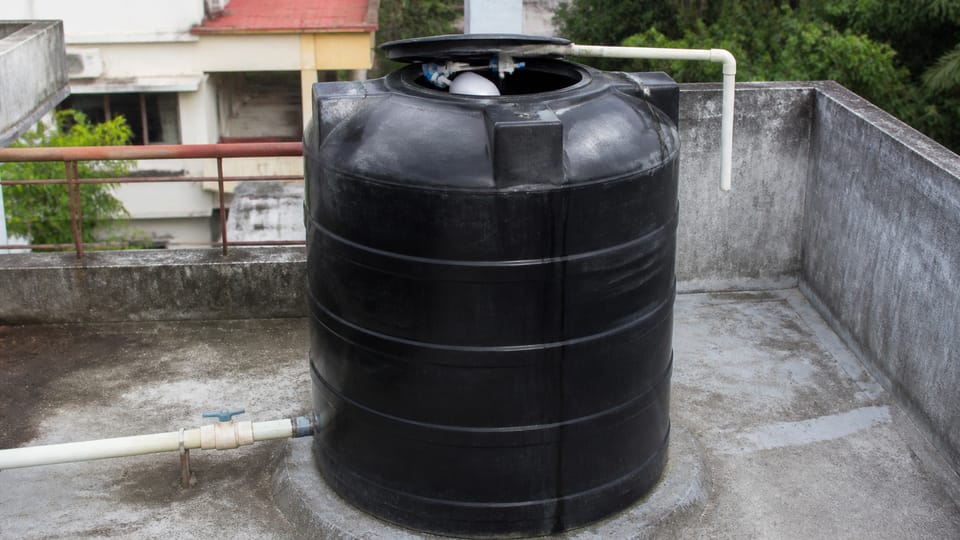
On the roof of most houses is a tank with five or six pipes and a lid, and nobody can say which pipe does what. When the tank overflows, runs dry or sends muddy water down, the cause is usually one of these fittings. This page explains each fitting, what NBCS 2026 and IS 2065 say about it, and what the owner can check. It covers the overhead tank only. It gives no tank size, pipe size, height or support design; for the tank’s capacity, see water tank size for a house: litres per person and tank capacity, and for leaks at the fittings, see water tank leakage: how to find the source and fix it.
What does NBCS 2026 ask each tank to have?
NBCS 2026 Part E Section 1 clause 4.4.4 begins “Each tank shall be provided with the following”, and lists:
| Fitting | What the clause says (summary) |
|---|---|
| Manholes (a) | An adequate number for access and repair, made of corrosion resistant material, with a locking arrangement to avoid misuse and tampering |
| Ladders (b) | Corrosion resistant ladders for tanks above a stated depth, so a person can reach the bottom |
| Overflow pipe (c) | Terminating above the ground or terrace level to act as a “warning pipe” that indicates overflow; large enough to take the flow, normally one size higher than the inlet pipe |
| Vent pipes (d) | For tanks above a stated capacity, to prevent pressure developing that could cause “NO FLOW” or inward collapse |
| Scour pipe (e) | “with an accessible valve for emptying the tank” |
| Drain rule (f) | “Under no circumstances tank overflow and scour pipe shall be connected to any drain, gully trap or manhole”; they discharge over a grating with an air gap, and overflow and vent pipes carry a mosquito proof brass grating |
| Top slab (g) | Sloped away from the centre so rainwater drains |
The definitions agree: a warning pipe is an overflow pipe whose outlet is “in a conspicuous position where the discharge of any water there from can be readily seen” (2.1.78), and a wash-out valve is a device at the bottom of the tank for draining it for cleaning and maintenance (2.1.79). Clause 4.4.6 asks that the outlet pipe be fixed above the bottom of the tank and fitted with a strainer, preferably of brass, and the usual reason, in practice, is that sediment stays behind. Clause 4.4.8 asks that the bottom of an overhead tank be clear of the terrace slab. Clause 4.4.4(h), on supporting a tank on structural members, is a structural matter for the engineer and is not covered here. The heights and sizes are in the standard and are not printed here.
What does IS 2065 add?
IS 2065:1983 clause 11 covers the fittings NBCS 4.4.4 does not list:
- A lid: every tank is “properly covered with a closed fitting dust, light and mosquito-proof lid fitted with a lock and key” (11.3).
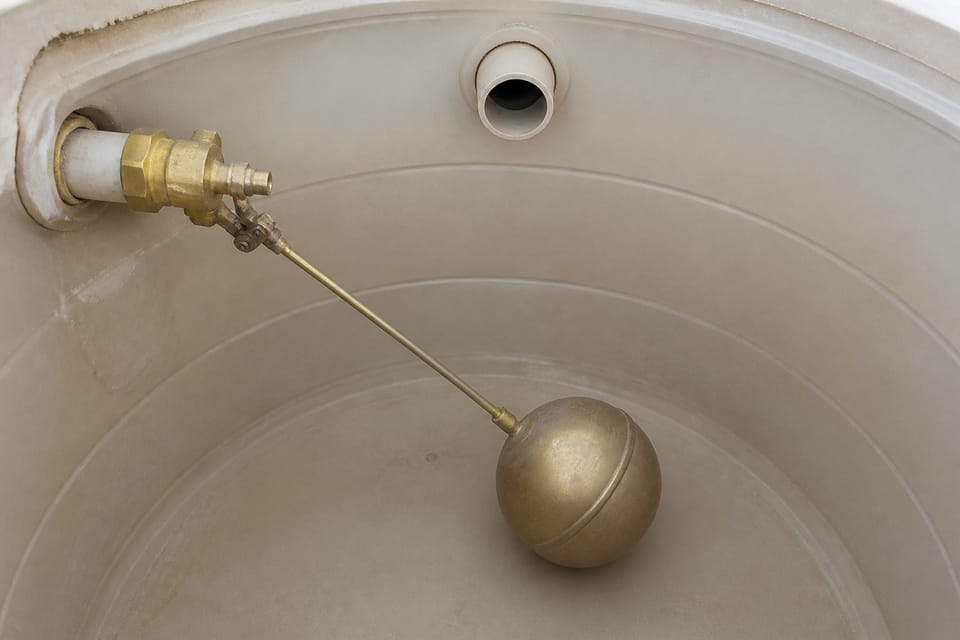
- A float (ball) valve: a ball valve to IS 1703, “set in such a position that the body of the ball valve cannot become submerged when the cistern is full up to the water line”, adjusted to keep the water level below the lip of the warning or overflow pipe (11.3).
- Stop valves: one “as near the tank as practicable on every outlet pipe”, except the warning pipe (11.3), and “A stop valves [sic] shall be provided on the inlet connection also to facilitate stopping of flow temporarily in the event of improper functioning of ball valve or for cleaning of storage tank” (11.5). Outlet valves are preferably full-way gate valves.
- A warning pipe that can be seen: it is mosquito-proof, its outlet is where discharge “can be readily seen”, it is set a stated distance above any drain, sink or gully, and “No overflow pipe shall be allowed to be connected directly to any drain or sewer” (11.4).
- An outlet above the bottom: the outlet pipe is fixed above the bottom of the tank, with a strainer, preferably of copper gauge (11.8).
- A wash-out pipe: made flush at the bottom of the tank at its lowest point, with the floor given a slight fall to it (11.8). Where there are several tanks or compartments, each has its own float valve, overflow and draining valve (11.7).
IS 2065 has no vent clause for an overhead tank; NBCS asks for vent pipes above a stated capacity. The two standards word the scour pipe differently (NBCS “scour pipe”, IS 2065 “wash-out or draining pipe”) and do not conflict on the overflow rules.
What are the float valve standards?
IS 1703:2000 covers copper alloy float valves of the horizontal plunger type, in high pressure and low pressure classes, with marking of the maker, size and class. IS 12234:2021 covers plastic equilibrium float valves for cold water, for uses that include overhead tanks, and its BIS validity runs only to 2026-12-30. NBCS 2026 defines a float operated valve as ball valves or ball taps and equilibrium valves operated by a float (2.1.33).
What does each fitting do, and what can I check? (practice)
This is practice, apart from the clauses named.
| Fitting | What it does | What the owner checks |
|---|---|---|
| Inlet with float valve | Lets water in and shuts off when the tank is full | The float shuts the flow fully; the inlet has its own stop valve |
| Outlet with strainer | Takes water to the house, above the bottom | A valve on the outlet; the strainer is clear |
| Overflow (warning) pipe | Shows the tank is full and carries water away safely | The open end is visible, has a mesh and does not join a drain |
| Wash-out (scour) valve | Empties the tank for cleaning | The valve works and the pipe does not join a drain |
| Vent | Lets air in and out as the level changes | It has a mesh |
| Lid or manhole | Keeps dirt, insects and light out | It closes and locks |
Regular water from the overflow is not normal: it usually points to a float valve that has failed or is set wrongly. NBCS 4.18.6 also asks that overflow pipes be examined and kept free from obstructions. Every pipe should be supported by its own bracket and not hang on the tank wall.
What should I ask the plumber? (practice)
- Where does the overflow end, and where does the wash-out discharge?
- Is the outlet above the bottom of the tank, and is there a strainer?
- Which valve shuts which pipe, and can I reach each of them?
- Is there a vent, and does it have a mesh?
- How do I test the float valve?
- Who supports the pipes?
What mistakes should I avoid? (practice)
- No overflow pipe, or an overflow joined to a drain, gully trap or sewer.
- An open overflow or vent with no mesh.
- No wash-out valve, so the tank cannot be emptied.
- The outlet taken from the very bottom, so sediment goes to the house.
- Pipes loading the tank wall.
- No lid, or a lid that does not close.
- A float valve left stuck or worn.
- Valves that cannot be reached, with no labels.
Frequently asked questions
Can the overflow pipe go into a drain?
No. NBCS 4.4.4(f) says under no circumstances; it discharges over a grating with an air gap. IS 2065 says no overflow is connected directly to a drain or sewer.
What is the difference between the overflow and the wash-out?
The overflow is near the top and warns when the tank is full. The wash-out or scour pipe is at the bottom, with its own valve, for emptying the tank.
Does an overhead tank need a vent?
NBCS asks for vent pipes above a stated capacity. IS 2065 has no vent clause for an overhead tank. IS 12701 Annex E, which is recommendatory, suggests a vent or overflow pipe near the top with a mosquito and insect proof cap.
Why is the outlet not at the very bottom?
NBCS 4.4.6 and IS 2065 11.8 fix the outlet above the bottom, with a strainer. The usual reason, in practice, is that sediment stays in the tank.
Do I need a float valve?
IS 2065 asks for a ball valve on every tank. It is the normal shut-off, and the overflow is the warning if it fails.
Related guides
- Water tank size for a house: litres per person and tank capacity
- Water tank leakage: how to find the source and fix it
- Air lock in water pipes: why a tap splutters and how it is cleared
- IS 2065 explained: the water supply code, clause by clause
- Float valve not closing: why the tank overflows and how to fix it
This guide is general information. Read the disclaimer. Your plumber and engineer decide the tank connections for your house.
Sources
- SP 7:2026, National Building Construction Standards (NBCS) 2026, Part E Section 1, Water Supply: clauses 2.1.33, 2.1.78, 2.1.79, 4.4.4, 4.4.6, 4.4.8 and 4.18.6 (page images read; 4.18.6 text only). From an unofficial archive.org copy.
- IS 2065:1983, Water Supply in Buildings, Code of Practice (second revision): clauses 11.3 to 11.8 (page images read). BIS lists it as in force, valid to 2027-02-28. It cites IS 1703 and IS 781 in older editions.
- IS 1703:2000, Water Fittings, Copper Alloy Float Valves (Horizontal Plunger Type) (fourth revision): clauses 1.1, 3.1 and 9 (page images read). BIS lists it as in force, valid to 2031-02-27. IS 12234:2021, Plastic Equilibrium Float Valves for Cold Water Services: clause 1.1 (page image read). BIS lists it as in force, valid to 2026-12-30: check the status again before relying on it.
- IS 12701:1996, Rotational Moulded Polyethylene Water Storage Tanks (first revision): Annex E-1 (page image read). BIS lists it as in force, valid to 2027-03-31. Annex E is recommendatory.
Change log
- : Added Related guides link to newly published article(s): float-valve-not-closing-why-the-tank-overflows-and-how-to-adjust-or-replace-it. No other text changed. Approved by the reviewing engineer.
- : Added Related guides link to newly published article(s): air-lock-in-water-pipes-why-a-tap-splutters-and-how-it-is-cleared, is-2065-explained-the-water-supply-code-clause-by-clause-for-a-house. No other text changed. Approved by the reviewing engineer (owner report, 2026-10-31).
General information only. It is not a structural design or professional advice. Ask a licensed structural engineer or architect to check your plans and site.