
Short answer
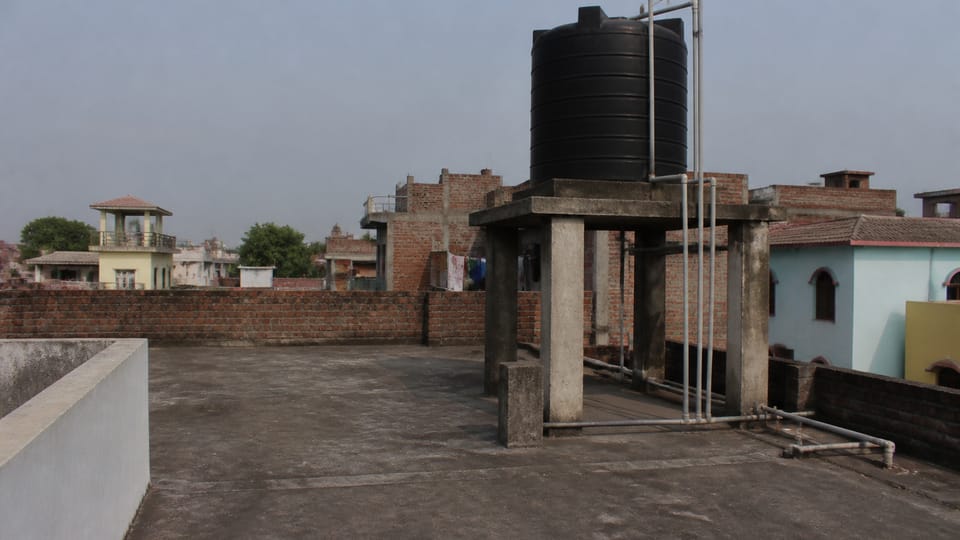
Overhead tank or pressure pump system: which one does a house need? An overhead tank feeds taps by gravity. NBCS 2026 calls this the most common system in multi-storeyed buildings. A hydro-pneumatic system pumps from a storage tank through a diaphragm vessel. It can give more pressure but needs more parts and backup power. For multi-storeyed buildings, NBCS still advises a small overhead tank with it. No code picks one for a house, so ask your engineer.
On this page (12)
- What is the difference between gravity and hydro-pneumatic supply?
- How does a hydro-pneumatic system work?
- What does the code ask of a pressure pump system?
- Can a pressure pump go straight on the municipal line?
- What is a booster pump on an overhead tank?
- Which pressure numbers does the code give?
- What about the geyser and mixers?
- Which system should I choose for a house?
- What mistakes should I avoid?
- Frequently asked questions
- Related guides
- Sources
Your plumber offers two ways to get water to the taps. One is the familiar tank on the terrace. The other is a pressure pump system with a blue vessel and no big tank on the roof. This page explains how the two differ, what each needs and what happens to each in a power cut. It gives no prices, no pump ratings and no vessel sizes. Those come from your engineer and the maker’s data sheet.
What is the difference between gravity and hydro-pneumatic supply?
The difference is what pushes the water to the tap. In a gravity system, the height of the tank does. In a hydro-pneumatic system, a pump does.
NBCS 2026, the national building code that replaced NBC 2016, lists four ways of distributing water in clause 4.8. They are direct supply, gravity supply, pressurized (hydro-pneumatic) supply and a combined system. The clause is headed “Distribution Systems in Multi-Storeyed Buildings”, and the code does not define multi-storeyed. It has no separate clause for one house. So using these clauses for a house is our reading, not a rule the code sets for houses.
| Point | Overhead tank (gravity) | Pressure pump (hydro-pneumatic) |
|---|---|---|
| What moves water to the tap | Height of the tank | Pump, working with a pressure vessel and a pressure switch |
| What the code calls it | “the most common water distribution system” (NBCS 4.8.3) | “a direct pumping system incorporating a recharge diaphragm vessel” (NBCS 4.8.4.1) |
| Main parts | Sump or supply, fill pump if needed, overhead tank, pipes | Storage tank at low level, pump, diaphragm vessel, pressure switch, low level cut-off |
| Where stored water sits | On the roof, and in the sump if there is one | Mostly in the low-level tank |
| Pressure at the top floor | Depends on the height of the tank above the fitting | IS 12183 says it “may supply water at a much higher pressure than available from overhead tanks” |
| Pump runs when | The tank needs filling | Water is used and pressure falls |
| In a power cut | Taps run until the tank is empty (practice) | Taps stop soon after, unless there is backup or a small gravity tank (practice) |
Direct supply means taps fed from the mains. NBCS 4.8.2 says that “With limited pressure available in most city mains, water from direct supply is normally not available above two or three floors.” In practice, many houses also store water because the supply is not steady or strong enough.
How does a hydro-pneumatic system work?
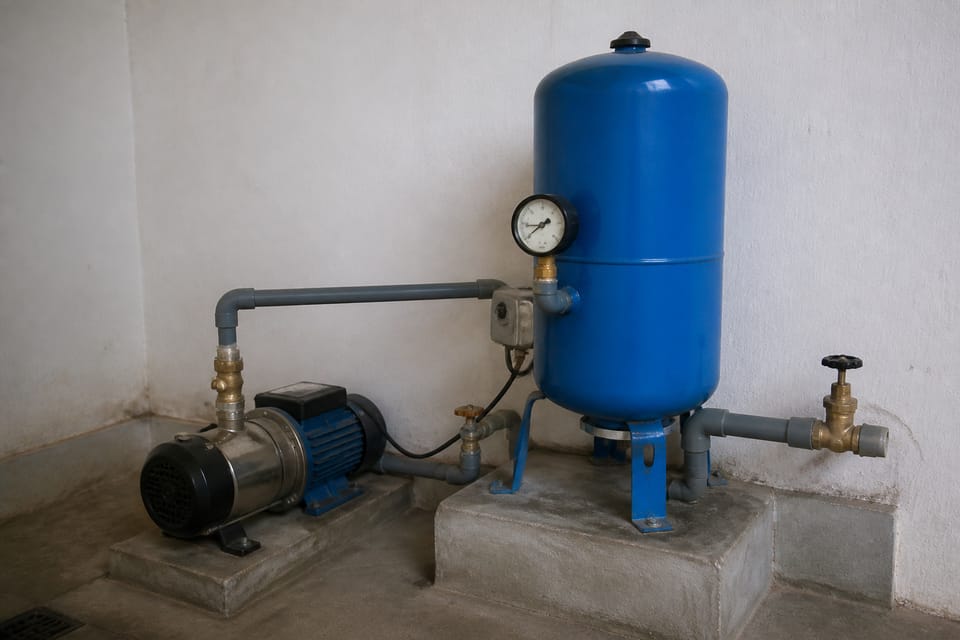
NBCS 2.1.48 defines it as “The water supply pumping system which operates automatically in conjunction with pump(s), pressure vessel and pressure switch.”
The cycle is simple. You open a tap. Water leaves the diaphragm vessel, which holds it under pressure. The pressure falls to a set point and the pump starts. When the pressure reaches the upper set point, the switch stops the pump. One foreign maker’s manual (Grundfos Hydro Solo-S) describes the cycle this way, and the set points differ from model to model.
The vessel is a pressure cushion. It is not the house’s water store. The store is the tank that feeds the pump.
What does the code ask of a pressure pump system?
The first three lines come from the multi-storeyed clause. A house is not named in them, but they are the best checklist the code offers.
- Dry-run protection. NBCS 4.8.4.3 says the system “shall also incorporate” automatic pump sequencing and “a low level cut-off, to prevent dry run of the pumps”. On a one-pump house system there is nothing to sequence, but the cut-off still matters.
- Backup power. The same clause says: “The system shall be provided with continuous power supply with provision of emergency power backup.”
- A small overhead tank. NBCS 4.8.4.5 says a hydro-pneumatic system “generally eliminates the need of an overhead tank”. It then adds: “As a good engineering practice and to take care of emergencies, an overhead of smaller capacity should be provided which feeds by gravity to the system”. Fig. 3 of the code labels this tank as being for emergency use during maintenance of the system.
- More storage at low level. A note under NBCS 4.4.10 says that for a pressurized system from an underground tank, the storage is “to be considered as 200 percent of one day’s requirement”. For a gravity system with both tanks, it gives 150 percent for the underground tank and 50 percent for the overhead tank. These notes follow the code’s guidelines for intermittent supply, which name apartments and other large buildings. Your engineer decides how these apply to a house, and our water tank size guide shows how a day’s requirement is worked out.
So “no tank on the roof” is not the code’s position for multi-storeyed buildings. It removes the big tank and advises keeping a small one.
Can a pressure pump go straight on the municipal line?
No. This is the most important rule on this page. NBCS 4.9.3(d) says: “Pumps shall not be allowed on the service pipe, as they cause a drop in pressure on the suction side, thereby affecting the supply to the adjoining properties. In cases where pumping is required, a properly protected storage tank of adequate capacity shall be provided to feed the pump.” Clause 4.9.3(e) adds: “No direct boosting (by booster pumps) shall be allowed from the service pipes (communication and consumer pipes).”
IS 2065, the older water supply code, has the same rule as 4.9.3(d) in clause 8.1.6. It has no clause on direct boosting. NBCS 4.11.4 also bars such a pump without the water supplier’s prior written permission in each instance, and gives backflow risk as a reason. So pump from a tank, never from the line. If your plumber or a shop suggests an inline pump, say no.
What is a booster pump on an overhead tank?
This is a third arrangement, and it is what many people mean by “pressure pump”. The overhead tank stays. In practice, a small pump is fitted on a tank outlet to raise the pressure on one line, such as a bathroom. Lower floors and other lines stay on gravity.
NBCS 4.8.5 calls the larger version a combined system: “A few upper floors are provided with a pressure booster pumping system to achieve the desired residual pressure, while the lower floors are fed by gravity supply.” In practice, some small booster models start on a flow switch rather than a pressure switch, so read which type you are buying. If your only trouble is a weak shower on the top floor, read why upper-floor pressure is low first. The cause may be a tank set too low or a blocked pipe, and neither calls for a new system.
Which pressure numbers does the code give?
Three general figures are worth knowing.
| Figure | NBCS clause | What it means |
|---|---|---|
| 0.018 N/mm2 (0.18 bar) | 3.1.2 and Note | “at least a residual head” at the consumer’s tap, taken at the highest or farthest outlets |
| 2 m | 4.4.8 | Minimum height from the tank outlet pipe to the highest fixture on the top floor |
| 0.42 N/mm2 | 4.7.5 | “The maximum pressure shall be maintained at” this value |
The maximum matters for a pressure system. If a pump can push more than the pipes and fittings are made for, the design has to deal with it. Our page on the pressure reducing valve explains that part.
What about the geyser and mixers?
NBCS 4.14.10.1 says a pressure-type storage heater “shall be fed from a cold water storage tank and under no circumstances connected directly to the water main”, with an exception for cistern and non-pressure types. It does not say how a pumped feed fits in. So ask for the geyser’s rated working pressure from its maker before connecting it to a pressure system.
NBCS 4.14.12.2.4 says that at a mixer “the pressure in the cold and hot water systems shall be equal”. In practice, this means both sides of a mixer should come from the same system. A cold line on pressure and a hot line on gravity is a mismatch your plumber should raise before the walls are closed.
Which system should I choose for a house?
No code clause picks one for a house. These are practical points, not code rules.
- A gravity tank suits a house where power cuts are common, where the tank can be set high enough, and where the owner wants fewer parts to look after.
- A pressure system may suit a house where steady pressure at many outlets matters and reliable backup power exists. IS 12183, written for multi-storeyed buildings, treats hydro-pneumatic supply as a variation of direct pumping and warns that direct pumping “depends on a constant and reliable supply of power. Any failure in the power system would result in a breakdown in the water supply system.”
- A booster on the tank outlet may suit a house with a good tank and one weak line.
Whichever you choose, the tanks still need yearly cleaning. NBCS 4.16.1 says “the storage cisterns shall be thoroughly cleaned at least once every year”. A pressure system adds a vessel to check. One foreign maker’s manual asks you to check the pre-charge “at regular intervals (at least once a year)”. Follow the manual for your model. We found no Indian Standard for house-size diaphragm vessels in a BIS title search, so the maker’s document is what you have.
What mistakes should I avoid?
These are practice points unless a code is named.
- Fitting a pump on the incoming municipal line. NBCS 4.9.3 bars it.
- Fitting a pressure system with no dry-run cut-off on the feed tank.
- Removing the overhead tank and having no water in a power cut or during pump repairs.
- Keeping a sump sized for a gravity system when moving to a pressure system.
- Buying a bigger fill pump for a weak upstairs shower. A fill pump only fills the tank.
- Ignoring a pump that starts and stops too often. One foreign maker’s manual lists wrong switch settings, wrong pre-charge, a leaking non-return valve and a leaking diaphragm as causes. Pipe leaks can do it too.
- Fitting the pump where no one can reach the valves, or beside a bedroom.
Ask your plumber or engineer these before you pay:
- What feeds the pump, and is there a cut-off for low water?
- What happens to each tap in a power cut?
- Is there a small overhead tank for repairs?
- What are the pressure settings, and who checks them each year?
- Can the geyser and mixers take this pressure, according to their makers?
Frequently asked questions
Do I still need an overhead tank with a pressure pump?
NBCS 4.8.4.5, written for multi-storeyed buildings, says the system generally eliminates the need for one, then says an overhead tank of smaller capacity should be provided as good engineering practice and for emergencies. So plan for a small one and ask your engineer about its size.
What happens to a pressure pump system in a power cut?
The pump stops. The vessel holds only a small amount of water, so the taps soon stop too, unless there is backup power or a small gravity tank. This is our plain reading of how the system works. NBCS 4.8.4.3, written for multi-storeyed buildings, asks for emergency power backup.
Pressure pump vs pressure tank: what is the difference?
The pump moves the water. The pressure tank, or diaphragm vessel, holds a little water under pressure so the pump need not start for every small use. It does not create pressure by itself, and it is not storage for the house.
Does a pressure system need a sump?
It needs a tank to feed the pump. NBCS 4.9.3(d) requires “a properly protected storage tank of adequate capacity”. That is usually an underground sump. See our guide to the underground water sump for what to check.
Is a hydro-pneumatic system the same as a VFD pump?
Not quite. NBCS 2.1.48 needs pump, pressure vessel and pressure switch. A variable frequency drive (VFD) is an option in clause 4.8.4.4 that varies the pump’s speed. The code says such a system “consumes energy in proportion to the work done”.
Does a bigger overhead tank give more pressure?
No. Pressure comes from height, not from the amount of water. A bigger tank at the same level holds more water but gives the same pressure.
Related guides
- Types of water pump for a house: monoset, openwell, borewell, jet
- Overhead tank fittings: inlet, outlet, overflow, washout and vent
- Water tank size for a house: litres per person and tank capacity
- Float valve not closing: why the tank overflows and how to fix it
This guide is general information. Read the disclaimer. Your plumbing engineer decides which system suits your house.
Sources
- SP 7:2026, National Building Construction Standards (NBCS) 2026, Part E Section 1, Water Supply: clauses 2.1.48, 3.1.2, 4.4.8, 4.4.10 and Notes, 4.7.5, 4.8.1 to 4.8.5, Fig. 3, 4.9.3, 4.11.4, 4.14.10.1, 4.14.12.2.4, 4.16.1. From an unofficial archive.org copy.
- IS 12183 (Part 1):1987, Code of practice for plumbing in multi-storeyed buildings, Part 1 Water supply: clauses 6.3.3, 6.4.1 and 6.4.3. Written for multi-storeyed buildings.
- IS 2065:1983, Code of practice for water supply in buildings: clause 8.1.6 (no pump on the service pipe). It has no hydro-pneumatic clause.
- Grundfos Hydro Solo-S installation and operating instructions (one model, a foreign maker's document): how the pump starts and stops, causes of frequent starts and stops, and the yearly pre-charge check.
General information only. It is not a structural design or professional advice. Ask a licensed structural engineer or architect to check your plans and site.