
Short answer
What is a dual flush cistern and how does it differ from a flush valve? IS 774:2021 covers manually operated ceramic dual flush cisterns of 6/3, 4.8/2.8 and 4/2 litres, with a full and a reduced flush. A flush valve has no tank and is connected to pressure water pipes (IS 9758). NBCS asks that WC supplies come from flushing cisterns or flush valves fed from a storage tank. A cistern that keeps running needs its float valve and flush seal checked.
On this page (10)
- What is a flushing cistern?
- What does dual flush mean?
- What is the difference between a cistern and a flush valve?
- What parts does IS 774 name, and what can I see?
- Why does a cistern keep running? (practice)
- What should I decide and ask? (practice)
- What mistakes should I avoid? (practice)
- Frequently asked questions
- Related guides
- Sources
A flushing cistern is the part of a toilet that most owners never look at until it runs all night. The words are muddled too: cistern, flush tank, flush valve, dual flush. This page sets out what IS 774:2021 and the other standards actually say a cistern is, what dual flush means, how a flush valve differs, and what an owner can check on a cistern that keeps running. It prints no price or brand, and it gives no repair beyond the checks an owner can make by eye. For the tank that feeds the house, see water tank size for a house: litres per person and tank capacity.
What is a flushing cistern?
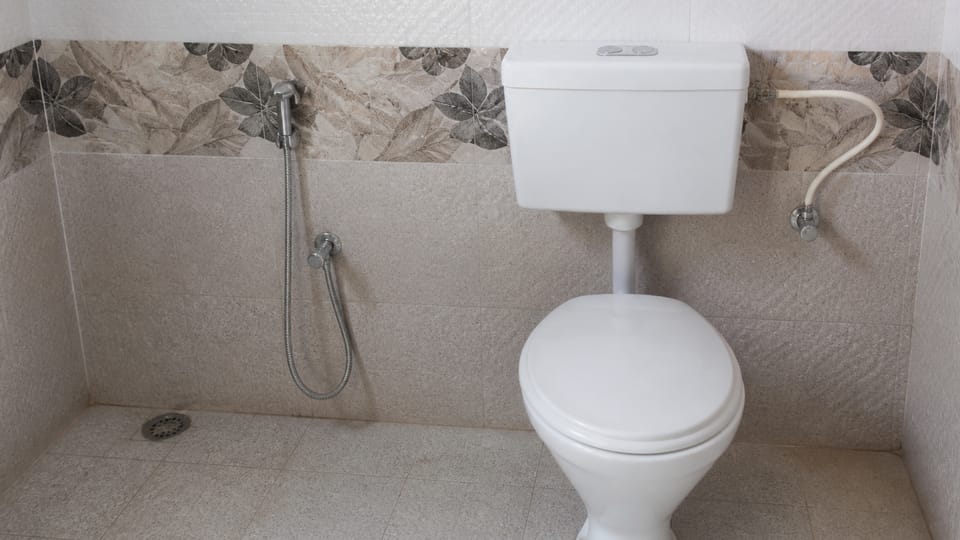
NBCS 2026 (Part E Section 1, clause 2.1.34) defines a flushing cistern as “a cistern provided with a device for rapidly discharging the contained water and used in connection with a sanitary appliance for the purpose of cleaning the appliance and carrying away its contents into a drain”, and notes that its nominal size is the quantity of water discharged per flush. IS 774:2021, clause 3.1, defines the cistern it covers as a flushing device “intended to operate at a height not exceeding 300 mm between the top of the pan and the underside of the cistern”. IS 774:2021 covers only ceramic (vitreous china) cisterns. Plastic cisterns are in IS 7231, and close-coupled cisterns, sitting on the back of the pan, are in IS 2556 (Part 8) (clause 1.2).
What does dual flush mean?
IS 774:2021 clause 3.3 defines a dual-flush cistern as “a construction that enables the user to cause a reduced flush of partial discharge when only urine needs to be flushed away instead of the customary full flush”. Clause 1.1 covers manually operated dual-flushing cisterns of capacities 6/3 litres, 4.8/2.8 litres and 4/2 litres: the first figure is the full flush and the second the reduced flush. The Foreword says earlier editions included single-flush cisterns, which an amendment to the 2004 edition deleted to promote dual flush, and that the 2021 edition withdrew the 10/5 litre size and discontinued high-level cisterns. Clause 12 points to IS 17650 (Part 1) for water efficiency rating and labelling, its Table 4 sets star limits of 6.0/3.0, 4.8/2.8 and 4.0/2.0 litres per flush, the same three sizes. The standard does not say a dual flush cistern always saves water: that depends on use and on whether the seal leaks.
What is the difference between a cistern and a flush valve?
A cistern is a tank that fills slowly and discharges a set volume. IS 9758:1981 describes flush valves as fittings “directly connected to pressure water pipes” that, when operated, “allow a limited quantity of water through in order to flush water closets and urinals and slowly close automatically”. So a flush valve has no tank and needs adequate pressure and pipe size. NBCS clause 4.9.4(d) says no service or supply pipe shall be connected directly to a water closet or urinal: all such supplies “shall be from flushing cisterns/flush valves which shall be supplied from storage tank”. IS 2065:1983 clause 12.4 says a flush valve may be fitted on premises supplied by the water Authority only with the Authority’s previous permission (text read, not page images). Which suits your house depends on your supply, and your plumber decides.
What parts does IS 774 name, and what can I see?
| Part | What the standard says |
|---|---|
| Float valve | Of 15 mm nominal size, to IS 1703, IS 12234 or IS 13049 (clause 5.5) |
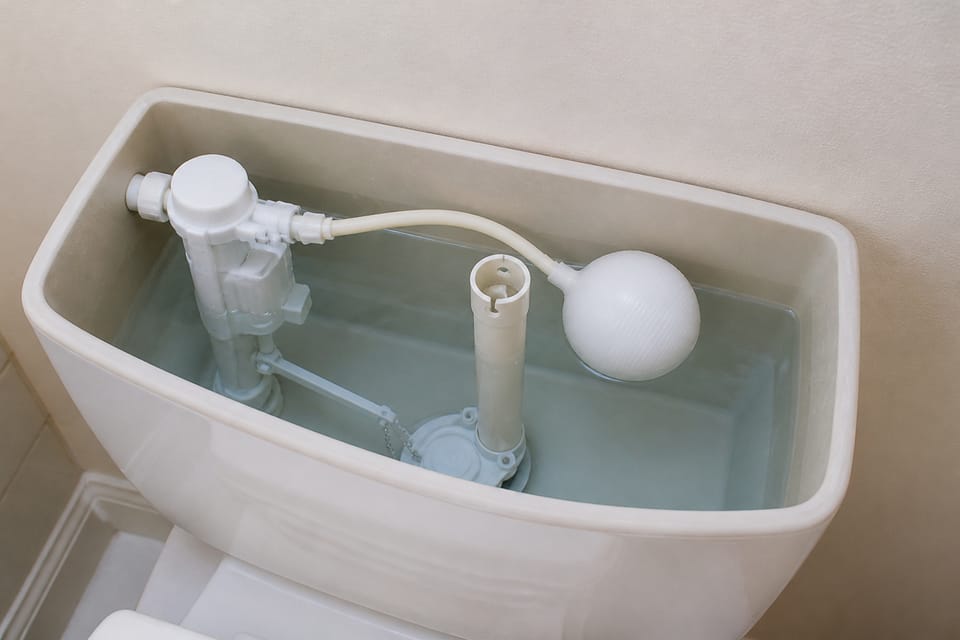
| Overflow pipe | Fitted, with a mosquito-proof device that can be cleaned; water must drain out through the overflow pipe “and not through the beta (outflow) valve”, and an overflow must not reach the soil pipe unnoticed (clause 5.7) |
| Working water level | Marked “legibly and permanently” on the inside of the cistern (clause 7.2) |
| Flushing (beta or outflow) valve | “Completely leak-proof” (clause 7.1) |
| Marking | Maker’s name or trade-mark, and the discharge capacity, marked on the cistern; the BIS Standard Mark “may” be added (clauses 13.1 and 13.4) |
The marked working level is the thing an owner can see inside the lid. IS 774 does not give causes of a cistern running on, repair steps, a service interval or a life figure. The endurance test in the standard is a factory type test, not a promise of life.
Why does a cistern keep running? (practice)
The standards do not say, so this is practice, apart from the clauses named. Open the lid (or the service panel of a concealed cistern) and look.
- Water level: is it above the marked line, or at the top of the overflow? A float valve that does not shut off lets water run to the overflow.
- Flush seal: if water trickles into the bowl while nobody flushes, the seal on the outflow valve may not be sealing. A few drops of food colour in the cistern, left for some minutes, that show in the bowl without a flush point to a leak at the seal.
- Inlet: if the cistern keeps refilling, the float valve or a stuck button may be the cause.
- Call a plumber if the checks do not find it, and do not seal a leak with silicone. For the feed to the cistern, an angle valve lets the plumber isolate it. See plumbing work during house construction: stages and inspection points.
What should I decide and ask? (practice)
- Concealed or exposed cistern: a concealed one needs an access panel to reach the mechanism; ask where it is and who gives the spares.
- Ask the vendor: the marked discharge capacity; the IS marking; whether spare parts for the mechanism are available; and that the mechanism and cistern come from one maker.
- Supply: the pressure and pipe size, if you are choosing a flush valve; and an angle valve to isolate the cistern.
- Overflow: where it discharges; keep it clear.
What mistakes should I avoid? (practice)
- A concealed cistern with no access panel.
- No angle valve to isolate the cistern.
- A blocked or unconnected overflow.
- A concealed frame fixed to a weak wall.
- Ignoring a cistern that runs all the time.
- Mixing mechanisms and cisterns from different makers.
- A flush valve on a supply with too little pressure.
Frequently asked questions
What are the dual flush sizes?
IS 774:2021 covers 6/3, 4.8/2.8 and 4/2 litres, full flush first and reduced flush second.
Why does my cistern keep running?
The standards do not give causes. Check the water level against the marked line, the overflow and the flush seal, then call a plumber.
Cistern or flush valve?
A cistern is tank-fed; a flush valve connects to pressure water pipes and needs adequate pressure. NBCS asks that both be supplied from a storage tank.
Is the BIS mark compulsory on a cistern?
IS 774 says the cistern may be marked with the Standard Mark. We found no statement that it is compulsory.
Does a dual flush cistern save water?
Not by itself: a leaking seal can waste more than the reduced flush saves.
Related guides
- Water tank size for a house: litres per person and tank capacity
- Plumbing work during house construction: stages and inspection points
- House drainage system explained: soil, waste and rainwater pipes
- Float valve not closing: why the tank overflows and how to fix it
This guide is general information. Read the disclaimer. Your plumber decides the flushing arrangement for your house.
Sources
- IS 774:2021, Ceramic (Vitreous China) Flushing Cisterns for Water Closets and Urinals, Specification (sixth revision): clauses 1.1, 1.2, 3.1, 3.3, 5.5, 5.7, 7.1, 7.2, 12, 13.1 and 13.4, and the Foreword (page images read). BIS lists it as in force, valid to 2026-12-30.
- IS 9758:1981, Flush Valves and Fittings for Water Closets and Urinals, Specification: clauses 1.1 and 2.1 (text read, not page images). BIS lists it as in force, valid to 2027-10-31.
- SP 7:2026, National Building Construction Standards (NBCS) 2026, Part E Section 1, Water Supply: clauses 2.1.34 and 4.9.4(d) (page images read). From an unofficial archive.org copy.
- IS 17650 (Part 1):2021, Water Efficient Plumbing Products, Requirements, Part 1: clause 8.1.1.1 and Table 4 (table page image read). BIS lists it as in force.
- IS 2065:1983, Code of Practice for Water Supply in Buildings (second revision): clause 12.4 (text read). BIS lists it as in force, valid to 2027-02-28.
Change log
- : Added Related guides link to newly published article(s): float-valve-not-closing-why-the-tank-overflows-and-how-to-adjust-or-replace-it. No other text changed. Approved by the reviewing engineer.
General information only. It is not a structural design or professional advice. Ask a licensed structural engineer or architect to check your plans and site.