
Short answer
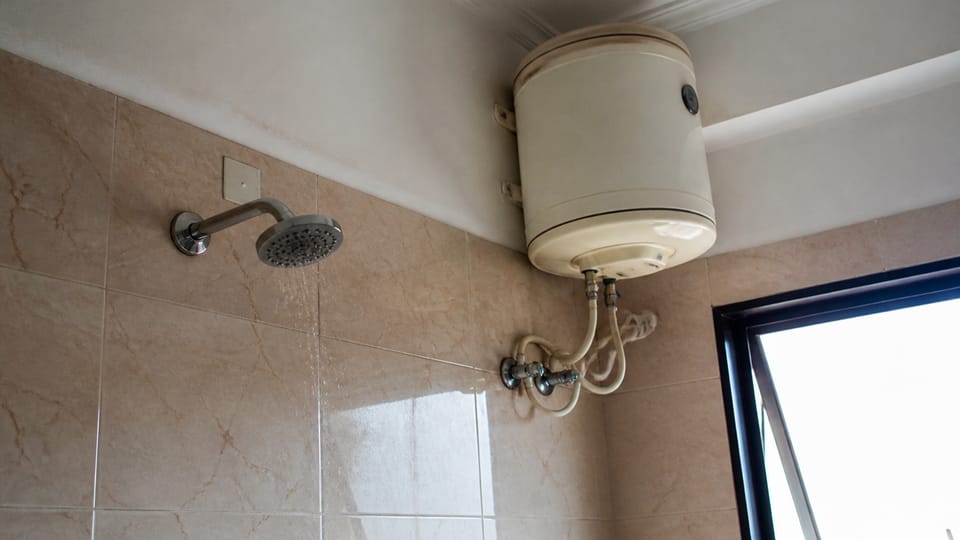
Why is the water pressure low in my upper-floor shower, and does a pump fix it? In practice, low pressure at an upper floor is usually a low tank, choked or narrow pipes, closed valves or an air lock, and a pump cannot create water. IS 2065 and NBCS say a pump is fed from a storage tank and not boosted directly from the service pipe, unless the water supplier permits it in writing.
On this page (10)
- What pressure do the codes ask for?
- What lowers the pressure at an upper floor?
- What do the codes say about pumps?
- How do I find the cause before buying a pump? (practice)
- What are the fixes, by cause? (practice)
- What mistakes should I avoid? (practice)
- What should I ask the plumber? (practice)
- Frequently asked questions
- Related guides
- Sources
A shower that dribbles on the top floor while the ground floor tap runs well is one of the commonest complaints in a new house, and the usual answer, “buy a pressure pump”, is sometimes right and often wasteful. This page explains what the codes say about the pressure a house tap should have, what lowers it, what a pump can and cannot do, and a way to find the cause first. It gives no pump rating, pipe size or flow figure, because the codes give none for a house. For the tank itself, see water tank size for a house: litres per person and tank capacity.
What pressure do the codes ask for?
IS 2065:1983, clause 5.1.1: “There shall be at least a residual head of 0.018 N/mm2 at the consumer tap.” Its note says the residual head “shall be taken at the highest/farthest outlet in the building”. NBCS 2026 (Part E Section 1, clause 3.1.2) repeats it, as “0.018 N/mm2 (0.18 bar)”, and adds that “there may be certain fixtures or appliances in the installation that may require a higher pressure” and that the system then “shall be designed using pumps, tanks or both to achieve the required minimum pressure”. NBCS 4.7.5 says to maintain the pressure a special fixture needs “as per the technical data sheet”, and sets a maximum pressure for the distribution system, with pressure reducing valves to be installed where it is exceeded and the system may not withstand it.
This is a design minimum at a tap, not a promise that a shower will feel strong. The codes give no shower pressure, no minimum shower flow and no pump rating for a house; NBCS 4.7.3.3 gives only a maximum flow for a shower head, as a water-saving limit. Check the maker’s data sheet for the shower, mixer and geyser.
What lowers the pressure at an upper floor?
- Little height above the fixture. NBCS 4.4.8 asks that the bottom of an overhead tank be clear of the terrace slab “such that the elevation difference between the outlet pipe of the tank and the highest fixture at the top floor of the building is minimum 2 m”. In practice, a tank flat on the roof gives the top floor little head.
- Friction. For sizing the communication and service pipe, IS 2065 5.3.1 lists the head lost by friction and the losses in fittings, “such as bends, stop-taps, meters and any obstructions to the flow of water”; the same kinds of loss apply inside a house (practice). NBCS 4.12.8 and 4.12.9 ask for smooth piping and gradual rather than abrupt changes of diameter and direction, and IS 2065 8.1.8, which is a noise clause, also says high velocity in pipes and fittings shall be avoided. Stop valves on branch pipes in large buildings “may be of the gate type to minimize loss of head by friction” (clause 8.1.4); where the service pipe is small, clause 8.1.3 asks for screw-down stop valves.
- Air locks. IS 2065 8.1.7 asks that service pipes be designed to avoid them, with draining taps at the lowest points from which the piping rises continuously to the draw-off points. NBCS 4.9.3(f) says the same of consumer pipes, and 4.14.11.3 says care is taken to prevent air locks in the pipe feeding a water heater. The codes do not say how to clear one.
- Unequal hot and cold pressure. NBCS 4.14.12.2.4 says that at a mixing fitting, such as a shower, “the pressure in the cold and hot water systems shall be equal”, for example by feeding both from tanks at the same static height, and otherwise supplying hot and cold by separate taps. A pressure-type storage heater is fed from a cold water storage tank and not directly from the main, unless it is a cistern-type or non-pressure heater (4.14.10.1).
- A weak supply. NBCS 4.8.2 says direct supply from the mains is adopted when adequate pressure is available, and with limited city main pressure, water is normally not available above two or three floors, so gravity supply from an overhead tank is the common way.
What do the codes say about pumps?
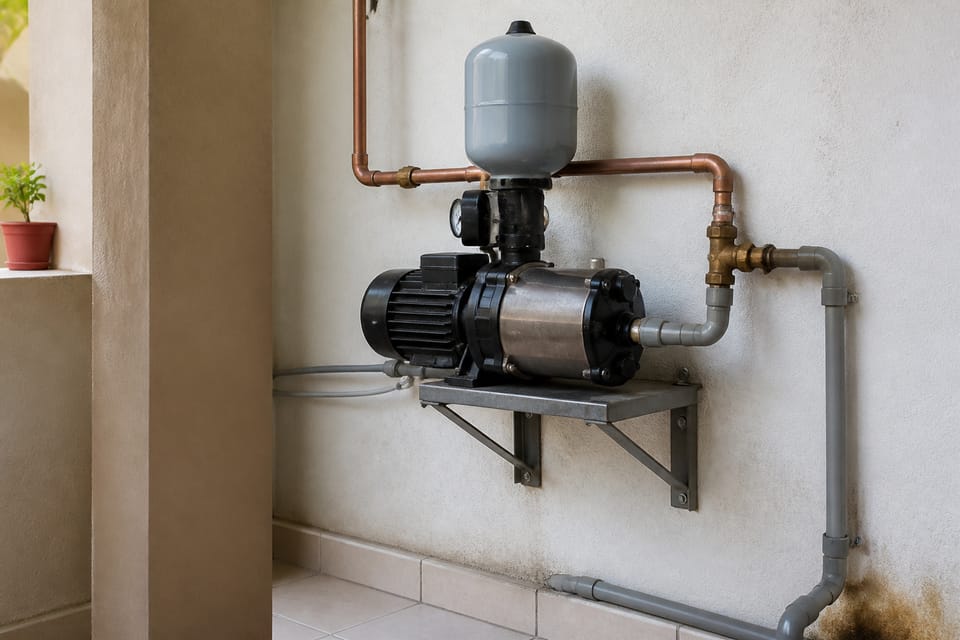
IS 2065 clause 11.12.1: “In case of multi-storey buildings where the height of the fitting or storage tank is such as will not permit of their being fed with the available pressures in the water main, pumping is necessary.” The pumps are usually centrifugal and driven by electric motors. The rule on where the pump draws from is firm:
- IS 2065 8.1.6: “Pumps shall not be allowed on the service pipe as they cause a drop of pressure on the suction side thereby affecting the supply to the adjoining properties”, so where pumping is required, a properly protected storage tank is provided to feed the pump.
- NBCS 4.9.3(e): “No direct boosting (by booster pumps) shall be allowed from the service pipes.” Clause 4.11.4 allows a pump on a supply pipe only with the water supplier’s prior written permission.
- NBCS 4.8.5: a combined system serves a few upper floors with a booster pumping system on a dedicated outlet from the overhead tank, for multi-storey buildings; NBCS 4.8.4 describes a hydro-pneumatic system with a diaphragm vessel and a low level cut-off “to prevent dry run of the pumps”.
The pump standards (IS 8472, IS 9079, IS 8034) were not read for this page, and no code gives a pump size for a house.
How do I find the cause before buying a pump? (practice)
This is practice, apart from the clauses named.
- One fixture or all? Only the shower points to the shower head, aerator or mixer. All fixtures on the floor point to the tank, pipe or supply.
- Upper floor only, or every floor? The top floor only points to tank height and friction.
- All hours or only peak? Only at peak points to the supply or the tank level.
- Hot side only? Check the geyser inlet valve and any scale in the heater pipes.
- Check the easy things: clean or descale the shower head and aerators, clean the tank outlet strainer, open every stop valve fully, and check the tank level.
- Look for leaks: a wet wall, or a meter that moves with all taps closed.
- Listen for air: gurgling or spitting on opening a tap suggests an air lock.
What are the fixes, by cause? (practice)
| Cause | Fix |
|---|---|
| Scale in shower head or aerator | Clean or descale |
| Partly closed valve or choked strainer | Open or clean |
| Narrow or choked pipe sections, sharp bends | The plumber replaces them |
| Tank too low for the top floor | The engineer checks raising the tank, because it is a load on the structure |
| Tank is high enough but the pipe or friction is the limit | A booster pump with protection, fed from the tank, fitted by the plumber and electrician |
| Unequal hot and cold pressure at a mixer | Feed both from the same tank level, or use separate taps |
A pump needs water in the tank and cannot cure a choked pipe. It also needs dry-run protection and a plan for noise and servicing. See plumbing work during house construction: stages and inspection points for the pressure test, and CPVC vs UPVC pipes: which one to use for home plumbing for pipe pressure ratings.
What mistakes should I avoid? (practice)
- Buying a pump before diagnosing the cause.
- Drawing the pump from the service pipe shared with neighbours.
- A pump on a tank or sump without dry-run protection or priming care.
- Narrow pipes or many bends after the pump.
- Ignoring a leak.
- Mismatched hot and cold pressure at the mixer.
- Cleaning only the shower head and missing the tank outlet strainer.
What should I ask the plumber? (practice)
- What is the head at this fixture, and what do the pipe sizes and bends do to it?
- Where will the pump draw from, and what dry-run and non-return protection is fitted?
- Does the mixer or geyser need balanced pressure?
- Who services the pump, and where is it fitted?
Frequently asked questions
Do I need a pressure pump for my bathroom?
In practice, only after you find the cause. IS 2065 says pumping is necessary where the tank or fitting height does not allow feeding at the available pressure, and the pump is fed from a tank, not directly from the service pipe.
Can I connect a pump straight to the water line?
IS 2065 8.1.6 says pumps shall not be allowed on the service pipe, and NBCS 4.9.3(e) says no direct boosting from service pipes.
How high should the tank be above the top-floor shower?
NBCS 4.4.8 asks for a minimum elevation difference of 2 m between the tank outlet pipe and the highest fixture at the top floor. It gives no value for a shower to work well.
What is the minimum water pressure?
IS 2065 asks for a residual head of 0.018 N/mm2 at the consumer tap, at the highest or farthest outlet. Some fixtures need more; see the maker’s data sheet.
Does an air lock cause low pressure?
The codes ask for pipes designed to avoid air locks. They do not say how to clear one.
Related guides
- Water tank size for a house: litres per person and tank capacity
- Plumbing work during house construction: stages and inspection points
- CPVC vs UPVC pipes: which one to use for home plumbing
- Air lock in water pipes: why a tap splutters and how it is cleared
- Overhead tank vs pressure pump system: gravity and hydro-pneumatic
This guide is general information. Read the disclaimer. Your plumber and engineer decide the water supply for your house.
Sources
- IS 2065:1983, Code of Practice for Water Supply in Buildings (second revision): clauses 5.1.1, 5.3.1, 8.1.3, 8.1.4, 8.1.6, 8.1.7, 8.1.8 and 11.12.1 (page images read). BIS lists it as in force, valid to 2027-02-28.
- SP 7:2026, National Building Construction Standards (NBCS) 2026, Part E Section 1, Water Supply: clauses 3.1.2, 4.4.6, 4.4.8, 4.7.5, 4.8.2, 4.8.4, 4.8.5, 4.9.3, 4.11.4, 4.12.8, 4.12.9, 4.14.10.1, 4.14.11.3 and 4.14.12.2.4 (page images read; 4.12.8 and 4.12.9 text only). From an unofficial archive.org copy.
Change log
- : Added Related guides link to newly published article(s): overhead-tank-vs-pressure-pump-system-gravity-and-hydro-pneumatic-supply. No other text changed. Approved by the reviewing engineer.
- : Added Related guides link to newly published article(s): air-lock-in-water-pipes-why-a-tap-splutters-and-how-it-is-cleared. No other text changed. Approved by the reviewing engineer (owner report, 2026-10-31).
General information only. It is not a structural design or professional advice. Ask a licensed structural engineer or architect to check your plans and site.