
Short answer
What do 4-way, 8-way, SPN and TPN mean on an MCB box? IS 13032 calls the box an MCB board and names it by its number of outgoing ways, a way being an MCB connected to one or more circuits. Its types are single pole and neutral (SPN), triple pole (TP) and triple pole and neutral (TPN). A way count is the number of circuit slots, not load capacity, and no code gives a way count per house size.
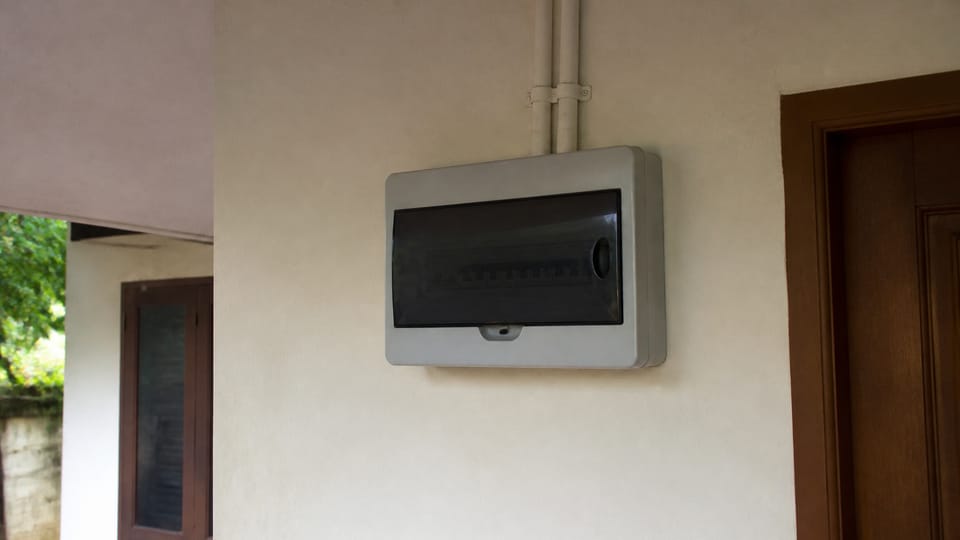
On this page (10)
- What is the box called, and what does the standard say?
- What do “way”, SPN, TP and TPN mean?
- What do the codes ask of the box in a house?
- Can I cover or hide the box?
- What do the standards not say?
- What should I ask the electrician? (practice)
- What mistakes should I avoid? (practice, except where a clause is named)
- Frequently asked questions
- Related guides
- Sources
A house has one box where the supply comes in and splits into separate circuits, each with its own breaker. Shops call it an MCB box, the codes call it a distribution board, and the vendor’s catalogue says “4-way SPN” or “8-way TPN”. This page explains those words from the standards, what the codes ask of the box, and what to ask your electrician. It gives no breaker rating, wire size, price, brand or “ways per house size”, because no code we read gives one. For what each breaker type protects against, see MCB vs RCCB vs RCBO: what each protects against at home.
What is the box called, and what does the standard say?
IS 13032:1991 calls it an MCB board: “an enclosure containing busbars and miniature circuit-breakers for the purposes of protecting, controlling or connecting more than one outgoing circuit fed from one or more incoming circuits”. It adds that these are also known as MCB distribution boards (MCBDB). NBCS 2026 (clause 2.1.93) defines an enclosed distribution board in much the same words. IS 732:2019 (clause 3.44) uses “consumer unit” for a type-tested distribution board used principally in homes. IS 13032 is a 1991 standard for the factory-built board; BIS still lists it, but its valid-to date has passed and the standards it cites are withdrawn.
What do “way”, SPN, TP and TPN mean?
| Term | What the standard says |
|---|---|
| Way | “The part of the MCB board comprising a miniature circuit-breaker connected to one or more circuits”; the board “is designated by the number of outgoing ways” (IS 13032 clause 3.2) |
| SPN | Single pole and neutral, one of the three board types (clause 5.1) |
| TP | Triple pole, the second type (clause 5.1) |
| TPN | Triple pole and neutral, the third type (clause 5.1) |
| Neutral | A busbar with terminals, and links if required, for the neutral conductors (clause 3.5) |
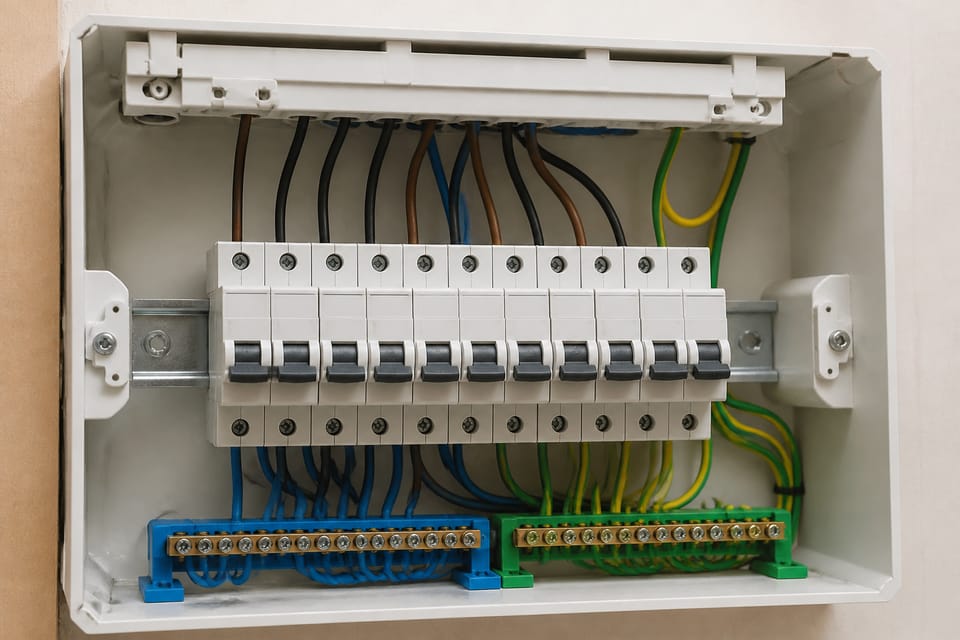
So “4-way” and “8-way” count the outgoing circuit slots. The preferred sizes in clause 5.2 are 4, 6, 8, 12 and 16 outgoing circuits per pole, and the standard notes that these include any provision for the incomer. Clause 3.2 notes that the neutral may or may not form part of a way. Beyond spelling out the letters, the standard does not explain SPN and TPN or say which supply each is for, and it has no definition of single phase or three phase. The usual reading, which is practice not a clause, is SPN for a single-phase supply and TPN for a three-phase supply; your electrician and the supply from the utility decide. Clause 5.1 also lists plain TP, triple pole with no neutral in the name. The foreword restricts a board to MCBs of one pole configuration, all single pole or all triple pole, and clause 3.1 note 2 treats mixed boards as outside the standard.
What do the codes ask of the box in a house?
- A spare circuit: NBCS clause 5.4.4.1 says “at least one spare circuit of the same capacity shall be provided on each branch distribution board”, and clause 5.4.5(f) asks that the load be divided as evenly as possible between the ways, “leaving spare circuits for future extension”. No count is given.
- RCCB at the incomer: clause 5.4.4.1 asks for branch MCB distribution boards to be provided along with an earth leakage protective device (RCCB or RCD) in the incoming circuit, and for the circuits to be separated and individually protected so that only the faulty circuit is disconnected.
- Location: as near as possible to the centre of the load, and “accessible for replacement/reset of protective devices” (clause 5.4.5(a) and (b)). A main switchboard is placed “only in dry situations and in ventilated rooms” and not above a gas stove or sink, or in a bathroom, lavatory, toilet or kitchen (clause 5.4.2.2(c) and (e)); the main switch is “easily accessible” and near the service line (clause 5.4.1.2).
- Identification: IS 13032 clause 7.7 asks for provision to identify the ways and the circuits they serve; NBCS clause 5.4.5(e) asks for a circuit list showing the diagram of each circuit and its rating; IS 732 clause 5.1.4.5.1 allows a schedule for simple installations.
- Neutral and earth: NBCS clause 8.2.3 asks for an earth bar and a removable link between the neutral bar and the earth bar, installed by a licensed electrician. See earthing for a house: what it is, earth vs neutral, and why it matters.
Can I cover or hide the box?
The codes we read say nothing about decorative covers. They do say what the cover is for. IS 13032 clause 7.4.4 asks that where breakers are operated with the cover on, the cover needs tools to open; where they are reached only by opening the cover, it must be quickly openable without tools and the live parts shrouded. Clause 7.4.5 asks that a metal enclosure prevent accidental contact with live parts. NBCS 5.4.5(b) asks that the box stay accessible. NBCS 5.4.2.2(b) allows a main switchboard to be in a room or fire-safe cupboard, or to have a lock and key in small residential installations, and clause 5.4.2.2(a) asks for easy access for firemen and other personnel; NBCS 5.4.2.1 (a note, text only) says woodwork shall not be used for mounting switchboards. From those, the practice rule (not a clause) is: do not seal or block the box or leave it behind furniture or curtains, keep the labels visible, and if it is locked, make sure someone holds the key and can open it quickly.
What do the standards not say?
- How many ways a house or flat needs. IS 13032 lists preferred sizes only.
- Which is better, metal or plastic. NBCS 5.4.5(c) names metal-clad or polycarbonate enclosures with protection degrees we do not print.
- Which boards suit a home with an RCCB at the incomer: IS 13032 says such boards are outside its scope (clause 3.1, note 1). The assembly standard BIS now lists for these boards, IS/IEC 61439 (Part 3):2024, was not read.
- Brands or prices.
What should I ask the electrician? (practice)
This is practice, apart from the clauses named.
- Is the supply single phase or three phase, and which board type follows?
- How many circuits are there and why, and how many spare ways does the board have?
- Where will it be fixed, and can you reach it without moving furniture?
- Are the circuits labelled, and will I get a circuit list or drawing?
- Where is the main switch, and is the earth wire connected to the earth bar?
What mistakes should I avoid? (practice, except where a clause is named)
- A board with no spare way (NBCS 5.4.4.1 asks for one).
- Putting it in a bathroom or kitchen, or above a sink or stove (NBCS 5.4.2.2(e) for a main switchboard).
- Hiding it behind furniture or a curtain, or locking it with no one holding a key.
- Unlabelled circuits, or labels that no longer match after changes.
- Open holes or missing blanks where the cover has gaps.
- Choosing a board by the number of ways alone.
- Opening the box yourself: visible checks only (cover on, labels readable, dry, no burning smell, no warm cover).
Frequently asked questions
What is the difference between SPN and TPN?
IS 13032 lists SPN, TP and TPN as the board types. In practice SPN suits a single-phase supply and TPN a three-phase supply; the electrician and the supply decide.
Does more ways mean more load capacity?
No. A way is a circuit slot, not a capacity rating.
How many spare ways should I keep?
NBCS asks for at least one spare circuit on each branch board and spare circuits for future extension. It gives no larger number.
Where should the box go?
NBCS asks for a distribution board near the centre of the load and reachable. For the main switchboard it asks for a dry, ventilated place, not in a bathroom, lavatory, toilet or kitchen.
Is a plastic or metal box better?
No code we read says. NBCS names both metal-clad and polycarbonate enclosures.
Related guides
- MCB vs RCCB vs RCBO: what each protects against at home
- Earthing for a house: what it is, earth vs neutral, and why it matters
- Electrical work in a house build: stages and inspection points
- kW vs kVA vs kWh: what each unit means on a meter, inverter and bill
This guide is general information. Read the disclaimer. Your licensed electrician decides the board for your house.
Sources
- IS 13032:1991, AC Miniature Circuit-Breaker Boards for Voltages Not Exceeding 1 000 V, Specification: Foreword and clauses 3.1 (with notes 1 and 2), 3.2, 3.5, 5.1, 5.2, 7.4.4, 7.4.5 and 7.7 (page images read). BIS still lists it, with a valid-to date of 2021-03-31 that has passed and no later edition. It cites withdrawn editions of IS 8623, IS 8828, IS 4237 and IS 2675.
- National Building Code of India, Second Revision (NBCS 2026, SP 7:2026), Part D Section 2 Electrical and Allied Installations: clauses 2.1.93, 5.4.1.2, 5.4.2.1 (note, text), 5.4.2.2, 5.4.4.1, 5.4.5 and 8.2.3 (page images read except 5.4.2.1).
- IS 732:2019, Code of Practice for Electrical Wiring Installations (fourth revision): clauses 3.44 and 5.1.4.5.1 (page images read). BIS lists it as in force, valid to 2029-12-31.
Change log
- : Added Related guides link to newly published article(s): kw-vs-kva-vs-kwh-what-each-unit-means-on-a-meter-an-inverter-and-a-bill. No other text changed. Approved by the reviewing engineer.
General information only. It is not a structural design or professional advice. Ask a licensed structural engineer or architect to check your plans and site.