
Short answer
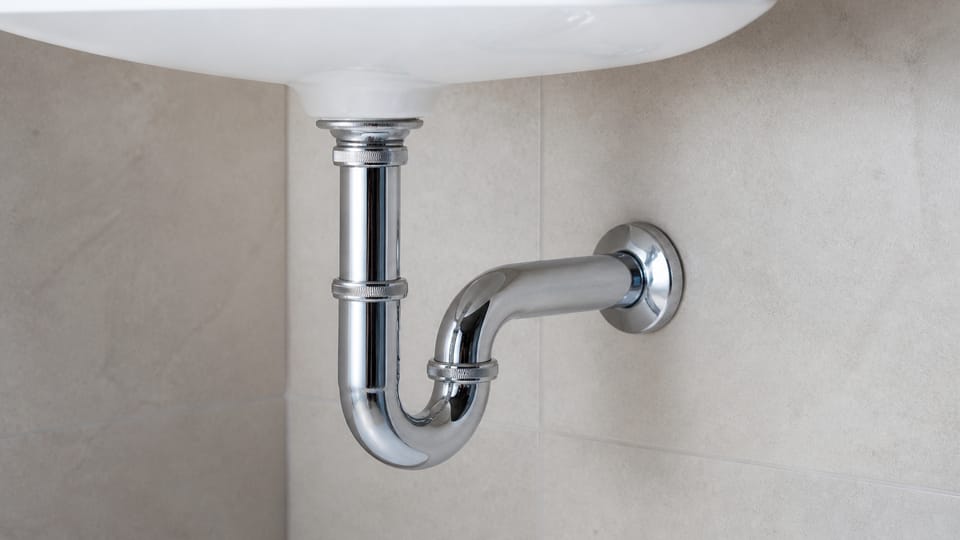
What is the difference between a P trap, an S trap and a bottle trap? All are traps that hold a water seal. In the NBCS drawings, a floor-mounted European WC is shown with an S-trap, an Orissa pan with a P trap, and basins and urinals with a P trap or bottle trap. In common use, a P trap outlet turns into the wall and an S trap outlet goes down into the floor. No standard ranks one as better: the position of the drain decides.
On this page (11)
“P trap or S trap?” is asked about the WC pan, and it is also a name for the bend in the pipe under a basin. Add the floor trap, the bottle trap and the gully trap, and a plumber’s list of traps can sound like one word with five meanings. This page separates them, says where the Indian codes show each, and says what no code decides: which of the S and P is better. It gives no WC outlet setting-out dimension, no brand and no price. The gully trap, the nahani (floor) trap and the kitchen trap each have their own page: see gully trap: what it is, where it goes and why a house needs one, bathroom drain smell from the nahani trap: causes and fixes and kitchen sink drain plumbing: pipe, trap and grease.
What is a trap?
NBCS 2026 definition 2.98 says a trap is “a fittings or device so designed and constructed as to provide, when properly vented, a liquid seal which will prevent the back passage of air without materially affecting the flow of sewage or waste water through it” (IS 5329 clause 2.23 is similar). The water seal (2.106) is “the water in a trap, which acts as a barrier to the passage of air through the trap”. NBCS 3.1.8 says every fixture directly connected to the drainage system shall have a liquid seal trap, maintained “to prevent sewer gas, other potentially dangerous or noxious fumes, or vermin from entering the building”. NBCS 4.5.3.6.1.1 says a trap may be formed as an integral trap with the appliance during manufacture, or be a separate fitting called an attached trap.
Which trap is which?
| Name | What it is | What the codes say |
|---|---|---|
| P trap | In common use, a bend whose outlet turns horizontally, into the wall | Named in NBCS: waste from every bath, wash basin or sink is “trapped immediately beneath … by an efficient siphon trap – P trap with adequate means for inspection and cleaning” (4.5.3.3). IS 5329 6.7.1 says “an efficient siphon trap” without the words “P trap”, though its Table 3 does use “P-trap” |
| S trap | In common use, a bend whose outlet drops down into the floor | Named in NBCS definition 2.42 (a list of fittings, “P or S trap (with or without vent)”) and in the Annex D drawing of a floor-mounted European WC “with flush tank and S-trap” (Fig. 24). Not defined |
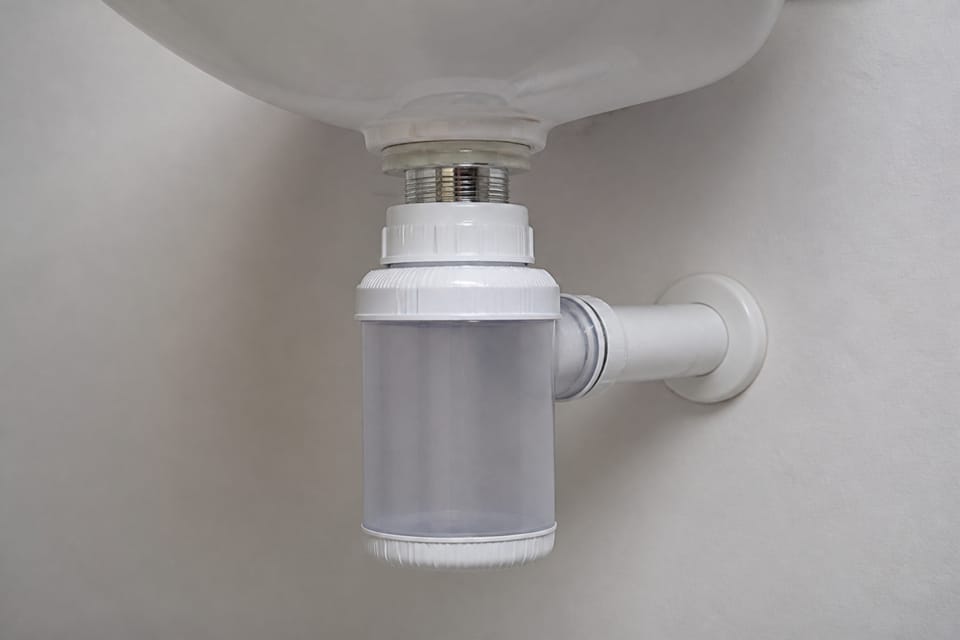
| Bottle trap | A wide body with a removable cap under a basin, sink or urinal | Named in NBCS only in the Annex D drawings, where basins and urinals are labelled “P trap / bottle trap” as one label, and in the drawing legend. IS 5329 does not name it |
| Floor trap | A trap in the floor drain of a wet area | NBCS 4.5.3.6.2.1: floor drains “shall connect into a trap so constructed that it can be readily cleaned”, accessible from the floor drain or by a separate cleanout. NBCS 4.2.4.1 asks a dwelling for one bathroom with a tap and a floor trap |
| Gully trap | A trap outside the building, taking waste and rainwater | IS 1742 2.20: a trap “with a water seal” to collect wastewater from the scullery, kitchen sink, wash basins, baths and rainwater pipes |
| Q trap | Not a term of any standard | It does not appear in NBCS 2026, IS 5329 or IS 2556 Part 1. Ask your plumber to name the fitting |
“Nahani trap” is a common name, and no standard we read defines it. NBCS and the gully trap page treat the fitting in the floor of a wet area as the floor trap, and a trap under a basin is a bottle trap or a P-shaped trap, not a nahani.
Where does each trap go?
The NBCS Annex D drawings of typical mounting arrangements show most of it:
- Wash basin: the waste under the basin is labelled “P TRAP / BOTTLE TRAP” (Fig. 20), and the waste pipe runs to a floor trap at floor level.
- Sink: a P trap under the sink (Fig. 23).
- Urinal: “BOTTLE TRAP / P TRAP” (Fig. 28).
- European WC, floor mounted: with S-trap (Fig. 24).
- Orissa pan (Indian WC): a P trap under the pan (Fig. 27).
- Bathroom or kitchen floor: a floor trap, which the drawings also label at floor level (Figs. 20, 23 and 28).
Outside the Annex D drawings, the gully trap goes in the yard outside the wall in a two-pipe layout, and a one-pipe layout has no gully (IS 5329 2.20; the gully trap page).
The standards do not say “use an S trap when the outlet goes to the floor and a P trap when it goes to the wall”. That rule is practice, and it follows from the drawing: the pan’s outlet has to meet the soil pipe where it actually is. The WC clause 4.1.1.1 describes the closet as a bowl to receive excretory matter, a trap and a flushing apparatus, and NBCS 4.5.3.6.1.1 allows the trap to be integral or attached.
Is an S trap or a P trap better?
No standard we read says so. The word “better” does not appear in the trap clauses. NBCS 2.98 says a trap provides a seal “when properly vented”, and NBCS 4.5.3.6.1 says all traps “shall be protected against siphonage and back pressure ensuring access to atmospheric air for air circulation and preserving the trap seal in all conditions”. So the question that matters is the position of the drain and the venting, not the letter. In practice, the pan’s outlet type is fixed by the planned drain position, and buying a pan before the drain is decided is a common mistake. In practice, changing a pan to the other outlet type usually needs an adaptor, which adds a joint.
What do the codes say about the water seal and venting?
IS 5329:1983, Table 2 (clause 6.5.4), gives the depth of seals for the plumbing system in use. We read it on the page image: for water closets and floor traps the seal is 50 mm in the two-pipe, one-pipe and single stack systems, and for other fixtures it is 40 mm, except 75 mm in a single stack system where the branch waste pipe is less than 75 mm. NBCS 4.5.2.4.2(f) repeats the single stack column. These values depend on the plumbing system, so do not apply one to every house. We found no seal depth in any standard for a bottle trap, a gully trap or an S-trap. A note under Table 2 says that when a fixture connects through a floor trap, no separate seals are required for individual fixtures.
Venting: NBCS 4.5.3.3 says a P trap “shall be ventilated into the external air whenever such ventilation is necessary to preserve the seal of the trap”. For single stack systems, IS 5329 Table 3 asks that a wash basin waste beyond a stated length be vented, or use a larger waste pipe or an approved resealing trap. A single stack system has no trap ventilation pipework (NBCS 2.73(a)). The mechanisms of seal loss are on the nahani trap page.
What else do the codes ask of every trap?
- Self-cleansing: “traps should always be of a self-cleansing pattern”, and one that is not part of the appliance should be attached directly to its outlet with a uniform, smooth pipe (NBCS 4.5.3.6.1.2; IS 5329 6.5.2).
- Accessible: “conveniently accessible and provided with cleansing eyes or other means of cleaning” (NBCS 4.5.3.6.1.4; IS 5329 6.5.3). A bottle trap boxed in or tiled over breaks this.
- Outlet size: the same as the largest waste inlet pipe (NBCS 4.5.3.6.1.3). The floor trap and basin outlet sizes differ between IS 5329 and NBCS 2026, so ask your plumber which applies and use none of them as a rough-in.
- No trap in a soil pipe: NBCS 4.5.3.2.2 and IS 5329 6.6.3 say there shall not be any trap in a soil pipe.
- Intercepting trap: only where the Authority requires it on the drain near the boundary (NBCS 4.4.2(g); IS 1742 4.2.2(g)).
What should I check?
This is practice, apart from the clauses named.
- The plumber’s list of traps for each fixture, before the walls close.
- The pan’s outlet type matches the drain position, decided before the pan is bought.
- A vent drawn where the plumbing drawing shows one (NBCS 4.5.3.6.1).
- Each trap is accessible and not buried (4.5.3.6.1.4).
- A water seal is present in every trap and floor drain at handover: pour water and watch it hold, and keep seals filled in an unused bathroom.
- No second trap on the same line (see below).
What mistakes should I avoid?
These are practice unless a clause is named.
- Double trapping: two traps in series on one fixture line, for example a floor trap and a P trap on the same waste.
- A trap far from its fixture. The standard direction is to trap the waste immediately beneath the fixture (NBCS 4.5.3.3).
- Boxing in or tiling over a bottle trap or floor trap, which goes against the accessibility clause (4.5.3.6.1.4, our reading).
- Fitting a trap in a soil pipe (4.5.3.2.2).
- Buying the WC pan before the drain position is fixed.
- An unvented trap where the system needs a vent.
- Letting an unused bathroom dry out.
- Taking a rule such as “S traps are banned” from a foreign code as Indian law.
- Calling every trap a “nahani”.
Frequently asked questions
Is an S trap or a P trap better?
No standard we read ranks them. The outlet position of the drain and the venting decide.
What is a Q trap?
It is not a term in NBCS 2026, IS 5329 or IS 2556 Part 1. Ask the plumber which fitting is meant.
What is the difference between a P trap and a nahani trap?
A P trap is a shaped bend under a basin or sink (and in some drawings a pan). A nahani, or floor trap, sits in the floor drain of a wet area. No standard defines “nahani trap”.
What is the difference between a gully trap and a bottle trap?
A gully trap is outside the building and takes waste and rainwater, per IS 1742. A bottle trap is a removable-cap trap under a basin or urinal.
Does a trap need a vent?
The definition of a trap says it gives a seal “when properly vented”, and NBCS says P traps shall be ventilated where that is necessary to preserve the seal. A single stack system is designed without trap ventilation.
Related guides
- Gully trap: what it is, where it goes and why a house needs one
- Bathroom drain smell from the nahani trap: causes and fixes
- House drainage system explained: soil, waste and rainwater pipes
This guide is general information. Read the disclaimer. Your plumber and engineer decide the traps, the vents and the pan outlet for your house.
Sources
- SP 7:2026, National Building Construction Standards (NBCS) 2026, Part E Plumbing Services, Section 2 Drainage and Sanitation: definitions 2.98 and 2.106 and clauses 2.42, 3.1.8, 4.1.1.1, 4.2.4.1, 4.4.2(g), 4.5.2.4.2(f), 4.5.3.3 and 4.5.3.6.1 to 4.5.3.6.2.1, and Annex D Figures 20, 23, 24, 27 and 28 (page images read for 4.5.2.4.2(f) and the figures; text layer for the other clauses). From an unofficial archive.org copy.
- IS 5329:1983, Code of Practice for Sanitary Pipework Above Ground for Buildings: clauses 2.23, 2.24, 6.5.2 to 6.5.4 and Table 2 (page image read), 6.6.3, 6.7.1 and Table 3 (text layer and page images). BIS lists it as in force, valid to 2027-02-28. IS 1742:1983, Code of Practice for Building Drainage, clause 2.20 (text layer read).
General information only. It is not a structural design or professional advice. Ask a licensed structural engineer or architect to check your plans and site.