
Short answer
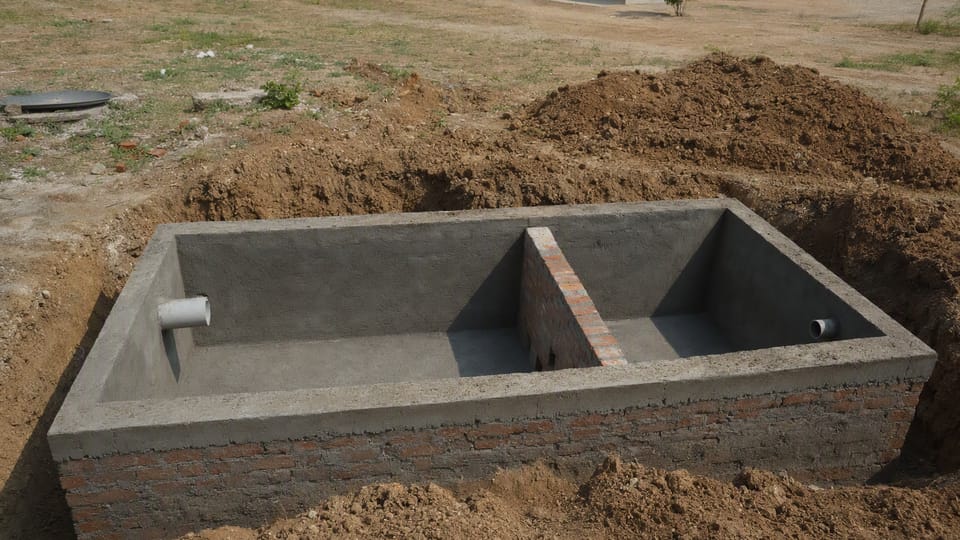
How is the size of a septic tank worked out? The size depends on how many people use the toilets and how often the tank will be cleaned. IS 2470 (Part 1) gives sizes for up to 20 users for toilet waste only. For 10 users cleaned every 2 years it gives 2.0 m by 0.9 m with 1.4 m of liquid depth, about 2,520 litres, plus 300 mm of free board. Your engineer confirms the final size.
On this page (13)
- How is a septic tank size worked out?
- What size septic tank do 10 users need?
- Which cleaning interval should I plan for?
- What rules apply to every septic tank?
- Can I use concrete rings for a septic tank?
- What should and should not go into the tank?
- Where should the septic tank be placed?
- How is a septic tank cleaned safely?
- What mistakes should I avoid?
- Frequently asked questions
- Related guides
- Work out your quantities
- Sources
Need quantities? Septic tank size calculator
Most people searching for a septic tank size want one number for their family. The Indian Standard gives a table, but the table only works if you know what it assumes. This page explains how the size is worked out, walks through a 10-user example, shows how to check a round (ring) tank, and covers where the tank goes and how it is cleaned safely. It gives no prices, no wall or slab thickness and no pipe details. Those come from your engineer and plumber.
How is a septic tank size worked out?
Two things decide it: how many people use the toilets, and how often the tank will be cleaned. The Indian code for septic tanks is IS 2470 (Part 1):1985. It is a code of practice, so it takes the form of recommendations, and it covers buildings with up to 300 users.
The standard builds the tank from three needs, in this order:
- Peak flow. How much water reaches the tank when several toilets are used at the same time.
- Settling. Enough floor area and depth for solids to settle out of that flow.
- Sludge. Space for the sludge to digest and to collect until the next cleaning.
A tank built this way holds the sewage for about 24 to 48 hours on an average day, the standard says. A tank cleaned less often has to be deeper, because it must store more sludge between cleanings.
For small installations, Table 5 of the standard turns all this into ready sizes for 5, 10, 15 and 20 users. Two notes under the table matter. The sizes assume that only toilet (WC) waste goes into the tank. And the standard says exact calculations shall be made when you choose a size. So the table is a starting point for your engineer, not a final design. The septic tank size calculator looks the table up for you.
What size septic tank do 10 users need?
Here is the calculator run for 10 users. Treat it as an example, not a design for your house.
| Item | Cleaned every 1 year | Cleaned every 2 years |
|---|---|---|
| Users (example assumption) | 10 | 10 |
| Waste going in (example assumption) | Toilet waste only | Toilet waste only |
| Inside length × width | 2.0 m × 0.9 m | 2.0 m × 0.9 m |
| Liquid depth | 1.0 m | 1.4 m |
| Free board above the liquid | 0.3 m | 0.3 m |
| Total inside depth | 1.3 m | 1.7 m |
| Liquid held | about 1,800 litres | about 2,520 litres |
| Two chambers? | Not above 2,000 litres, so one | Above 2,000 litres, so it may be split into two |
The liquid held is simply length × width × liquid depth. For the 2-year tank: 2.0 × 0.9 × 1.4 = 2.52 cubic metres, which is about 2,520 litres. Free board is the empty space above the water, and it is not counted in the liquid volume.
If your family is 7 people, the calculator rounds up to the 10-user row and never down. That is the calculator’s own careful choice, not a rule printed in the standard.
Which cleaning interval should I plan for?
The sources do not agree, so use the IS 2470 labels, which give the deeper tank for the same interval. If the tank will be cleaned only every 2 years, use the 2-year depth. Whatever you build, plan to clean it at least every 2 years unless your engineer says otherwise.
- IS 2470 labels the two depth columns of Table 5 as cleaning every 1 year and every 2 years. It says a small house tank may be cleaned at least once in 2 years, provided more people than it was designed for do not use it.
- The CPHEEO sewerage manual of the Ministry of Housing and Urban Affairs prints the same sizes but labels the columns 2 years and 3 years. It allows cleaning once in two to three years where yearly cleaning is not practical.
- The 2018 CPHEEO and MoHUA procedure for cleaning septic tanks says the interval should in no case be more than two years.
What rules apply to every septic tank?
IS 2470 (Part 1) sets a few minimums that no tank should go below:
- At least 1,000 litres of liquid, a width of at least 750 mm and a liquid depth of at least 1 m.
- A rectangular tank is 2 to 4 times as long as it is wide.
- At least 300 mm of free board above the liquid.
- A tank of more than 2,000 litres may be split into two chambers, with the first chamber twice the size of the second. The standard says “may”, not “must”.
- A vent pipe with a mosquito-proof mesh cage on top, high enough that the smell does not reach the house.
- An access opening for each chamber, with a cover sealed against water.
Precast tanks, for example of HDPE, can also be used if they are watertight and strong enough, the CPHEEO manual says.
Can I use concrete rings for a septic tank?
IS 2470 does not mention precast rings. It does allow circular tanks, with an inside diameter of at least 1.35 m and an operating (liquid) depth of at least 1.0 m. Check the inside diameter of any ring before you buy it.
To compare a round tank with the table, work out its liquid volume: 3.14 × radius × radius × liquid depth. Measure the radius inside the ring and the depth up to the outlet pipe only.
| Item | Value (example, not a design) |
|---|---|
| Inside diameter | 1.35 m (radius 0.675 m) |
| Liquid depth | 1.0 m |
| Liquid held | about 1,431 litres |
| 10 users, cleaned every year (table) | about 1,800 litres |
| Liquid depth needed at 1.35 m to hold 1,800 litres | about 1.26 m |
Matching the volume is not the whole check. The standard also sizes the floor area for settling, and a narrow, deep tank can fall short on area even when the volume matches. Ask your engineer to check a ring tank before it is built.
What should and should not go into the tank?
The tank is meant for toilet waste. IS 2470 says water from baths, kitchens and washing (called sullage) may go to a separate seepage pit or dispersion trench. If you want that water in the tank too, the Table 5 sizes no longer apply, and your engineer must size the tank for the extra flow.
Keep these out, the standard says:
- Rainwater and groundwater.
- A lot of detergent, grease or disinfectant, because they upset the bacteria that break the waste down. Pouring strong toilet cleaners, acid or phenyl in large amounts falls in this group. Naming those products is our practical reading, not the standard’s words.
The liquid that leaves the tank is only partly treated. It must never go into an open drain or a water body without further treatment. It goes to a soak pit, a dispersion trench or another secondary treatment.
Where should the septic tank be placed?
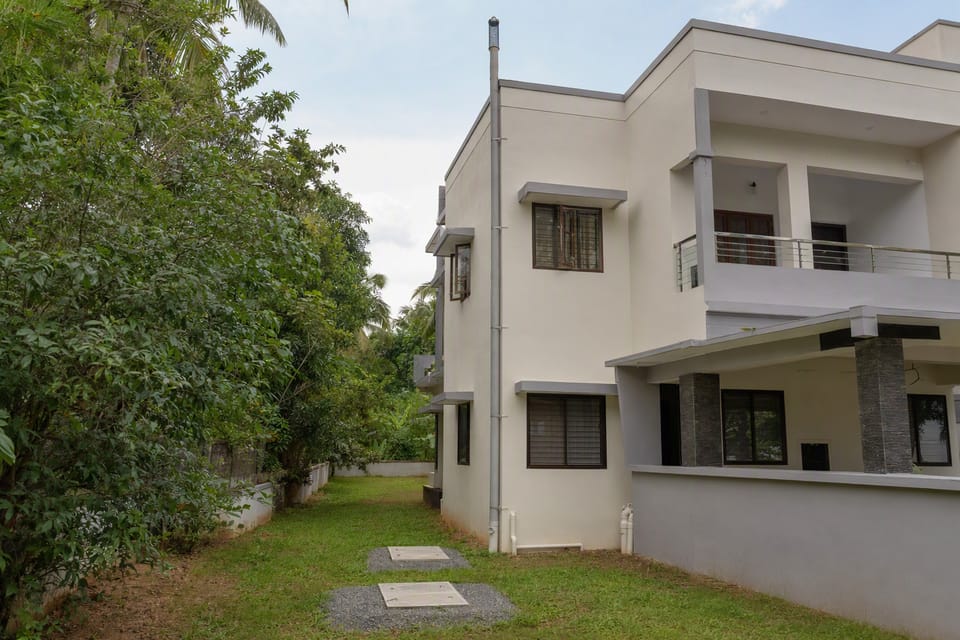
IS 2470 asks for a place that is open to the sky, as far from the building wall as you can manage, not on swampy or flood-prone ground, and easy to reach for cleaning. It gives no distance in metres between the tank itself and a well.
The distance figures you see online, such as 18 m from a well, are for the soak pit or dispersion trench that takes the tank’s outflow, not for the tank. IS 2470 (Part 2) and the CPHEEO manual give different figures for it, and IS 2470 (Part 2) says the actual distance depends on the soil. Follow your engineer and your local body’s rules.
How is a septic tank cleaned safely?
- Before first use, fill the tank with water up to the outlet level. The standard suggests seeding it with a little digested sludge, or digested cow dung if none is available.
- When to clean: normally when the sludge and the scum together fill more than half the tank’s depth. Cleaning too often is not good either, because it slows the digestion.
- Do not empty it completely. Leave at least 25 mm of sludge at the bottom. It restarts the bacteria.
- Use a machine, not people. The standard says manual handling of sludge should be avoided. In practice, that means a vacuum tanker from your local body or an authorised operator. Where groundwater is high, an empty tank can float, so the operator should check first.
- Never send anyone inside. This is our advice. Under the 2013 Manual Scavengers Act, no person may engage anyone for hazardous cleaning of a septic tank, which means manual cleaning without the protective gear and safety precautions the law requires. Breaking this can lead to imprisonment. The 2018 cleaning procedure warns of poisonous gases such as hydrogen sulphide.
- Do not spread the sludge on the ground around the house.
The owner of the property is responsible for looking after the septic tank and soak pit, says the 2020 MoHUA and CPHEEO advisory on sewage management.
What mistakes should I avoid?
These come from site practice and from what the standard warns against:
- Sizing the tank for toilet waste and then connecting the kitchen and bathrooms to it.
- Sizing for today’s family and then letting more people use it.
- Leaving out the vent pipe, or leaving its top open without mesh.
- Building the tank under a room or covered parking where a tanker hose cannot reach the cover.
- Using covers that let rainwater in.
- Building a sealed tank with no soak pit, or running the outflow into a drain.
- Using a ring narrower than 1.35 m inside.
- Trusting formulas online that are said to come from IS 2470. Check the clause yourself: the standard sizes the tank from Table 5 and clause 3.4, not from a single formula.
Frequently asked questions
What is the septic tank size for 10 users?
IS 2470 Table 5 gives 2.0 m long and 0.9 m wide inside. The liquid depth is 1.0 m if it is cleaned every year, or 1.4 m if cleaned every 2 years. Add 300 mm of free board. That holds about 1,800 or 2,520 litres. This is for toilet waste only.
What is the minimum size of a septic tank?
The standard’s minimum is 1,000 litres of liquid, 750 mm wide and 1 m of liquid depth, with 300 mm of free board on top.
Can kitchen and bathroom water go into the septic tank?
The table sizes assume toilet waste only. Bath and kitchen water can go to a separate soak pit or trench. If it goes into the tank, the tank must be sized for it by an engineer.
Does a septic tank need two chambers?
IS 2470 says a tank above 2,000 litres may be split into two, with the first chamber twice the second. It is allowed, not required by the standard. The 2020 MoHUA and CPHEEO advisory describes the standard design as having two chambers.
How often should a septic tank be cleaned?
IS 2470 says yearly cleaning is desirable, and allows a small house tank to be cleaned at least once in 2 years if it is not overloaded. The 2018 cleaning procedure says never more than two years apart. Clean it when sludge and scum fill half the depth.
What is the difference between a septic tank and a soak pit?
The septic tank settles and partly digests the waste. The soak pit or trench takes the liquid that leaves the tank and lets it soak into the ground. The soil decides the soak pit’s size, so this page does not size it. Our guide to soak pit vs septic tank explains when a soak pit works.
Related guides
- Stages of house construction in India: checklist and inspection points
- How to calculate house construction cost: the method, step by step
- Soak pit vs septic tank: what each does and when a soak pit works
- Water tank size for a house: litres per person and tank capacity
This guide is general information. Read the disclaimer. Your engineer decides the size, the materials and the location of the septic tank and soak pit for your house, following your local body’s rules.
Work out your quantities
- Septic tank size calculator: Look up the septic tank size for toilet waste from the number of users and the cleaning interval, using the dimensions in IS 2470 (Part 1).
Sources
- IS 2470 (Part 1):1985, Code of Practice for Installation of Septic Tanks, Part 1: Design Criteria and Construction (Second Revision; scan reaffirmed 2001). Clauses 0.4, 1.1, 3.1, 3.3.1, 3.4, 5, 6.2, 7.1 and Table 5.
- IS 2470 (Part 2):1985, Code of Practice for Installation of Septic Tanks, Part 2: Secondary Treatment and Disposal of Septic Tank Effluent (with Amendments 1 and 2). Clause 5.3.
- CPHEEO Manual on Sewerage and Sewage Treatment Systems, Part A, Chapter 9: On-site Sanitation (MoHUA; copy hosted by NIUA). Sections 9.3.4.1 to 9.3.4.4 and Table 9.7.
- CPHEEO and MoHUA, Standard Operating Procedure for Cleaning of Sewers and Septic Tanks, November 2018 (copy hosted by SuSanA). Sections 5 and 6.
- CPHEEO and MoHUA, Advisory on On-Site and Off-Site Sewage Management Practices, May 2020 (copy hosted by NIUA).
- The Prohibition of Employment as Manual Scavengers and their Rehabilitation Act, 2013 (Act 25 of 2013). Sections 2(1)(d), 7 and 9.
General information only. It is not a structural design or professional advice. Ask a licensed structural engineer or architect to check your plans and site.