
Short answer
What are the types of switches used in a house? IS 3854:2023 classifies switches by poles and connections: single-pole, double-pole, two-way and others, with rocker, push-button and other ways of operating, and flush or surface mounting. A two-way switch lets one light be controlled from two places. A bell-push is a momentary contact switch. IS 3854 has no definition of 'modular' or 'one-way'. A licensed electrician does the wiring.
On this page (10)
- What types of switch are there?
- How else does the standard sort switches?
- Which conductor does a switch go on?
- What is the rating of a switch?
- What should I plan before the walls close?
- What should I check on delivery and after fixing?
- What mistakes should I avoid?
- Frequently asked questions
- Related guides
- Sources
A switchboard looks simple, but the choices behind it are made before the walls close: which lights need control from two places, how many switch positions each board needs, and what rating each one has. This page explains the common types in words, what the Indian Standards say about them, and what to settle with the electrician at the planning stage. It has no wiring diagram and no terminal-by-terminal steps, on purpose: wiring a switch is the work of a licensed electrician, and a mistake can kill. For the stages of the electrical work, see electrical work in a house build: stages and inspection points.
What types of switch are there?
| Name people use | What it does | What the standard says |
|---|---|---|
| One-way switch | Turns one light or fan on and off from one place | IS 3854 does not use the words “one-way”. Its on/off switch is a “switch for alternatively closing and opening one or more electric circuits” (3.32), and its single-pole switch is pattern 1 |
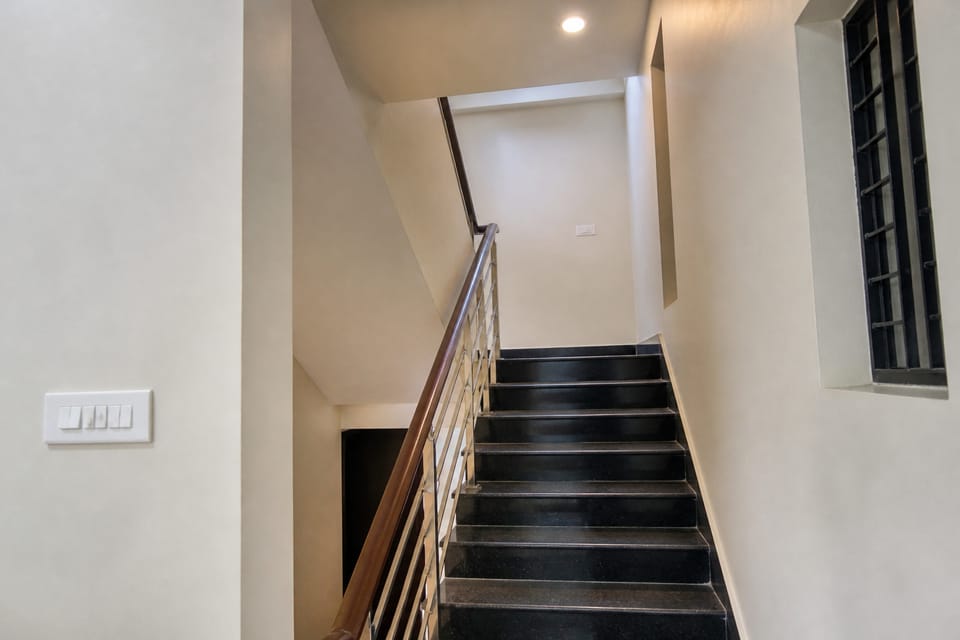
| Two-way switch, staircase switch | Two switches together control one light from two places, such as the top and bottom of a staircase | IS 3854 classifies “two-way switches” as pattern 6 (7.1.1) but does not define the term. NBCS 2026 7.4.1 says: “Where control at more than one point is necessary, either two way or intermediate switches may be provided as required” |
| Intermediate switch | Adds a third or further control place to a two-way pair | IS 3854 has no definition: “intermediate switch” appears once, in a table row label for the two-way reversing switch (pattern 7) |
| Bell-push | A button that works only while it is pressed and then springs back | The term “bell-push” is not in IS 3854. A momentary contact switch “returns its contacts automatically to the initial state after operation”, and the note says such switches are intended to operate bells and similar devices (3.17). A push-button switch has a single actuator with stored energy return (3.16) |
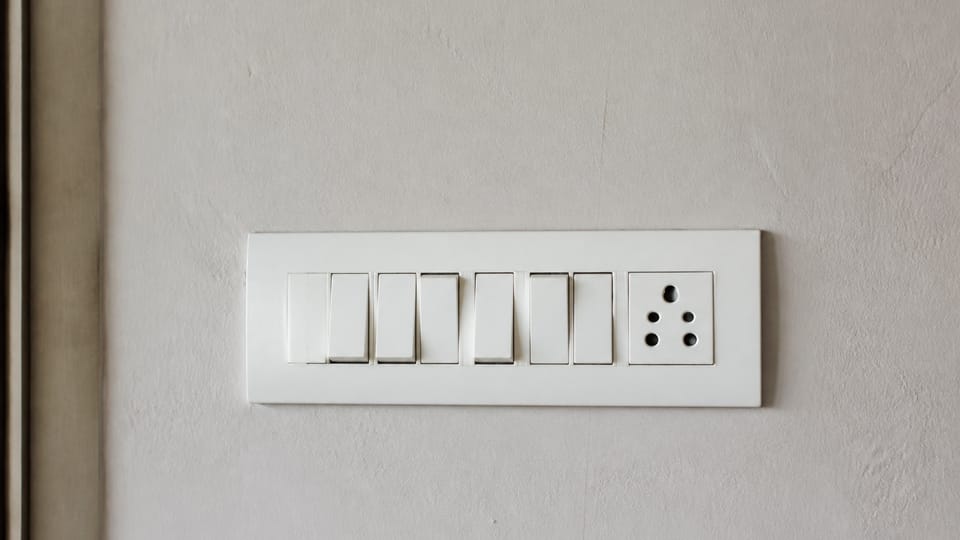
| Modular switch | Switches and sockets built into one plate system | IS 3854 has no definition of “modular”. NBCS 2026 6.3 uses “flush/modular type” without defining it |
| Fan regulator, dimmer | Controls speed or brightness | We found these words nowhere in IS 3854; a fan regulator is covered by its own standard, which we have not read here |
A “two-way” switch is not two switches: it is one switch type with a changeover action, used as a pair at the two control places. IS 3854 8.6 does not require the on/off position marking for patterns 6, 6/2 and 7. In practice a two-way and a one-way plate often look alike from the front, so the type has to be on the electrician’s schedule and not guessed from the face.
How else does the standard sort switches?
IS 3854:2023 applies to manually operated general-purpose switches for alternating current for household and similar fixed installations, indoors or outdoors, with limits on rated voltage and current. It does not apply to circuit breakers, switches for appliances, in-line cord switches or switches in cable reels (1.7).
- By connections (7.1.1). Single-pole, double-pole, three-pole, and several two-way patterns. Each has a pattern number.
- By how it is operated (7.1.5). “Rotary; Tumbler; Rocker; Push-button; Cord-operated; and Dolly type”.
- By mounting (7.1.6). “Surface-type; Flush-type; Semi flush type; Panel-type; and Architrave-type”.
- Poles. A switching device is called single-pole if it has only one pole, and multipole if poles are coupled to operate together (3.25).
- Pilot lights. A switch may have a pilot light to indicate its state or its location (3.34).
- Several on one plate. The standard says two or more switches may be mounted on a common base (7.1.1, note).
Which conductor does a switch go on?
IS 3854, the product standard, says nothing on which conductor a switch controls. The rule comes from the wiring codes, in words only:
- NBCS 2026 6.3, where the supply is from a three-wire or four-wire source and distribution is on the two-wire system: “all branch switches shall be placed in the outer or live conductor of the circuit and no single phase switch or protective device shall be inserted in the middle wire, earth or earthed neutral conductor of the circuit”. The same clause says single-pole switches carrying not more than 16 A “may be of flush/modular type”, and that for controlling points for air conditioners and geysers, “suitable MCB type switches shall be provided”.
- NBCS 2026 7.3 says each socket-outlet shall be controlled by a switch, preferably adjacent to it or combined with it, on the live side of the line.
- IS 732:2019 5.3.1.2 and 5.3.7.6.1.2 say a single-pole switching device shall not be placed in the neutral conductor (with a residual current device exception in 5.3.1.2 for single-phase circuits).
- IS 732:2019 5.4.3.3.3 says no switching device shall be inserted in the protective conductor: see earthing for a house: what it is, earth vs neutral, and why it matters.
This is a rule for the electrician. A single-pole switch found in the neutral is a defect to raise with the licensed electrician, who should check it against IS 732 5.3.1.2, which has an exception for single-phase circuits with a residual current device.
What is the rating of a switch?
Each switch is marked with a rated current and a rated voltage, assigned by the maker (IS 3854 3.14 and 3.15). The standard lists preferred rated currents and says the rated current shall not be below a minimum, with lower values allowed for momentary contact switches such as bell-pushes (6.2). IS 3854 clause 8.1 asks that a switch be marked with its rated current, rated voltage, a symbol for the nature of supply, and the maker’s or responsible vendor’s name, trade-mark or identification mark; a type reference or catalogue number is optional. The switch “may also be marked with the Standard Mark” (8.10). The BIS list of products under compulsory certification (Scheme I), read on 2026-10-29, includes an entry for IS 3854, switches for domestic and similar purposes, with no edition shown; we did not read the order behind it.
A switch for a heavy load such as an air conditioner or a geyser is a question of switch and breaker choice for the electrician. NBCS 6.3 asks for suitable MCB-type switches at those points; see MCB vs RCCB vs RCBO: what each protects against at home.
What should I plan before the walls close?
This is practice, unless a clause is named. Heights of switches and sockets are a separate topic: the drawing fixes them.
- Tell the electrician which lights need control from two places: staircase top and bottom, a long corridor, the bedroom door and the bedside. A third place needs an intermediate switch (NBCS 7.4.1).
- The extra cable runs for two-way control are hard to add without breaking the plaster. Ask for the switch positions on the electrical layout and a switch schedule before conduit is fixed: see working drawings for a house: the full list to get before construction.
- Decide how many switch positions each board needs, and where the fan regulator and the bell-push go.
- Place the switches relative to the door swing, so that they can be reached with the door open.
- Ask for an MCB-type switch at the air conditioner and geyser points (NBCS 6.3). Whether each gets its own circuit is the electrician’s design call.
- Choose modular or ordinary plates for looks and layout. The standard does not say one is safer: check the markings and the conformity instead.
What should I check on delivery and after fixing?
- Check the marking on each switch: rated current and voltage, the maker’s name, and the IS number (IS 3854 8.1).
- Switches are fixed firmly with the plates level, and no part is loose; terminals are the electrician’s job to check.
- Test every switch, and test each two-way pair from both ends, before final payment: see snag list for a new house: what to check before final payment.
- As practice, not from a code: a switch that is warm, buzzing or gives a tingle needs an electrician at once.
What mistakes should I avoid?
These are practice, not code rules, unless a clause is named.
- Planning the two-way positions after the plaster is done.
- Leaving out the bedside control because the drawing showed one switch.
- Asking a helper, not a licensed electrician, to wire or change switches.
- Buying the cheapest unmarked switch for a heavy load.
- Assuming “modular” means safer by default.
- Changing a one-way switch to a two-way without a wiring change.
- Putting a single-pole switch in the neutral (IS 732 5.3.1.2 forbids it, with an exception for single-phase circuits with a residual current device; NBCS 6.3).
Frequently asked questions
What is a two-way switch?
A switch used as a pair to control one light from two places. IS 3854 classifies it as pattern 6 but gives no definition; NBCS 2026 7.4.1 allows two-way or intermediate switches where control at more than one point is needed.
Is a two-way switch only for stairs?
No. It suits any light that needs control from two places, such as a corridor or the bedroom door and bedside.
What is a bell-push?
A push button that works only while pressed and then returns, which IS 3854 calls a momentary contact switch; its note says it is meant for bells and similar devices.
What is a modular switch?
IS 3854 has no definition. NBCS 2026 6.3 says single-pole switches up to 16 A, other than for multiple control, may be of flush or modular type. Ask the supplier what the product is made to.
Can I change a switch myself?
The licensing regulation has a few exceptions, such as replacing a lamp, fan, fuse, switch or domestic appliance of up to 250 V that does not change the capacity of the installation, as the electrical stages page explains. An electrician is still the safer choice, and adding a two-way control or changing wiring is electrician’s work.
Related guides
- Electrical work in a house build: stages and inspection points
- Earthing for a house: what it is, earth vs neutral, and why it matters
- MCB vs RCCB vs RCBO: what each protects against at home
This guide is general information. Read the disclaimer. A licensed electrical contractor designs and wires your switches.
Sources
- IS 3854:2023, Switches for Domestic and Similar Purposes, Specification (third revision): foreword, clauses 1.1 to 1.7, 3.1, 3.15 to 3.18, 3.25, 3.32, 7.1.1 to 7.1.6 and 8.1 to 8.10 (page images read; the November 2023 text, with an Amendment 1 listed by BIS that was not read). BIS lists it as in force, valid to 2031-05-21.
- SP 7:2026, National Building Construction Standards (NBCS) 2026, Part D Building Services, Section 2 Electrical and Allied Installations: clauses 6.3, 7.3, 7.4.1 and 9.2.2.4 (page images read). From an unofficial archive.org copy.
- IS 732:2019, Code of Practice for Electrical Wiring Installations: clauses 5.3.1.2, 5.3.7.6.1.2 and 5.4.3.3.3 (page images read). BIS lists it as in force, valid to 2029-12-31.
- BIS list of products under compulsory certification, Scheme I, read on 2026-10-29: row for IS 3854, Switches for domestic and similar purposes (no edition shown).
General information only. It is not a structural design or professional advice. Ask a licensed structural engineer or architect to check your plans and site.