
Short answer
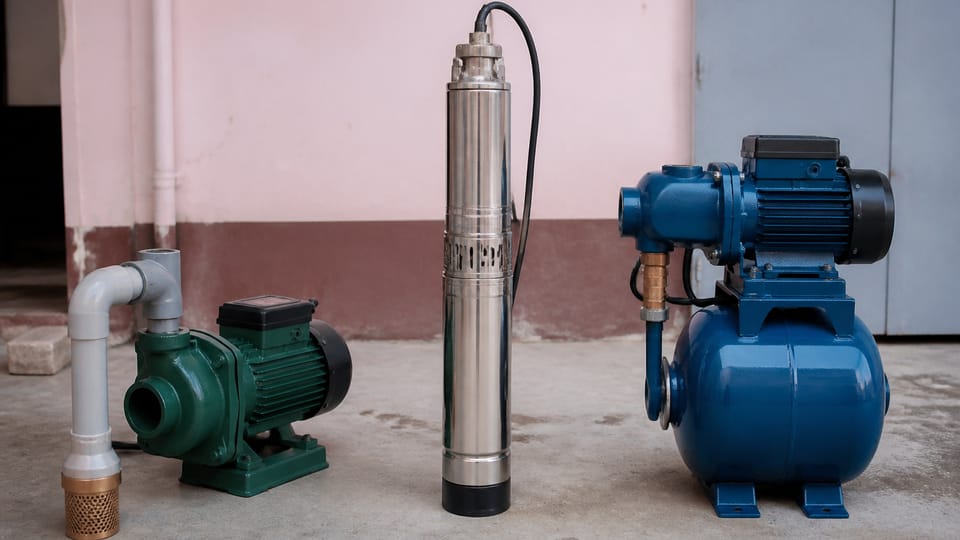
What are the types of water pump for a house? Indian standards describe monoset pumps (IS 9079, sold as monoblock), openwell submersible pumpsets (IS 14220) and borewell submersible pumpsets (IS 8034), all for clear, cold water, and jet and self-priming pumps under other standards. A booster may not draw directly from the service pipe without the water supplier's written permission. Your plumber chooses the pump by source, depth and delivery.
On this page (11)
- What types do the standards name?
- What does “clear, cold water” mean for the pump?
- What is a booster or pressure pump?
- What do the codes say about where a pump may draw from?
- What is marked on the pump?
- What do the standards not say?
- How should I choose, and what should I check? (practice)
- What mistakes should I avoid? (practice)
- Frequently asked questions
- Related guides
- Sources
Choosing a pump is usually left to the shopkeeper, and the names do not help: monoblock, pressure pump, booster, openwell, borewell. This page sorts the types by what the Indian standards say each is for, and says what a standard does not decide. It gives no horsepower, head, flow, depth or price, and no brand, because the standards give none for a house. Decide the source first: sump, open well, borewell or municipal line.
What types do the standards name?
| Type | Standard | What its scope says |
|---|---|---|
| Monoset (sold as monoblock) | IS 9079:2018 | “Monoset pumps (single/multi stage) using single/three phase a.c. induction motor/motor portion for handling clear, cold water for agricultural and water supply purposes” (clause 1) |
| Openwell submersible | IS 14220:2018 | “Submersible pumpsets (single/multi-stage) using single/three phase a.c. induction motor commonly used in openwells for handling clear, cold water for application in agriculture, domestic and water supply purposes” (clause 1) |
| Borewell submersible | IS 8034:2018 | “Submersible pumpsets (single/multi stage) using single/three phase AC induction motor, commonly used in boreholes (borewells or tubewells) for handling clear, cold water for application in agriculture and water supplies purposes” (clause 1) |
| Jet and self-priming | Their own standards | Centrifugal jet pumps and self-priming pumps have separate Indian standards; their 2025 editions are listed as in force, but we could not read them for this page |
IS 9079 says “monoset”, not “monoblock”; monoblock is the trade word. The standard does not define a monoset in one sentence. It refers to IS 5120 for terminology, and its scope sentence is the nearest thing to a definition. IS 14220 names a horizontal as well as a vertical openwell pumpset, and says the dimensions of an openwell pumpset are at the manufacturer’s discretion because they are meant for openwells only (clause 11.1). Both are submersibles, and IS 8034 is the one for boreholes.
What does “clear, cold water” mean for the pump?
All three standards define clear, cold water by limits on turbidity, chlorides, total solids, pH, temperature and specific gravity (IS 9079 and IS 14220 also give a hardness limit), and say that where a characteristic differs, the details are to be agreed between the maker and the user and specified in the order. The figures are in the standards and not repeated here. So a pump from a shop is made for water that fits that definition; hot water or dirty water needs a different pump.
What is a booster or pressure pump?
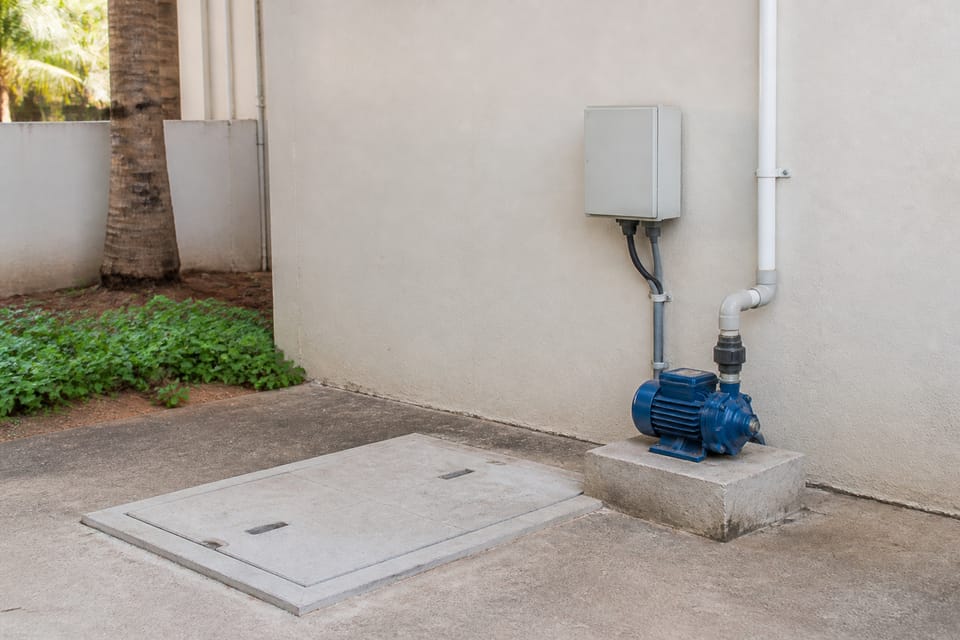
No Indian standard we read defines “pressure pump” or “booster pump” for a house; they are trade terms. NBCS 2026 uses “pressure booster pumping system” in clause 4.8.5, in a combined system where a few upper floors of a multi-storey building get a booster installed on a dedicated outlet from the overhead tank. Clause 4.8.4 separately describes a hydro-pneumatic system, defined in 2.1.48 as pumps, a pressure vessel and a pressure switch, with a low level cut-off to prevent dry run of the pumps (4.8.4.3). In practice (not from a standard), a booster adds pressure to water that is already in a pipe; it does not lift water from far below.
What do the codes say about where a pump may draw from?
IS 2065 clause 8.1.6 says “pumps shall not be allowed on the service pipe”, and where pumping is required a properly protected storage tank of adequate capacity feeds the pump. NBCS 4.9.3(d) says the same and 4.9.3(e) says “no direct boosting (by booster pumps) shall be allowed from the service pipes”. Clause 4.11.4 allows a pump on a supply pipe only with the water supplier’s prior written permission. IS 2065 clause 11.12.1, on multi-storey buildings where tank or fitting height needs pumping, says the pumps are “usually of the centrifugal type driven by electric motors”.
What is marked on the pump?
IS 9079 clause 15.1 asks that the pump be marked, and the two submersible standards ask for a corrosion-resistant nameplate, with items such as the motor rating, type or model, voltage, frequency, head and discharge at the duty point, overall efficiency and the maker. The BIS Standard Mark may also be marked. The standards do not list the IS number or a star rating among the marking items. BEE has a star labelling schedule that names these three pump types; the 2020 schedule we read ran to January 2023 and we did not confirm its present status, so ask the seller and check the label.
What do the standards not say?
- No pump type for a house, no horsepower or kilowatt, no head, depth or discharge for a house.
- No comparison of jet and centrifugal pumps, or of pressure pumps and boosters.
- No rule for pump room ventilation or clearances.
- Nothing on price, brand or the better maker.
How should I choose, and what should I check? (practice)
This is practice, apart from the clauses named.
- Start from the source: sump, open well, borewell or the municipal line. The pump type follows.
- Where must the water go: the overhead tank or straight to fixtures; whether a booster is needed at all after checking tank height, pipes and air locks.
- Ask the plumber or electrician: which type suits my source and why; who sizes the head and flow, in writing; where the foot valve or non-return valve sits; what protects the pump from dry run and voltage swings; whether the pump is earthed on its own MCB.
- For a borewell, IS 14536 asks for protection against running without water, and the pump manufacturer states the minimum borehole size in IS 8034 clause 8.9. Ask the driller for the written specification.
- Check on site: the nameplate, earthing, no leaks at the joints, no unusual noise, and a float or level control that works. Keep the pump where you can reach it for service.
What mistakes should I avoid? (practice)
- A booster fed directly from the service pipe.
- A surface pump placed beyond its suction reach.
- No dry-run protection.
- A pump in a closed, damp room with no ventilation.
- Choosing by horsepower alone.
- No non-return valve.
- A submersible hung by its cable.
- A booster bought for what is really a low tank, a choked pipe or an air lock.
Frequently asked questions
What is the difference between a water pump and a submersible pump?
In practice, a monoset pump (IS 9079) is a surface pump with a suction pipe, and a submersible (IS 8034, IS 14220) works under the water. Which fits depends on the source.
What is the difference between a pressure pump and a booster pump?
No standard we read defines either. They are trade terms for a pump that adds pressure on a line from a tank.
Is a borewell pump the same as a submersible?
A borewell is the hole. IS 8034 submersible pumpsets are the pumps made for it, and IS 14220 covers openwell submersibles.
Can I connect a booster pump directly to the municipal line?
No. IS 2065 8.1.6 and NBCS 4.9.3(e) do not allow direct boosting from the service pipe; NBCS 4.11.4 allows it only with the supplier’s written permission.
Do I need a star-rated pump?
BEE has a star scheme for these pump types; we could not confirm its present status. Ask the seller.
Related guides
- Plumbing work during house construction: stages and inspection points
- Water tank size for a house: litres per person and tank capacity
- HDPE pipe for a house: service line, borewell and where to avoid it
- Overhead tank vs pressure pump system: gravity and hydro-pneumatic
This guide is general information. Read the disclaimer. Your plumber and electrician choose the pump for your house.
Sources
- IS 9079:2018, Monoset Pumps for Clear, Cold Water for Agricultural and Water Supply Purposes, Specification (third revision): clauses 1, 4, 4.2, 15.1 and 15.3 (page images read for clauses 1 and 4; the others text only). BIS lists it as in force, valid to 2027-10-31.
- IS 14220:2018, Openwell Submersible Pumpsets, Specification (first revision): clauses 1, 4.1.4, 6 (Fig. 1 to 3), 11.1, 18.1 and 21 (clauses 1 and 4 page images read; the others text only). BIS lists it as in force, valid to 2031-02-10.
- IS 8034:2018, Submersible Pumpsets, Specification (third revision), with Amendment 1: clauses 1, 4.4, 8.9, 14.1 and 14.2 (clause 1 page image read; clause 8.9 text and Fig. 2 image; the others text only). BIS lists it as in force, valid to 2027-10-31.
- IS 14536:2018, Selection, Installation, Operation and Maintenance of Submersible Pumpset, Code of Practice (first revision): clauses 6.10 and 6.12 (text read). BIS lists it as in force, valid to 2028-07-31.
- IS 2065:1983, Code of Practice for Water Supply in Buildings (second revision): clauses 8.1.6 and 11.12.1 (page images read). BIS lists it as in force, valid to 2027-02-28.
- SP 7:2026, National Building Construction Standards (NBCS) 2026, Part E Section 1, Water Supply: clauses 2.1.48, 4.8.4, 4.8.5, 4.9.3 and 4.11.4 (clauses 4.8.5 and 4.9.3 page images read; others text). From an unofficial archive.org copy.
- Bureau of Energy Efficiency, Schedule No. 7, Pump Set, Revision 4, effective 1 February 2020 (text read; its star plan ran to 31 January 2023, so its present status is not confirmed).
Change log
- : Added Related guides link to newly published article(s): overhead-tank-vs-pressure-pump-system-gravity-and-hydro-pneumatic-supply. No other text changed. Approved by the reviewing engineer.
General information only. It is not a structural design or professional advice. Ask a licensed structural engineer or architect to check your plans and site.