
Short answer
Can HDPE pipe be used for a house's water supply, and where not? HDPE is a flexible polyethylene pipe. It can be used for the water service line from the main, if the local authority accepts it and the maker's joining method is followed. IS 4984:2016 covers it for water supply. It is not a hot-water pipe, and the codes read here do not settle the borewell casing, so get a written specification from the driller. Ask the local water department for the approved pipe.
On this page (12)
Most house plumbing uses PVC, CPVC or copper, but HDPE is also sold for water supply, and many owners meet it when the water line from the street or a borewell is laid. HDPE is tough, flexible and joined by fusion, not by glue. That makes it useful underground, but it is not the right pipe for every job. This guide sets out what the Indian codes say about HDPE and water supply, where it suits a house, where it should not be used, and what to check. It gives no sizes, pressures, depths or prices. Your plumber, the local water department and your engineer set those for your site.
What is HDPE pipe?
HDPE stands for high-density polyethylene, a plastic pipe material. IS 4984, the Indian standard for polyethylene pipes for water supply, covers pipes for mains and service pipes that carry water for human consumption, including raw water before treatment, and water for general purposes (clause 1.1). So the standard is about water supply, not drains.
The standard also says something important about its own limits. Its Foreword states that it gives no information on whether the pipes may be used without any restrictions, and that the applicable regulations, if any, on their use must be followed (Foreword). In plain words: the standard tells you what a good pipe must be, but the local rules decide where it may be used.
The pipe material must also be safe for drinking water. IS 4984 says it should not be a toxic hazard, should not support microbial growth, and should not give rise to unpleasant taste, odour, cloudiness or colour in the water (clause 5.1).
Where can HDPE be used in a house?
The table below sets out the common uses. The first column is the use, the second is what the codes read here say, and the third is what to check.
| Use | What the codes read here say | What the owner checks |
|---|---|---|
| Service line from the municipal main to the house | The pipe from the street main to the meter is the service pipe. The service connection, from that pipe to the meter, is provided by the local authority (BMTPC Digest 10) | The authority approves the connection and says which pipe it accepts |
| Water line from a borewell pump to the tank | IS 2065 covers water supply inside buildings; the codes read here do not set the borewell casing or the rising pipe | A written specification from the driller and the pump maker |
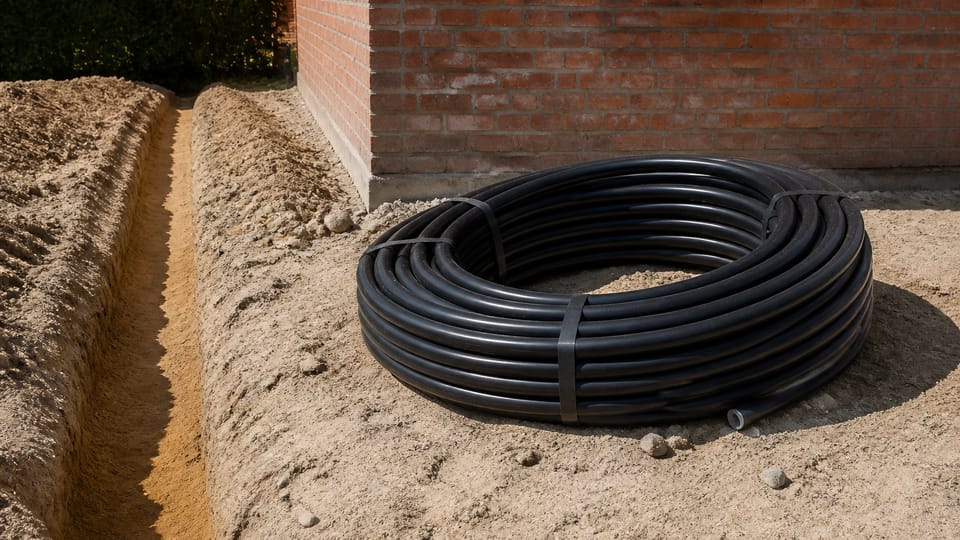
| Underground run inside the plot | Underground piping should have adequate cover and be laid where frost or traffic will not damage it (IS 2065 clauses 8.1.1 and 7.11) | The trench, the bedding and the cover, as the maker and the plumber agree |
| Pipe in a wall or a solid floor | Piping is not buried in walls or solid floors, except a short unavoidable run that is protected and has no buried joint (IS 2065 clause 8.1.11) | Practice: route the pipe in a chase or an open run, and keep joints visible |
| Hot-water line | No supply pipe is connected directly to a hot-water system except through a feed cistern (IS 2065 clause 8.2.4). Polythene and PVC pipes should not be laid on hot surfaces or too close to hot-water pipes (clause 6.2.6). BMTPC’s digest says copper is generally used for hot water (Digest 10) | Practice: do not use HDPE for hot water in the house |
| Near a drain, sewer or manhole | No piping may pass into, through or next to a sewer, drain or manhole connected with it, unless the code allows (IS 2065 clause 7.6) | The route keeps clear of drains and manholes |
| Gas | Not covered by IS 4984, which is for water | Never use a water pipe for gas |
Who lays the service line?
The pipe from the street main to the water meter is the service pipe. The service connection, from that pipe to the meter, is provided by the local authority (BMTPC Digest 10). The supply pipes inside the premises are the owner’s responsibility (BMTPC Digest 10). So the first step for a new house is to ask the authority how it connects, which pipe it accepts and whether it must inspect the joints.
Practice: ask the water department for the approved pipe specification in writing, and keep the connection approval with the house papers.
Borewell: what the codes say and do not say
A borewell is a source, not a house pipe, so the codes read here are of limited help. IS 2065 clause 1.1 scopes it to water supply in buildings and plumbing connected to the public supply. It does not cover the borewell casing. BMTPC’s digest describes drilled and driven wells in general terms, but it does not give a borewell pipe specification.
Online sources also disagree on whether HDPE or PVC is the right casing for a borewell. The sources read for this guide do not settle that question, so this article does not choose one. Practice: do not decide the borewell pipe from a seller’s page. Ask the driller for a written specification that names the pipe, its class and its standard, the rising pipe from the pump to the house, and the joints. Ask your engineer to check it.
Practice: keep the borewell away from drains and soak pits, as the soak pit guide explains, and keep any pump connection sealed.
Where should HDPE not be used?
Practice: a list of places where a careful owner avoids HDPE, based on the codes above.
- Hot water. HDPE is not the hot-water pipe. IS 4984 sets a maximum recommended water temperature in a table note (no figure is printed here), so it is not written as a hot-water pipe. The codes read here use a feed cistern and do not put supply pipes straight onto a hot-water system (IS 2065 clause 8.2.4). BMTPC’s digest says copper is generally used for hot water. The CPVC standard, IS 15778, covers hot and cold potable water pipes made of CPVC, not HDPE, so it does not apply to HDPE. See the CPVC guide for the indoor choice.
- Inside a wall or a solid floor. IS 2065 says piping is not buried in walls or solid floors (clause 8.1.11).
- Next to a drain or a manhole. BMTPC’s digest says water lines placed near sewage drains, sullage or manholes increase the chance of contamination (Digest 10). IS 2065 clause 7.6 bars piping passing into or next to a sewer or drain.
- Gas. A water pipe must never carry gas. Gas needs its own pipe and its own standard. Confirm the right pipe with the gas supplier. Practice.
- Where the local rules say no. The IS 4984 Foreword says the local regulations, if any, must be followed.
How to tell a good pipe
IS 4984 sets what the pipe must show on its surface. Each straight length or coil is marked with the manufacturer’s name or trade-mark, the material designation, the pressure rating, the standard dimension ratio, the outside diameter, and the lot or batch number (clause 10.1.1). The standard mark is optional, so a pipe without it is not proof of a fault (clause 10.2).
The standard colour is black with blue identification stripes (clause 6.2). The standard notes that blue pipes were left out because there was not enough experience with them in India. Colour alone is not a safe test, so read the marking.
Practice: before you accept the pipe, read the marking on the pipe, ask for the lot number on the invoice, and keep a photo of the coil with the marking visible.
Joints and tests
IS 4984 tests the joints the maker uses. It names the butt-fusion and electrofusion joints as the ones tested for hydraulic performance (clause 8.1.2). The standard does not describe how to make the joint. For that it points to the laying and jointing code, IS 7634 Part 2, which was not read for this article.
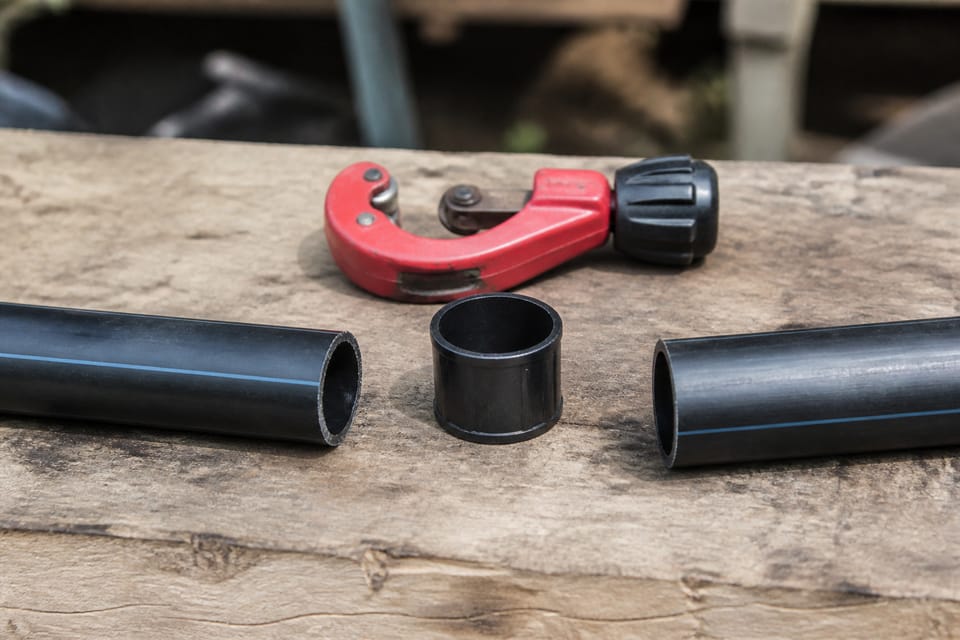
The maker says the joint is made by butt fusion, by electrofusion, or by mechanical compression fittings, and that the method depends on the application. It warns against mixing incompatible fittings or adhesives, and says to pressure-test the joints after installation (Ashirvad, manufacturer text). Practice: ask the plumber which method the maker specifies, and who will make the joints. Do not accept glue or a fitting that the maker does not list.
IS 2065 says water mains are tested in sections as the laying goes on, and that it is an advantage to have the joints exposed during the test (clause 14.2). BMTPC’s digest says plastic pipes do not keep water as clean as copper unless the joints are properly made and sealed (Digest 10). Practice: ask for the pressure test before the trench is filled, and keep the test record with the drawing.
Sun, frost and the trench
IS 4984 has no clause on sunlight or UV. It points to IS 7634 Part 2 for storage and handling (Foreword). Its only weathering mention is a test a buyer may ask for with blue pipes (clause 6.2 note), and its table notes give an ambient range but no frost rule. The maker says to store the pipe in a shaded area, to avoid UV damage, and to check the pipe for damage before use (Ashirvad, manufacturer text). The maker’s page does not say what to do with a pipe that stays exposed in sunlight after it is laid, so ask the maker that question before you use it above ground.
IS 2065 gives frost protection due attention in the layout, if required (clause 7.8), and says underground piping must be laid so that it is unlikely to be damaged by frost or traffic (clause 7.11). The maker says to clear and level the trench, and to backfill with soft soil or sand and compact gently around the pipe. Practice: removing sharp stones from the trench is a sensible step.
What mistakes should I avoid?
Practice points:
- Using HDPE for the hot-water line, or a water pipe for gas.
- Buying a pipe with no marking, or a marking the plumber cannot match to the standard.
- Joining the pipe with a method the maker does not list.
- Laying the pipe in the same trench as a drain, or close to a manhole.
- Burying the pipe with sharp stones in the trench.
- Filling the trench before the pressure test has passed.
- Deciding the borewell casing on a seller’s word, without a written specification.
Frequently asked questions
Is HDPE good for hot water?
No. The codes read here do not treat HDPE as a hot-water pipe. BMTPC’s digest says copper is generally used for hot water, and the CPVC standard covers CPVC pipes for hot and cold water, not HDPE. Practice: keep HDPE on the cold side, and ask the plumber to confirm the hot-water pipe.
Can HDPE be used as borewell casing?
The codes read here do not settle it. Online sources disagree. Practice: get a written specification from the driller that names the pipe, its class and its standard, and ask your engineer to check it.
Is HDPE the same as PVC?
No. They are different materials, and the maker of each pipe says how it is joined. Practice: use the material the plumber and the maker specify for each run, and do not mix them without a transition fitting that the maker lists.
Can I use HDPE for gas?
No. A water pipe must never carry gas. Gas needs its own pipe and standard, so confirm the pipe with the gas supplier.
Related guides
- CPVC vs UPVC pipes for home plumbing
- Water tank size for a house
- Soak pit vs septic tank
- Pipes for the house sewer line: UPVC, stoneware, RCC or DWC
- Water meter for a house: how to read it and what IS 779 says
This guide is general information. Read the disclaimer. Your plumber, the local water department and your engineer decide the pipe, the route and the borewell specification for your house.
Sources
- IS 4984:2016, Polyethylene Pipes for Water Supply, fifth revision (BIS listing: not withdrawn; valid to 2031). Foreword, clauses 1.1, 5.1, 6.2, 8.1.2, 10.1, 10.1.1 and 10.2 read; the amendment of 2018 read; read from OCR text.
- IS 2065:1983, Code of Practice for Water Supply in Buildings, second revision (BIS listing: not withdrawn; valid to 2027). Clauses 1.2, 2.30, 6.2.6, 7.2, 7.3, 7.6, 7.7, 7.11, 8.1.1, 8.1.11, 8.2, 8.2.4, 14.2 and 14.3 read; read from OCR text.
- BMTPC, House Building Digest 10 (Water Supply), government text: the service connection, the owner's supply pipes, contamination from joints and nearby drains.
- Ashirvad, HDPE pipes product and installation page, manufacturer text: joining methods, trench and bedding, pressure testing and storage out of sunlight. Manufacturer claims, labelled as such in the article.
Change log
- : Added Related guides link to newly published article(s): water-meter-for-a-house-how-to-read-it-and-what-is-779-says. No other text changed. Approved by the reviewing engineer (owner report, 2026-10-31).
- : Added Related guides link(s) to newly published article(s): Pipes for the house sewer line: UPVC, stoneware, RCC or DWC. No other text changed.
General information only. It is not a structural design or professional advice. Ask a licensed structural engineer or architect to check your plans and site.