
Short answer
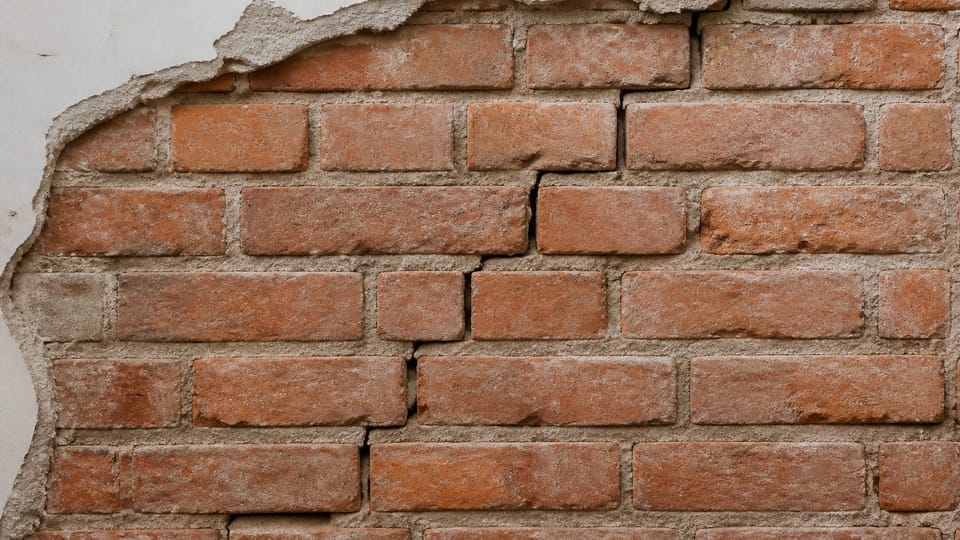
How are structural cracks in a brick wall repaired? An engineer first finds the cause and checks whether the crack is still moving. Then the method follows the cause. Filling closes a crack, injecting grout or epoxy is meant to rejoin the wall across it, and stitching ties the two sides together. None of these stops the movement that made the crack. For an owner, the job is to record, watch and call the engineer.
On this page (11)
Your engineer says the crack needs stitching, or a contractor offers epoxy injection. This page explains what these repairs are, what each can and cannot do, and why the order of work matters. It is written so that you can follow your engineer’s advice. It is not a how-to. It gives no bar size, spacing, pressure, mix or crack-width limit, and no rates. If you are not sure what kind of crack you have, start with types of cracks in house walls.
What must happen before any repair?
Find the cause first. IS 2212, the Indian brickwork code, says: “to execute effective repairs, it is necessary to know the cause of damage”. It adds: “The nature of repairs mainly depends on whether it is structural damage or surface cracking only.”
Then check whether the crack is still moving. SP 25, the BIS handbook on cracks, says: “No useful purpose is served in repairing cracks when these are still developing.” One UK maker’s sheet for stitching kits makes a related point: “Crack-stitching cannot cure the cause of the crack.”
SP 25 is also frank about the limits: “in many cases there may be no satisfactory method of repairing the cracks after they have appeared.” So a repair is not always possible, and it is not always a cure.
What does each repair do?
Each method does a different job. No code we read sets out a choice like this table for a house. The Source column shows where a method is named, and the “does not” column is our reading. Your engineer chooses.
| Method | What it does | What it does not do | Source |
|---|---|---|---|
| Filling or repointing | Closes the crack at the surface and keeps out rain | Does not rejoin the wall. Does not restore strength | IS 13935 cl 4.1.2; IS 2212 cl 14.3.3.3, 14.3.3.4 |
| Replacing cracked bricks | Rebuilds the broken part of the wall | Does not remove the cause | IS 2212 cl 14.3.3.1(a) |
| Grout injection | Fills the crack inside the wall and is meant to bond its two faces | Does not stop movement | IS 13935 cl 6.2 |
| Epoxy injection | Is meant to bond the crack with a resin | Not for live cracks, by the one maker’s sheet we read | IS 13935 cl 4.2.2(c), 5.4 |
| Stitching | Ties the two sides of a crack together | Does not cure the cause | IS 2212 cl 14.3.3.1(b); SP 25 cl 9.6.3 |
| Rebuilding part of the wall | Replaces a part that cannot be repaired | Needs support for the work above | IS 2212 cl 14.3.3.2 |
What is filling, and when is it enough?
Filling a surface crack is a repair of appearance. IS 13935, written for earthquake damage, is blunt that such patching does “not restore the original structural strength of structural components in the building”. Doing only this where structural repair is needed “may have serious implications on the safety of the building.” A BMTPC post-earthquake manual says: “Painting, plastering, adding water-proofing or changing floor tiles is not considered restoration.” A government post-earthquake guideline adds that superficial repair “will only hide the cracks”.
A stronger mortar is not always better. IS 2212 warns that “shrinkage of the new rich mortar may cause a fresh crack to develop”. For cracks that may keep widening, it says “it would be advisable not to repair the cracks with mortar”, and that “an oil based mastic shall be applied” if filling is needed to keep rain out. Which plaster-level material suits a fine crack is a separate question for your painter and engineer.
What is grout or epoxy injection?
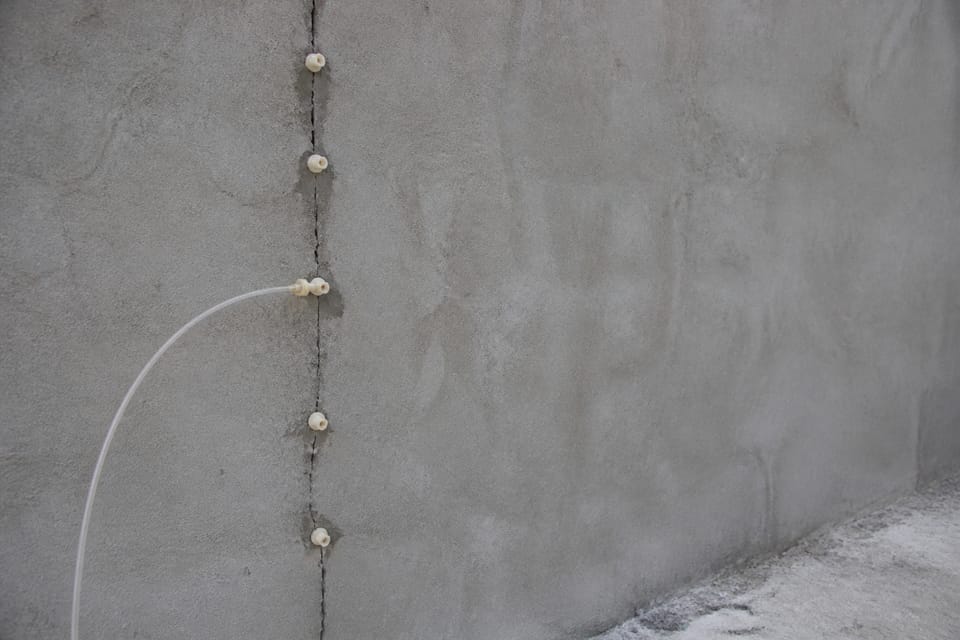
Injection pushes a liquid into a crack through small ports, so that it fills the crack inside the wall. IS 13935 names “Injecting cement, polymer-cement mixture or epoxy materials which are strong in tension, into the cracks in walls”.
For earthquake-damaged walls, it says “the technique to restore the original tensile strength of the cracked element is by pressure injection of non-shrink cement polymer grout”. Keep that scope in mind. It concerns that grout and that cracked element, and it is not a promise for your wall. IS 13935 also says that wider or crushed zones need “a treatment other than injection”. Government guides differ on where that line falls, so your engineer chooses.
Epoxy gets less detail. IS 13935 says some products “are of low viscosity and can be injected in fine cracks too”, and gives no crack range for it. The CPWD specification has an injection item, but it is written for concrete. One maker’s epoxy sheet says the resin “should not be used on live cracks or where further movement is expected”. So ask why the engineer prefers epoxy or cement grout for your wall.
One check is worth knowing. IS 13935 has the work go port by port, until grout “is seen flowing from the opposite sides of the member at the corresponding port or from the next higher port”. Ask how your applicator will show that the crack has filled.
What is crack stitching?
Stitching ties the two sides of a crack together. In IS 2212 and SP 25 it means blocks across the crack, not the thin bars you may see online.
- IS 2212, in its section on structural damage, says: “If the cracks are wide, the two portions can be stitched by inserting bond stone or precast reinforced concrete blocks at suitable intervals. The cracks shall then be grouted.”
- SP 25 says that for wide diagonal cracks, “if there is a possibility of further movement, repairs should be carried out by removing and replacing all cracked bricks, using RCC stitching blocks”.
SP 25 tells you not to repair a crack that is still widening, and it also has this method for a crack with a possibility of further movement. In our reading, the first means a crack that is moving now, and the second means a risk of movement later. Ask your engineer which applies to your wall.
Helical stainless bars set in slots cut along the joints are a maker’s system. We found no Indian Standard for them. UK makers’ sheets ask for the cause of the crack to be established first.
When is a crack not worth repairing?
IS 2212 says that where cracks cross each other, “these cracks can not be effectively repaired”. The wall is taken down and rebuilt, with the work above supported. IS 13935 also describes a mesh layer on both faces where there is a “concentration of multiple cracks in the same portion and appearing on both sides”. Those are engineer’s decisions, because they affect the load on the wall. If much of the house is affected, see renovate or rebuild.
What should I do as the owner?
Your role is to record, watch and call the engineer. This list is practice.
- Photograph the crack and note the date, with a scale beside it.
- Note what has changed, such as a leak, a new floor or digging next door.
- Watch it. SP 25’s tell-tale is a glass strip across the crack: “If the crack widens, the tell-tale will crack.”
- Fix any leak near the wall.
- Do not fill or plaster over it before the engineer sees it.
- Ask for a written repair note, covering the cause, the method, the materials and the order of work.
- Keep photos of the work while it is open.
IS 13935 asks for detailed damage assessment, including “mapping of the crack pattern”, before structural repair. We found no Indian text that says who must carry out this repair, so ask your local authority if permission is needed. Our advice is that an engineer decides, because IS 2212 places these repairs under structural damage.
What mistakes should I avoid?
These are practice points unless a code is named.
- Repairing a crack that is still developing. SP 25 9.6.1 says this serves no useful purpose.
- Choosing a method before the cause is known.
- Taking a “permanent” claim at face value. No method read stops the movement.
- Judging by width alone. The right method does not depend on width alone.
- Cutting slots in a wall without checking for hidden pipes and conduits.
- Paying for injection with no way to see that the crack has filled.
- Applying concrete crack advice to a brick wall without asking.
Frequently asked questions
Does crack stitching stop the movement?
No. It ties the wall across the crack. If the ground or the structure is still moving, the cause must be fixed first.
Does epoxy injection make the wall strong again?
IS 13935 lists epoxy injection among restoration work for earthquake damage, but its line on restoring tensile strength names only non-shrink cement polymer grout. Ask your engineer what result to expect.
Epoxy or cement grout: which is better for a wall crack?
No Indian text we read ranks them for an ordinary house. Your engineer chooses from the cause, the wall and the crack.
Can I do this myself?
Do not attempt a structural repair yourself. Pressure injection and stitching need an engineer’s method and a skilled applicator.
Can a repair be done before the monsoon?
Timing depends on the cause and on whether the crack has stopped moving. If rain is entering, ask your engineer how to keep it out for now.
Related guides
- Types of cracks in house walls: names, causes and who must judge
- Guniting, shotcrete and grouting: what each is and where it is used
- Crack filler vs putty vs white cement: what to fill a wall crack with
- Foundation settlement: uniform, differential and why houses crack
This guide is general information. Read the disclaimer. Your structural engineer decides how a cracked wall is repaired.
Sources
- IS 2212:1991, Brick works, code of practice: clauses 14.1, 14.3 and 14.3.3.1 to 14.3.3.4 (page images read).
- SP 25(S&T):1984, Handbook on causes and prevention of cracks in buildings: clauses 9.4, 9.6.1, 9.6.3 and Appendix A (page images read). A handbook.
- IS 13935:2009, Seismic evaluation, repair and strengthening of masonry buildings, guidelines: clauses 1.1, 1.2, 4.1.2, 4.2.1, 4.2.2(c), 5.4, 6.2, 6.2.1, 6.3 and 9.2. Written for earthquake damage; used here only as earthquake-repair guidance.
- BMTPC, Manual for Restoration and Retrofitting of Buildings in Uttarakhand and Himachal Pradesh, 2010: section 5.
- National Disaster Management Division, Ministry of Home Affairs, Guideline for Repair, Restoration and Retrofitting of Masonry Buildings in Earthquake Affected Areas of Jammu & Kashmir, January 2006: preface and clause 10.2.
- CPWD Specifications 2019, Volume 2: item 26.30 (grout injection, written for concrete). For CPWD works.
- SP 7:2026, National Building Construction Standards (NBCS) 2026: searched for a masonry crack repair clause; none found. From an unofficial archive.org copy.
- Makers' sheets for an epoxy injection resin and for crack stitching kits (the stitching sheets are UK). Not named here, and no figure from them is printed.
General information only. It is not a structural design or professional advice. Ask a licensed structural engineer or architect to check your plans and site.