
Short answer
What is the difference between uniform and differential settlement? Uniform settlement is when a whole building sinks by the same amount. Differential settlement is when parts of it sink by different amounts, and that uneven movement can crack walls. IS 8009 says settlement is generally non-uniform in practice. How long it goes on depends on the soil, not on a fixed number of years. If a crack is growing, ask an engineer.
On this page (10)
A crack has appeared in your new house, and someone says the building is “settling”. This page explains what settlement is, why it can crack walls, what can cause it, and how long it can go on. It gives no permissible settlement figures, no crack-width rule and no foundation sizes, and it does not diagnose your crack. That is your engineer’s job.
What is settlement?
Settlement is the downward movement of a foundation, usually because the ground under it compresses under load. SP 25, the BIS handbook on cracks, notes that “gradual settlement of foundation due to load on the soil takes place” as walls rise. So some movement is expected. The question is whether it is even.
| Type | What happens | Why it matters |
|---|---|---|
| Uniform settlement | The whole building goes down by the same amount | IS 8009: “it will not theoretically suffer damage, irrespective of the amount of settlement”. But “the underground utility lines may be damaged” |
| Differential settlement | Parts go down by different amounts | IS 1904: “the difference between such settlements will cause differential settlement in the structure”. This is what can crack walls |
| Tilt | The building leans | IS 1904 works it out as the differential settlement divided by the distance between the points of most and least settlement |
Do not read too much into “uniform”. IS 8009 goes straight on: “In practice, settlement is generally non-uniform.” It also says “it is more difficult to estimate the differential settlement than the maximum settlement”.
IS 1904 prints guide figures for permissible settlement and tilt in Table 1, and says they “may be taken only as a guide”. No row is named for an individual house, and your engineer works from the design. We do not print them.
Why can a new house crack?
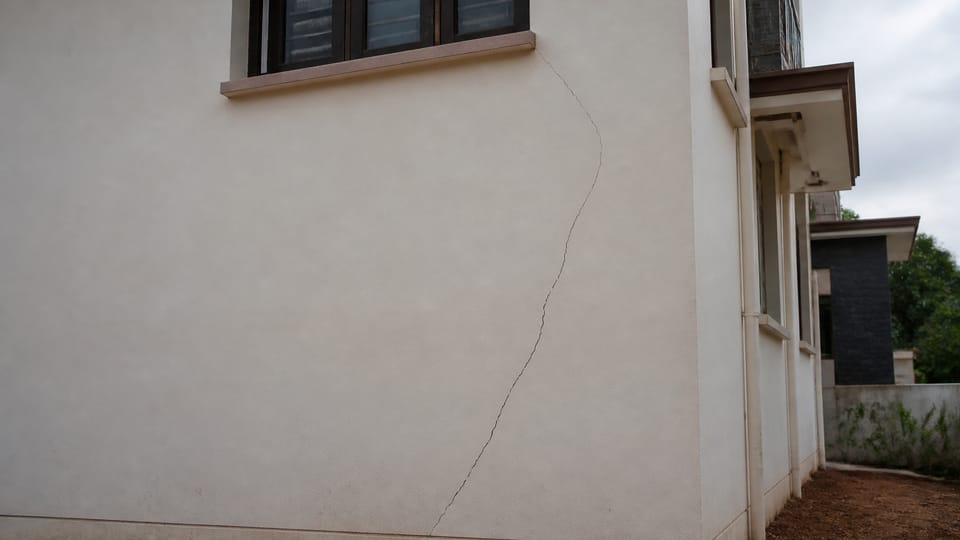
Walls of brick and mortar are weak when pulled or sheared. If one part of a building goes down more than another, the wall between them is forced out of shape. SP 25 says: “Shear cracks in buildings occur when there is large differential settlement of foundation”.
IS 1904, NBCS 2026 and SP 25 list causes. These are some that matter for a house:
- Mixed ground. Soil differs from one part of the plot to another. NBCS names “pockets of sand in clay”.
- Uneven load. NBCS names “non-uniform loading and incomplete loading of the foundations”. IS 1904 names “heavy structures built next to light ones”.
- Water in the ground. IS 1904 says an increase in moisture content can cause “substantial loss of bearing capacity in case of certain types of soils which may lead to differential settlement of foundations”. It also warns of leakage from water mains and sewers. SP 25 says water entering loose soil can bring settlement that “generally not being uniform in different parts, results in cracking.”
- A change in the ground water level. IS 1904 lists “Variation of ground water table”.
- Digging next door. IS 1904 lists nearby excavation among the causes of settlement. Its section on landslide-prone areas adds: “Cuttings and excavations adjoining foundations reduce stability and increase the likelihood of differential settlement.” NBCS adds: “The deeper the new foundation and the nearer to the existing it is located, the greater the damage is likely to be.”
- An extension. SP 25 says a crack at an old and new junction can be “due to compaction of soil under load of the newly built portion of the building”.
- Filled ground. Under a floor, SP 25 says settling of deep fill “may happen soon or long after the construction.”
- Shrinkable clay. This movement goes both ways with the seasons. SP 25 says: “In rains, the soil swells up and the movement is reversed but cracks once formed do not fully close.” See black cotton soil.
Avoiding these starts with a soil test, and with the design check that goes beyond safe bearing capacity.
What does a settlement crack look like?
There is no owner’s test. No standard we read gives one. Many cracks look alike, and a foreign digest warns that when cracks appear, people assume the foundation moved and that this is the sole cause: “Neither assumption is correct.”
The clues below come from SP 25. Treat them as notes for your engineer, not a diagnosis. Most of SP 25’s crack patterns are written for load-bearing masonry, so they may differ on an RCC-frame house. SP 25 also sets design faults and overloading outside its scope.
| What you see | What SP 25 links it with |
|---|---|
| Diagonal crack at a corner or end of a building, wider at the top | Foundation movement at that corner (cl 7.3) |
| Diagonal cracks across a corner on two walls, passing through the DPC, on shrinkable clay with a shallow foundation | “drying shrinkage of the foundation soil” (cl 9.5.1(n)) |
| Crack wide at the base, narrowing upward, after old trees were cut | Soil swelling (cl 8.4(c)) |
| Vertical crack at a junction of old and new work | The new part compressing the soil (cl 9.5.2(b)) |
| Random cracks in all directions, on both outer and inner walls | “generally due to either foundation settlement or sulphate action” (cl 9.5.2(j)) |
| Crack that opens and closes with temperature | Heat movement (cl 3.8) |
| Diagonal crack rising from lintel ends over a large opening, in the first dry spell | Drying shrinkage of in-situ RCC lintels (cl 9.5.2(h)) |
A crack can have more than one cause, and no row rules settlement out.
Doors that begin to stick and floors that begin to slope are worth reporting too. That is practice, not a clause. For the crack types, see types of cracks in house walls.
How long does settlement go on?
It depends on the soil, not on a calendar. We found no source that gives a number of years. IS 1904 says:
- “In sand and gravels, the settlement is likely to be over by the end of the construction.”
- “In silts and clays, the settlement may continue for a long period after the construction of structure.”
- “In strata of organic soils, settlement may continue for a long time after construction.”
So claims that settlement stops after a set number of months or years have no support in what we read. In practice, a later crack can also have a different cause, such as a leak.
How do I watch a crack?
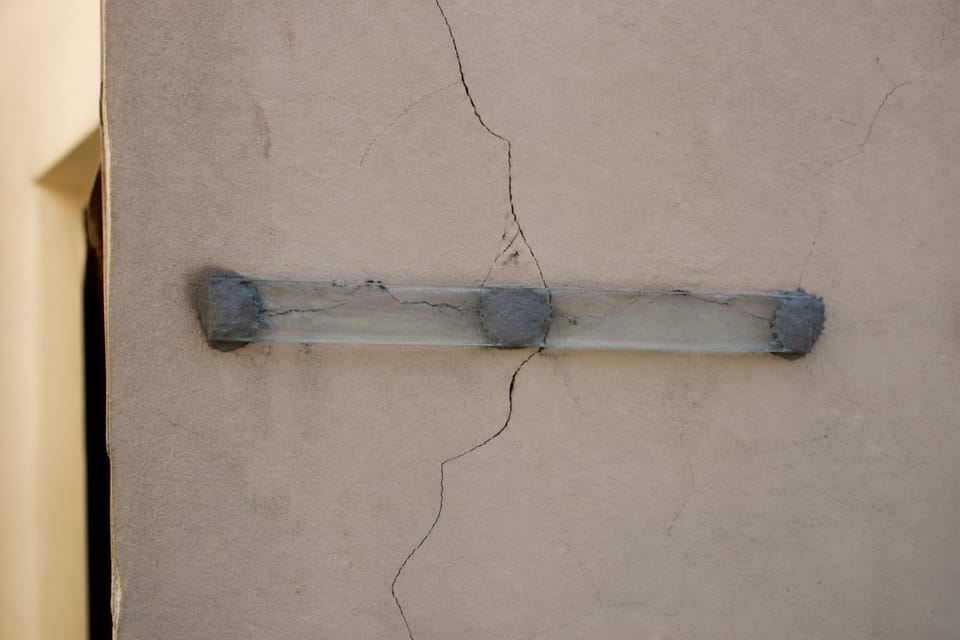
SP 25 Appendix A describes a tell-tale, a strip of glass fixed across a crack with mortar or adhesive. “If the crack widens, the tell-tale will crack.” As a simple method, you can also mark the ends of the crack with a pencil and date, and take dated photos with a scale beside the crack. Those two are practice, not code methods. As practice, keep the record through wet and dry seasons if you can. This is not a waiting period: if the crack worries you, call your engineer now.
The reason not to rush the repair is in SP 25: “No useful purpose is served in repairing cracks when these are still developing.” For settlement cracks it adds: “Cracking due to foundation settlement requires detailed investigations before any course of remedial measures could be decided upon.”
What should I do if I suspect settlement?
Do not fill and paint first. This list is practice.
- Note when the crack appeared, and whether it has grown.
- Fix any leak near the walls. Check drains, the sump and rainwater outlets.
- Keep water away from the foundation. See plinth protection.
- Ask what has changed nearby, such as digging next door or a new tree cut.
- Call a structural engineer, who may survey levels and ask for a soil report.
Repairs such as strengthening a foundation are for the engineer to decide, after the cause is known. Do not start with the fix a contractor suggests.
What mistakes should I avoid?
These are practice points unless a source is named.
- Calling every crack “settling”, and waiting for it to stop.
- Waiting for a date instead of checking whether the crack is still growing.
- Judging a crack by its width alone.
- Filling a crack that is still moving. SP 25 9.6.1 says this serves no useful purpose.
- Bonding an extension to the old walls without asking your engineer. SP 25 7.5 asks for them to be separated.
- Adding a floor without an engineer’s check.
- Ignoring a leak near the foundation.
Frequently asked questions
Is settlement normal in a new house?
Some settlement happens as load comes on. SP 25 says so. Whether your crack is normal is a different question, and only an inspection can answer it.
When does settlement stop?
It depends on the soil. IS 1904 says it is likely to be over by the end of construction in sand and gravel, and may continue for a long period in silts and clays.
Which crack width is dangerous?
We give no figure. Width alone does not tell you the cause or whether it is safe. Show the crack to your engineer if it is growing.
Do settlement cracks run vertical or diagonal?
Either can occur. SP 25 describes diagonal cracks at corners, and vertical cracks at old and new junctions. No single direction proves the cause.
Does the wide end show which part sank?
We found no support for this in what we read. SP 25 tells the engineer to note the taper, as one clue among many.
Related guides
- Footing vs foundation: the difference and the common types
- Backfilling around a foundation: layers, material and checks
- How wall cracks are repaired: filling, injection and stitching
This guide is general information. Read the disclaimer. Your structural engineer decides what caused a crack and what to do about it.
Sources
- IS 8009 (Part 1):1976, Calculation of settlement of foundations, shallow foundations: clauses 0.3 and 9.6 (page images read). BIS lists a decision to reaffirm and archive; not withdrawn; validity shown to 30 November 2028.
- IS 1904:2021, Design and construction of foundations in soils, general requirements: clauses 6.3.5, 9, 10.2.6 (landslide-prone areas), 16.1, 16.2, 16.3.4 and Note, 16.3.5 (page images read).
- SP 7:2026, National Building Construction Standards (NBCS) 2026, Part C Section 2: clauses 6.9 and 7.2.3. From an unofficial archive.org copy.
- SP 25(S&T):1984, Handbook on causes and prevention of cracks in buildings: clauses 1.4, 3.8, 7.1, 7.3, 7.4, 7.5, 7.7, 8.4(c), 9.2, 9.3(g), 9.5.1(n), 9.5.2(b), (g), (h) and (j), 9.6.1, 9.10(d) and Appendix A (page images read). A handbook. Clauses 9.5.1 and 9.5.2 are headed load-bearing structures.
- National Research Council Canada, Canadian Building Digest 148, 1972, Crawford (MIT mirror). Foreign guidance, not an Indian standard.
General information only. It is not a structural design or professional advice. Ask a licensed structural engineer or architect to check your plans and site.