
Short answer
What do punning and screeding mean in plastering? Punning is fine finishing of a plastered surface with a thin layer of binding material, according to IS 10403. It names no binder, so ask whether a quote means neat cement or POP. A screed on a wall is a narrow band of plaster that guides the level. On a floor, screeding means laying the layer that receives the floor finish.
On this page (11)
A plaster quote says “with punning”, the mason mentions dubbing, and the contract asks for hacking. This page gives the plain meaning of these words as the Indian Standards use them, and the names of the common plaster defects. It is a word list, so it gives no mix, thickness, spacing, waiting time or price. For the steps, see how to plaster a wall. For the checks, see how to check plastering work.
What is punning?
IS 10403, the Indian glossary for building finishes, defines punning as “Fine finishing of plastered surfaces with addition of thin layer of binding material.” It does not say which binder. That is why the word causes trouble, so ask which one is meant.
| Term on a quote | What it usually means | Basis |
|---|---|---|
| Neat cement punning | A paste of neat cement rubbed smooth on fresh plaster | CPWD 13.6.1 sends you to 13.2.1: “a paste of neat cement and rubbed smooth, so that the whole surface is covered with neat cement coating” |
| POP punning | A smooth coat of plaster of paris over cement plaster | Trade and tender term. None of the standards or CPWD texts we read covers it |
| Punning, with no binder named | Unclear | Ask, and write it down |
Plaster of paris is a listed class of gypsum plaster in IS 2547 (Part 1), but that does not define POP punning. See wall putty vs POP vs white cement for where POP suits. In practice, do not rely on a thin finish to correct an uneven wall or hide a crack.
One more trap: CPWD uses “floating coat” for this neat cement finish, while IS 10403 defines a floating coat as “The undercoat immediately preceding the final coat.” The same words mean different coats.
What is a screed, and what is screeding?
The same word means two things, on a wall and on a floor.
| Word | Where | Meaning | Source |
|---|---|---|---|
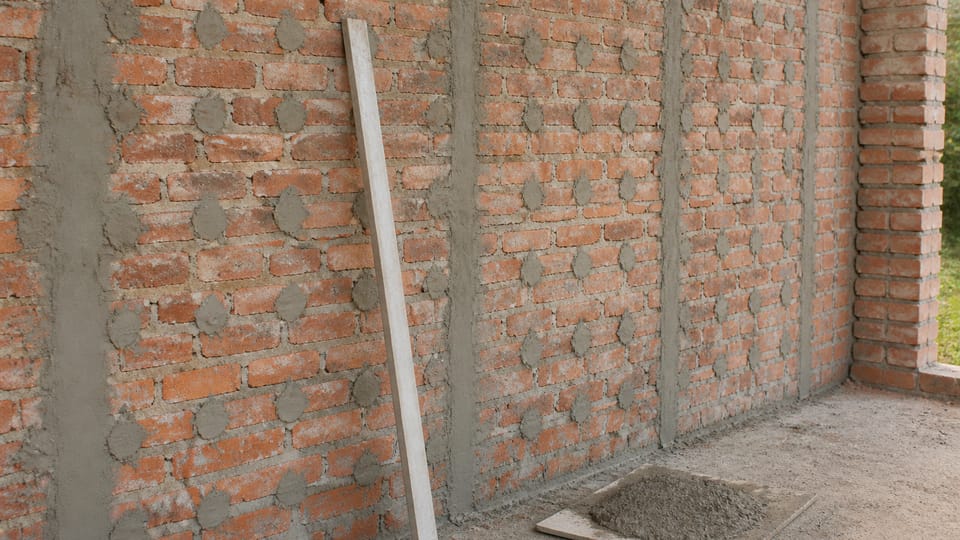
| Dot | Wall | “A small patch of plaster, fixed at intervals on a background, plumbed or levelled, and used in fixing screeds.” | IS 10403 cl 2.19 |
| Screed | Wall or ceiling | “Narrow strips or bands of plaster laid on walls or ceilings to serve as guide for bringing the whole work to a true or even surface” | IS 10403 cl 2.49 |
| Screeding | Floor | “The range of operation involved in laying a screed to receive floor finish.” | IS 10403 cl 2.50 |
| Screeding | Floor | “Bringing the floor to a true and even surface by means of screeding board.” | IS 2571 cl 2.3.1 |
| Screed strips | Floor | “Temporary narrow strips of wood or steel” | IS 2571 cl 2.2.1 |
A wall screed stays in the work: IS 10403 says the screeds are “incorporated in the final undercoats”. A floor screed strip is temporary. CPWD calls the wall patches “gauges”. For floors, read what screeding is in flooring.
What is dubbing out?
Dubbing out means building up low spots before the main coat. The strict definition is different. IS 10403 and IS 1661 call it “The operation of attaching pieces of slate, tile, etc, to a wall with plaster, and then likewise covering them in order to fill out hollows or to form projections.”
In working use, it often means filling with mortar alone. IS 2394, the lime plaster code, says it “consists in filling the holes and depressions with mortar of the same mix as for the first coat. The patches of plaster thus done are left rough so that the subsequent coat of plaster would stick to it.” IS 1661 has a similar line for old brickwork, with a different mix.
The timing matters. IS 1661 clause 9.4 says: “If dubbing out is necessary, it should be done in advance, so that an adequate time interval may be permitted before the application of the first undercoat.” So it is not done on the same pass as the main coat.
What are hacking and spatterdash?
Both give plaster something to grip on a smooth surface.
Hacking is “The roughing of solid backgrounds, by hand or mechanical methods, to provide a suitable key.” A key is the rough or grooved surface that plaster holds on to. IS 1661 says a smooth surface may be roughened “by wire brushing, if it is not hard; or by hacking or bush-hammering if it is hard.” For concrete, CPWD Volume 1 clause 5.4.7(d) says: “The roughening shall be done by hacking. Before the surface is plastered, it shall be cleaned and wetted so as to give bond between concrete and plaster.” In practice, your engineer should watch how deep the hacking goes. See plastering a ceiling.
Laitance is the skin that this roughening removes. IS 2571 calls it “A thin layer, consisting essentially of fine cement particles, which often forms a scum on the surface of freshly laid concrete.”
Spatterdash is “A mix of cement and fairly coarse sand, prepared as a thick slurry. It is thrown on as initial coating to provide a key on dense backgrounds having poor suction, or to reduce or even-out suction of other types of background.” IS 1661 gives it as an alternative for a hard surface. It contains coarse sand, is thrown on and is left to harden. That differs from the cement slurry brushed on as a bond coat before plaster or tiles.
In what order do these happen on a wall?
No code gives one list for every wall. IS 1661 gives pieces of the order. Pipes and fixings go in first (clause 9.3), and dubbing out is done in advance (9.4). Surfaces are prepared before the first undercoat (10.2), which is where roughening belongs. IS 1661 says it is “an advantage to plaster the ceilings first” (10.4), and CPWD says ceiling plaster shall be completed before wall plaster. Then come the undercoats and the finishing coat. Sources differ on when the guides are set: IS 1661 clause 10.5 lays screeds on the first undercoat, as the second coat goes on, while CPWD sets its gauges first. Follow your specification.
What do the plaster defect names mean?
These are the IS 10403 definitions, with the cause IS 1661 gives where it gives one.
| Defect | Meaning | Cause or note |
|---|---|---|
| Blistering | “The development of one or more local swellings on the finished plaster surface.” | IS 1661: “The most common cause is local exposure to radiant heat.” |
| Cracking | “The development of one or more fissures not assignable to structural cause.” | IS 1661: “usually caused by movement in the background or the surrounding structure” |
| Crazing | “The development of a series of hair cracks on the finished plaster surface.” | Called map crazing when the pattern is haphazard |
| Efflorescence | “A deposit of soluble salts on the surface of the plaster or background.” | IS 1661: dry brushing as it appears |
| Flaking | “The scaling away of patches of plaster surface due to lack or loss of adhesion with the earlier coat.” | The top coat lets go of the coat below |
| Peeling | “The dislodgement of substantial areas of plaster work from the background.” | Whole areas leave the wall |
| Grinning | “The appearance on the surface of the plaster of the pattern of joints or similar breaks in the continuity of the surface characteristics of the background.” | IS 1661: “generally caused by marked differences in suction of the background” |
| Popping | “The appearance on the surface of the plaster or rendering of conical hollows ( pops or blows ).” | IS 1661: unsound particles, often from poorly slaked lime |
The definition of cracking does not mean every crack is harmless. A crack that may be structural needs your engineer. See types of cracks in house walls.
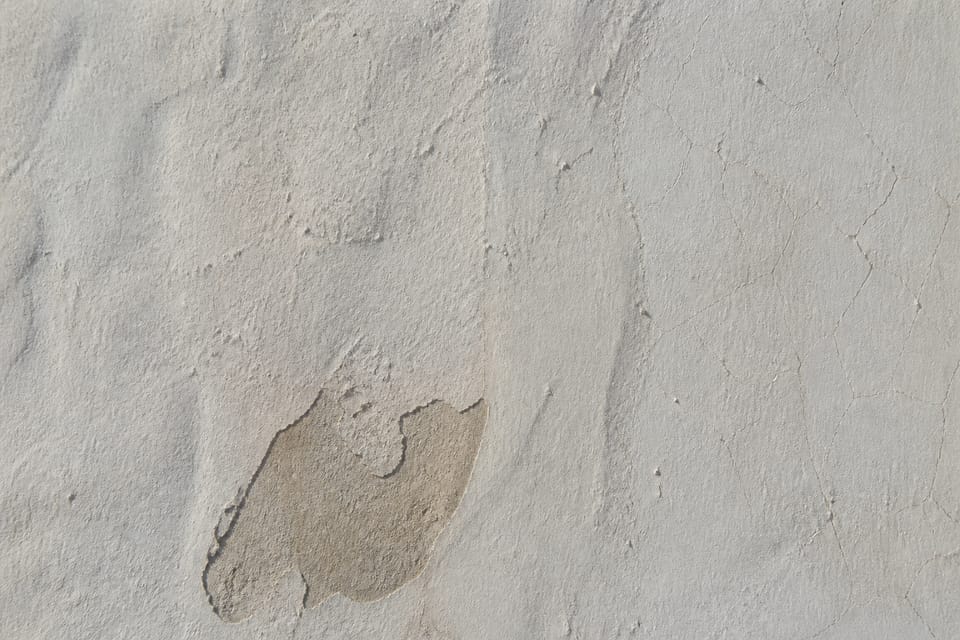
IS 1661 clause 17.1.1 gives the first rule for all of these: “It is essential to determine the cause of any defects of plasterwork before any attempt is made to remedy or repair them”.
What is neeru?
IS 1661 clause 4.2(a) says: “Lime Putty ( or Neeru ) — This shall be obtained by slaking lime with fresh water, and sifting it.” IS 2394 has a “Neeru finishing coat” in Table 2. In practice, ask what is in any bagged product sold under that name.
What mistakes should I avoid?
These are practice points unless a code is named.
- Signing a quote that says “punning” with no binder named.
- Using a thick finishing coat to correct an uneven wall. Dub out first.
- Dubbing out on the same pass as the main coat. IS 1661 9.4 says it is done in advance.
- Skipping the roughening on smooth concrete.
- Mixing up a floor screed and a wall screed in a contract.
- Patching a defect before finding its cause. IS 1661 17.1.1 asks for the cause first.
Frequently asked questions
Is punning the same as putty?
No. Punning is a word for a finishing process, and it names no binder. Wall putty is a product. See plaster vs putty.
Is hacking needed on RCC?
CPWD says the concrete surface is roughened by hacking before plaster. For your house, your specification and engineer decide. A maker’s claim that a bonding agent replaces hacking needs your engineer’s agreement.
What is the difference between flaking and peeling?
Flaking is the top coat scaling away from the coat beneath it. Peeling is a substantial area coming away from the wall itself.
What is a sponge finish?
IS 10403 lists a sponge plaster finish as “A textured finish produced by dabbing with a sponge.”
Are mason’s words the same across India?
No. Site words vary by region and trade, and we could not verify them, so we leave them out. Write the English term in your contract and agree what it means.
Related guides
- How to plaster a wall: the steps from preparation to finish
- How to check plastering work: hollow patches, line, level and finish
- IS 2116 and IS 1542: sand grading for masonry mortar and plaster
This guide is general information. Read the disclaimer. Your engineer and written specification decide what is done on your walls.
Sources
- IS 10403:1983, Glossary of terms relating to building finishes: clauses 2.10, 2.15, 2.16, 2.19, 2.21, 2.22, 2.27.6, 2.28, 2.29, 2.32, 2.34, 2.38, 2.42, 2.45, 2.49, 2.50 and 2.53 (page images read). BIS shows validity to 31 January 2027.
- IS 1661:1972, Application of cement and cement-lime plaster finishes: clauses 2.5.1, 4.2(a), 9.3, 9.4, 10.2, 10.4, 10.5, 12.1.2, 12.2.2, 17.1.1 and 18.2, and Table 1. BIS shows validity to 31 January 2027.
- IS 2394:1984, Application of lime plaster finish: clause 9.3 and Table 2. BIS shows validity to 31 January 2027.
- IS 2571:1970, Laying in-situ cement concrete flooring: clauses 2.1.2, 2.2.1 and 2.3.1. BIS shows validity to 31 January 2027.
- IS 2547 (Part 1):1976, Gypsum building plaster: clause 3.1 (classes). BIS shows validity to 31 January 2027.
- CPWD Specifications 2019: Volume 1 clause 5.4.7(d); Volume 2 clauses 13.1.4.1, 13.1.4.2, 13.2.1 and 13.6.1. For CPWD works, used here as a reference. Volume 2 link; Volume 1 is spev1.pdf at the same address.
General information only. It is not a structural design or professional advice. Ask a licensed structural engineer or architect to check your plans and site.