
Short answer
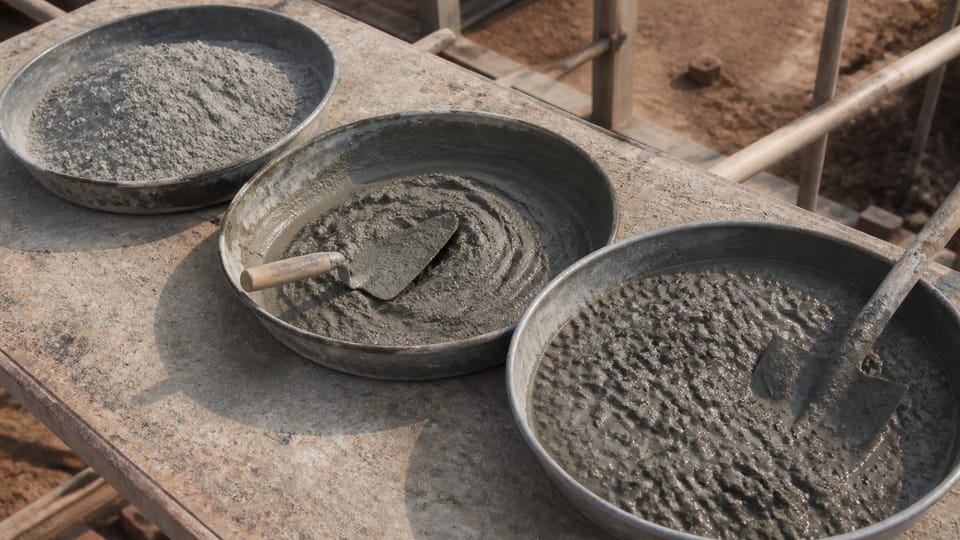
What is the difference between cement, concrete and mortar? Cement is the grey binding powder and is mixed, not used by itself. Mortar is cement paste with sand, used between bricks and as the base of plaster. Concrete is cement paste with aggregate in it, poured into forms for footings, columns, beams and slabs. Reinforced concrete adds steel bars. The grade and the mix are set by your engineer.
On this page (10)
On a site these three words are used loosely: “put cement on the road”, “cement slab”, “concrete plaster”. The confusion is costly, because an owner who orders “cement” when the drawing asks for a concrete grade has not ordered a slab. This page explains each in plain words, quotes what the Indian standards define, and shows where each goes in a house. It prints no mix ratio, strength or price; for those see cement, sand and aggregate per cubic metre: M5 to M20 and mortar ratio for brick walls: 1:4, 1:5 or 1:6?.
What is cement?
Cement is the binder. IS 4845:1968, the old definitions standard, says “hydraulic cement, more commonly known as cement, is one of the most extensively used basic materials in all civil engineering constructions”. It defines hydraulic cement as a finely ground material which, on adding water, is capable of hardening both under water and in air by chemical interaction with water. Portland cement is cement obtained by grinding Portland clinker with the possible addition of a small quantity of gypsum, water or both. In practice (not from a standard), cement is not used by itself as a building material, thin slurry and finish coats aside: it is the glue, mixed with sand or with sand and aggregate, and it hardens by reacting with water, not by drying.
IS 269 is the Indian specification for ordinary Portland cement; other cement types have their own standards. BIS lists the 2015 edition as the one in force, and NBCS 2026 lists it too, but we could not read it, and this page makes no claim about its clauses. For the cement types, see OPC vs PPC vs PSC cement: which one for your house?.
What is mortar?
Cement mortar is cement paste with sand in it. IS 6461 (Part 12) defines cement paste as “a mixture of cement and water”. IS 2250 clause 2.1 defines masonry mortar as “a homogeneous mixture, produced by intimately mixing cementitious materials, water and inert materials, such as sand, to the required consistency for use in building together with masonry units”. Its scope covers mortars for masonry work, and IS 2250 also names lime mortar, “a mortar containing lime and sand”, and composite mortar, “a mortar containing cement and lime in addition to other ingredients”. In a house, mortar is the joint between bricks and blocks, and the base layer for plaster.
What is concrete?
Concrete is cement paste with aggregate in it. IS 6461 (Part 12) clause 2.84 calls concrete “a composite material which consists essentially of a binding medium within which are embedded particles or fragments of aggregate”, and for Portland cement concrete the binder is a mixture of Portland cement, any admixture the engineer-in-charge accepts, and water. The standard’s “matrix” entry (clause 2.148) nests the two: for mortar it is “the cement paste in which the fine aggregate particles are embedded”, and for concrete it is “the mortar in which the coarse aggregate particles are embedded”.
IS 383:2016 draws the line between the aggregates: fine aggregate is “aggregate most of which passes 4.75 mm IS Sieve” and coarse aggregate is “aggregate most of which is retained on 4.75 mm IS Sieve”. So in plain words, sand is the fine part, and the stone chips are the coarse part. Concrete is poured into forms for footings, columns, beams and slabs. For the grade on your drawing, see concrete grades M15 to M25: what the number means on your drawing.
How do they compare?
| Cement | Mortar | Concrete | |
|---|---|---|---|
| What it is | The binder powder | Cement paste with sand | Cement paste with sand and coarse aggregate |
| Standard that deals with it | IS 269 (ordinary Portland cement; other types have their own) | IS 2250 (masonry mortar) | IS 456 (structural use), IS 383 (aggregates) |
| Where it goes | Mixed with sand or aggregate (practice) | Joints between bricks and blocks; base for plaster | Footings, columns, beams, slabs |
IS 456 clause 3 sends readers to IS 4845 and IS 6461 for its definitions. Clause 1.1.1 says that for plain concrete structures, “reinforcement, if provided is ignored for determination of strength … of the structure”. Plain concrete has no counted steel and reinforced concrete has steel bars, which is the difference between PCC and RCC. See PCC vs RCC: plain and reinforced concrete in a house.
What about grout, plaster and screed?
NBCS 2026 (Part C Section 4, clause 2.10) defines grout as “mortar of pourable consistency”. Plaster is a mortar-type coat on a wall: IS 6461 (Part 12) clause 2.173 defines it as a cementitious material, or a mix of cementitious material and aggregate, that is applied to a surface and hardens. Screed, in the floor sense, is the thin levelling layer under a floor finish; IS 6461 (Part 7) clause 2.286 defines screed as guide strips or a tool for striking off concrete, not as a floor layer, so we describe the floor layer in plain words only. In the standards we read, PCC and RCC are not defined as abbreviations.
What should I do with this? (practice)
This is practice, apart from the clauses named.
- Order the right thing: ask for concrete by grade per member, not by “cement ratio”. A cement bag count is not a concrete quantity.
- Walls and plaster: the mortar mix is what your engineer specifies for them.
- Ask the contractor: which concrete grade goes where; who measures the mix and checks it; who looks after curing afterwards.
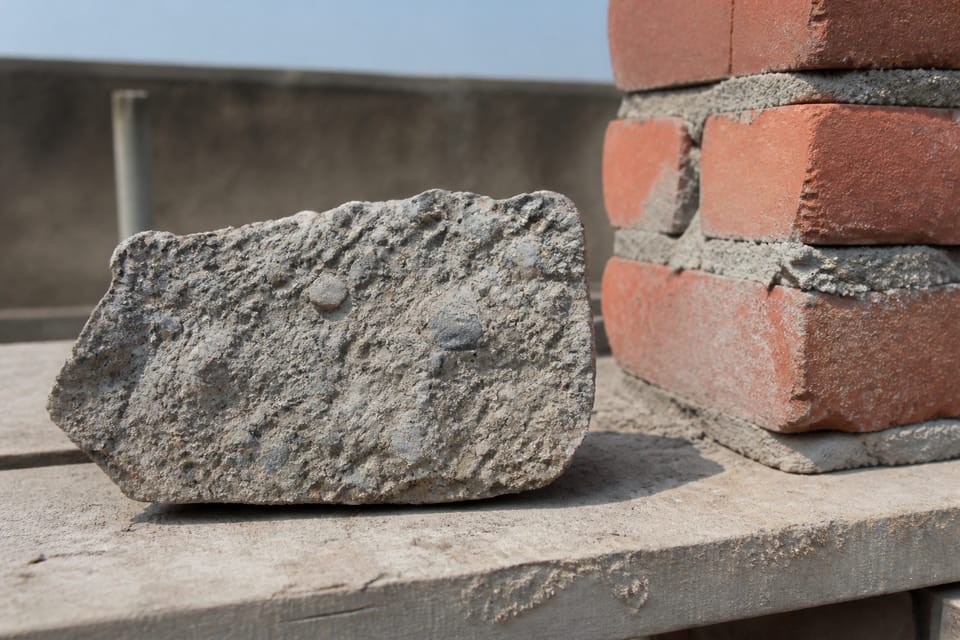
- Check on site: a broken piece of concrete may show stone pieces, and mortar shows only sand; cube test records exist for concrete.
What mistakes should I avoid? (practice)
- Filling a column or lintel with sand and cement and calling it concrete.
- Believing more cement is always better.
- Mixing by eye with no measure.
- Letting concrete or mortar dry out with no curing.
- Using a concrete mix for plaster, or a plaster mix for structure.
- Adding extra water to make it easier to work.
Frequently asked questions
Is cement the same as concrete?
No. Cement is the binder powder. Concrete is a mix of cement paste, sand and coarse aggregate.
What is the difference between concrete and mortar?
Mortar has sand and no coarse aggregate and is used for joints and plaster. Concrete has coarse aggregate and is used for structure.
Can I use mortar instead of concrete?
In practice, not for structural members. IS 456 covers structural concrete, and mortar is not what it covers; your engineer sets the grade.
Does concrete dry or cure?
It hardens by chemical reaction between cement and water, which IS 6461 (Part 12) clause 2.139 calls hydration, and it then needs curing, meaning it is kept moist. IS 4845 describes cement as hardening both under water and in air by reaction with water.
What is the difference between PCC and RCC?
PCC is plain concrete and RCC is reinforced concrete with steel bars in it.
Related guides
- Cement, sand and aggregate per cubic metre: M5 to M20
- Mortar ratio for brick walls: 1:4, 1:5 or 1:6?
- PCC vs RCC: plain and reinforced concrete in a house
- Grout vs mortar: what each is made of and where each is used
This guide is general information. Read the disclaimer. Your engineer decides the concrete and mortar for your house.
Sources
- IS 4845:1968, Definitions and Terminology Relating to Hydraulic Cement: foreword 0.2 and clauses 2.1, 3.1 (page images read). BIS shows this edition as withdrawn on 2026-09-20, replaced by IS 4845:2026, which we could not read. NBCS 2026 still cites the 1968 edition.
- IS 6461 (Part 12):1973, Glossary of Terms Relating to Cement Concrete, Part 12: clauses 2.67, 2.84, 2.139, 2.148 and 2.173 (clauses 2.67, 2.84 and 2.148 page images read; 2.139 and 2.173 text layer). BIS shows the 1973 edition as withdrawn on 2025-04-17, replaced by a 2024 edition, which we could not read.
- IS 2250:1981, Code of Practice for Preparation and Use of Masonry Mortars: clauses 1.1, 2.1 to 2.3 (page images read). BIS lists it as in force, valid to 2030-09-17.
- IS 383:2016, Coarse and Fine Aggregate for Concrete, Specification: clauses 3.1 and 3.2 (page images read). BIS lists it as in force, valid to 2030-07-12.
- IS 456:2000, Plain and Reinforced Concrete, Code of Practice: clauses 1.1, 1.1.1 and 3 (page images read). BIS lists it as in force, valid to 2030-07-12.
- SP 7:2026, National Building Construction Standards (NBCS) 2026, Part C Section 4, Masonry, clause 2.10 (page image read). From an unofficial archive.org copy.
Change log
- : Added Related guides link to newly published article(s): grout-vs-mortar-what-each-is-made-of-and-where-each-is-used. No other text changed. Approved by the reviewing engineer.
General information only. It is not a structural design or professional advice. Ask a licensed structural engineer or architect to check your plans and site.