
Short answer
How should an AAC block wall be plastered, and what does IS 6041 say? IS 6041 asks for external renderings only on fully dried walls, not in the monsoon, with a surface cleaned, roughened if needed and moistened just before rendering, a coarse wooden-float finish, and a yearly pre-monsoon check. Its own text says nothing about mesh or a dash coat. IS 1661 says mesh over a material junction is not always successful and that the best treatment may be a neat cut.
On this page (8)
AAC blocks are light, absorbent and soft, so plaster that works on a brick wall can crack or fall off them. Web pages and makers give many methods. This page reads what the Indian code for AAC masonry (IS 6041) and the general plaster code (IS 1661) say, and where they say nothing. It gives no brands, no prices, and no mix ratios or thicknesses: IS 6041 does list ratios and coat thicknesses in clause 12, and your engineer or the block maker decides which suit your wall. For the general steps of plastering, see how to plaster a wall. For why AAC walls crack, see why AAC block walls crack.
What does IS 6041 say about rendering and plaster?
Clause 12 of IS 6041 covers renderings and plaster on cellular concrete block walls.
| Question | What the standard says | Clause |
|---|---|---|
| Why render outside? | The exterior surface “shall be made waterproof by treating the walls with different types of renderings, depending upon the intensity of rainfall, nature of exposure” | 12.1 |
| When? | “Renderings shall not be applied to the walls when these are wet or in monsoon. The walls shall be treated only after they are fully dried.” This is in the clause on external rendering | 12.1.1 |
| Bond | Satisfactory performance “depends entirely on the efficiency of the bond”: prepare the surface, roughen it if necessary, clean it of loose particles and dust, and moisten it with water “just prior to applying the rendering to prevent absorption of water from it” | 12.1.2 |
| Sand and finish | Sand graded from 3 mm downwards; the plaster “shall not be finished smooth but provided with a coarse finish by means of a wooden float” | 12.1.2 |
| Coats outside | The number of coats and mortar depend on rainfall: two coats in heavy rain or sea exposure, at least one coat or two coats of cement paint in moderate rainfall, pointing only where rainfall is scarce; exposed blocks have their own options | 12.1.3 to 12.1.6 |
| Inside | The interior surface may be plastered with one coat, with a second thin finish coat where a very smooth finish is wanted; or the block left exposed, flush pointed and painted. Oil-based paints “are liable to attack by alkali” from the blocks and mortar | 12.2 |
| After | Exposed walls “shall be inspected closely every year before monsoon, and cracks, if any shall be sealed properly with a cement grout and painted with two coats of cement paint” | 13.1 |
External rendering is to be applied “in accordance with IS 2402” (clause 12.1.1), the code for external rendered finishes, which we read only in part (see below). The mixes and thicknesses in 12.1.3 to 12.2 are not printed here. They are from 1985 and the standard is general, so ask the block maker and your engineer for the system on your wall.
What does IS 6041 not say?
This matters because many web pages attribute these to it. IS 6041’s own text does not ask for mesh at the joint between AAC and a column or beam, for a dash coat or bonding coat, for any plaster curing period, for a waiting period such as “28 days”, or for rules on chasing for pipes and conduits. It does not cover gypsum plaster on AAC or thin-coat plasters sold as systems. But it sends external rendering to IS 2402 (clause 12.1.1), and that code, which we read only in part from its text, has its own clause on curing and says that where a rendering is continuous across different backgrounds, metal lathing or wire netting fixed across the junction will minimise cracking, or a straight cut can be made through each coat. So the external-render rules come from IS 6041 and IS 2402 together, and an engineer should confirm which applies to your wall. Its “joint reinforcement” is galvanised wire in the bed joints of the masonry, not plaster mesh. The standard says the walls “shall be treated only after they are fully dried” before external rendering, and gives no number of days.
The bedding mortar clause (3.9.2) says the blocks “shall be embedded with a mortar, the strength of which is relatively lower than that of the mix used for making blocks”, to avoid cracks. That is a rule for the joints, not for the plaster.
What does IS 1661 add?
IS 1661:1972 is the general code for cement and cement-lime plaster. It is not about AAC, but it helps:
- Background: its table of background data for internal plastering (Table 1) has a row for aerated concrete: drying shrinkage “moderate to high”, suction “moderate to high” with a “reasonable key”, and “It may be necessary to reduce the suction unless special plasters are used”. It adds that the background should be dry to minimise shrinkage movement.
- Moistening: a wall “shall not be soaked but only damped evenly” before plastering, and spots that dry out are moistened again (clause 8.2.2). High suction pulls water out of the plaster and makes it weak and friable (8.2.1).
- Drying before plaster: the masonry is allowed to dry out for a sufficient period so that initial drying shrinkage is fairly complete (12.2), with no number of days.
- Strength: the strength and elasticity of the plaster “shall be compatible with that of the background” (12.1.5).
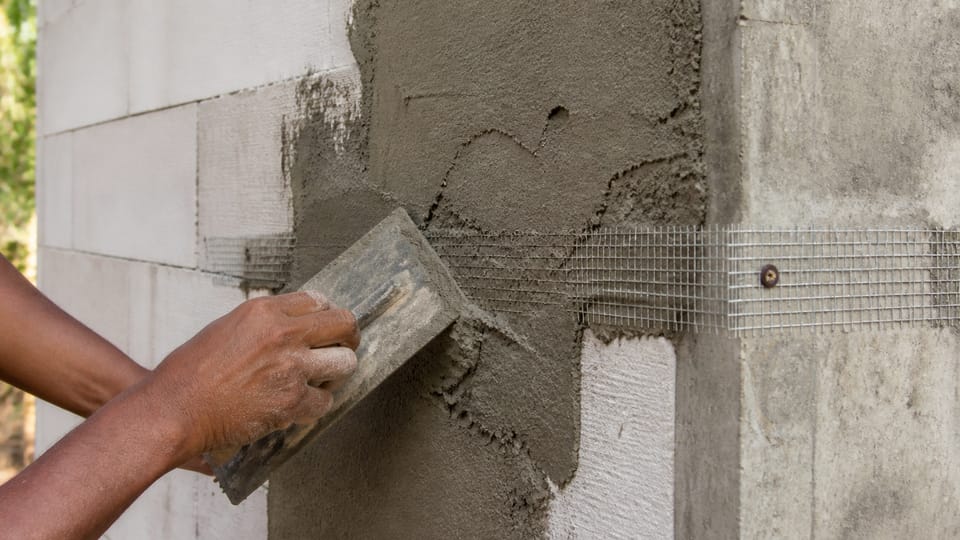
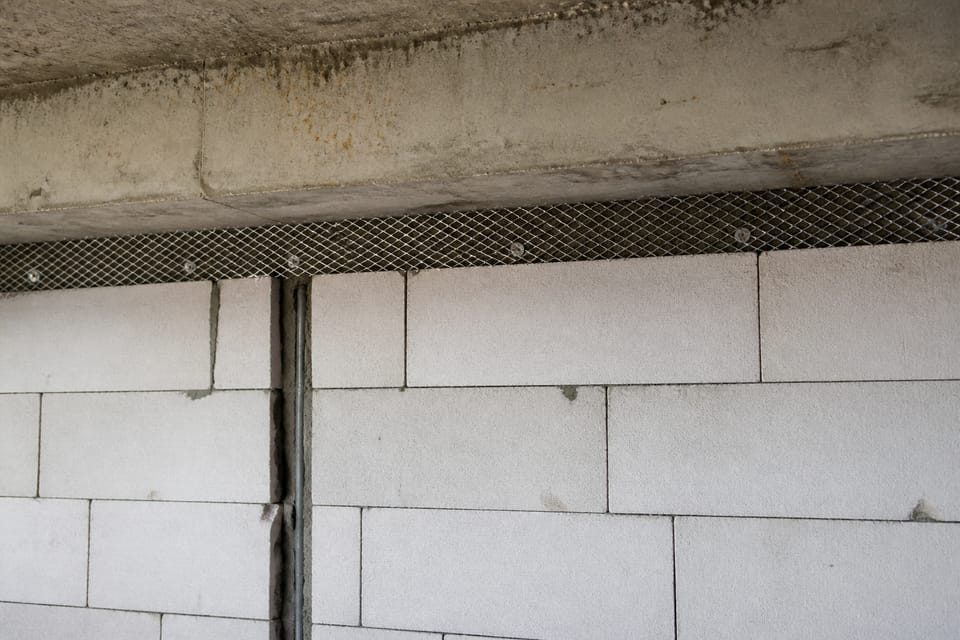
- Junctions: cracking is often caused by discontinuity, for instance changing from concrete to brickwork or from clay brickwork to lightweight concrete blockwork. Our reading is that an AAC wall meeting a column or beam is a similar case. “Reinforcement of the plaster by metal lathing or scrim over the junction is not always successful. The best treatment may be to separate the two portions by a neat cut through the plaster at the junction”, which may be masked by a cover strip (12.1.7). For a wall-to-ceiling junction it allows a straight cut through the plaster (12.1.7.1).
- Key: its clause 12.1.2 gives spatterdash for a hard surface like concrete, and for a soft smooth surface a thin cement slurry after hacking, and says wire netting may be fixed in special cases to improve the key. It does not name AAC, so a dash coat on AAC is a maker’s system.
So for the AAC-to-column or beam junction, IS 1661 says the best treatment may be a planned cut, and says mesh over the junction is not always successful, while IS 2402 (read in part) mentions metal lathing or wire netting across the junction as well as a cut. Mesh is common site practice. Ask your engineer which one the drawing uses. See how to check plastering work for the junction check.
What should I check before and during plastering?
This is practice, not a standard, unless a clause is named.
- The frame has settled and the wall is dry. IS 6041 asks for external walls to be fully dried and not rendered in the monsoon.
- Block joints are filled, the surface is clean of dust, and chases for pipes and conduits are cut, filled and finished before plaster (no clause for AAC chasing: ask your engineer).
- The wall is moistened evenly just before plastering, not soaked. This follows IS 6041 12.1.2 and IS 1661 8.2.2, and makers differ on wetting at the laying stage (see the AAC laying guide), so for any plaster system follow the maker’s data sheet.
- The mix suits AAC. Do not ask for a rich, strong mix on a soft block: IS 1661 asks that the plaster be compatible with the background.
- A planned cut or a mesh strip at the junction with a column or beam, as the engineer shows, and a cut between ceiling and wall plaster (IS 6041 4.6.2.3).
- Curing as the plaster maker or engineer says. IS 6041 gives no AAC curing period, so see plaster curing: how long and how for the general cement plaster rules.
What mistakes should I avoid?
These are practice, not code rules.
- Plastering in the monsoon or on wet or green blocks.
- Soaking the wall, or leaving it dry so that it pulls the water out of the plaster.
- A rich, strong mix on soft AAC, or one thick coat to hide uneven blocks.
- No planned cut or strip at the junction with a column or beam.
- Chasing the wall after plaster.
- Running plaster continuously from the wall to the ceiling.
- Assuming a primer or dash coat is required, or that it replaces the maker’s system, without reading the maker’s sheet.
- Filling large cracks with putty and paint. See hairline cracks in plaster.
Frequently asked questions
Do AAC blocks need mesh before plastering?
IS 6041’s own text does not ask for mesh. IS 1661 says reinforcing plaster over a junction between materials is not always successful and that the best treatment may be a neat cut, and IS 2402 mentions mesh or a cut. Mesh strips are common practice, so follow your engineer’s drawing.
Should I wet AAC blocks before plastering?
IS 6041 asks for the surface to be moistened with water just before rendering. IS 1661 says damp evenly and do not soak. Follow the plaster maker’s data sheet for a system.
Can I plaster an AAC wall in the monsoon?
IS 6041 says external renderings are not to be applied to wet walls or in the monsoon, and walls are treated only after they are fully dried.
Can I use the same plaster as on brick?
IS 6041 gives mixes for AAC in clause 12, and IS 1661 asks that the plaster be compatible with the background. Ask the block maker and your engineer for the mix and coats.
Do I need a dash coat?
IS 6041 does not ask for one. IS 1661 gives spatterdash for hard surfaces like concrete and a thin slurry for soft ones, without naming AAC. Follow the maker’s system.
Related guides
- How to plaster a wall
- Why AAC block walls crack and how to avoid it
- How to lay an AAC block wall: adhesive or mortar
This guide is general information. Read the disclaimer. Your engineer decides the plaster system for your walls.
Sources
- IS 6041:1985, Code of Practice for Construction of Autoclaved Cellular Concrete Block Masonry (first revision, reaffirmed 2005): clauses 3.9.2, 4.6.2.3, 12.1 to 12.2 and 13.1 (page images read). BIS lists it as not withdrawn.
- IS 1661:1972, Code of Practice for Application of Cement and Cement-Lime Plaster Finishes (first revision): Table 1 (aerated concrete), clauses 8.2, 12.1.2, 12.1.5, 12.1.7 and 12.2 (page images read). A general plaster code, not specific to AAC.
- IS 2402:1963, Code of Practice for External Rendered Finishes: read in part from its text (curing clause and the clause on mixed backgrounds); BIS lists it as not withdrawn.
- CPWD Specifications 2019 Vol 1, Sub Head 6.14 (AAC block masonry) and NBCS 2026 Part C Section 4 clause 6.1.1: searched, no AAC plaster clause found.
General information only. It is not a structural design or professional advice. Ask a licensed structural engineer or architect to check your plans and site.