
Short answer
What are the types of plaster used in a house? Sorted by what binds them, the main types are cement, cement-lime, lime and gypsum plaster. Mud plaster is a traditional type that IS 1661 does not cover. External finishes such as roughcast, pebble-dash, scraped and textured are not new plasters: IS 2402 describes them as treatments of an outside rendering. IS 3630 says gypsum plaster is not suitable for external walls.
On this page (10)
- How many types of plaster are there?
- What is cement plaster, and what is cement-lime plaster?
- What is lime plaster?
- What is gypsum plaster?
- What is mud plaster?
- What are rendered finishes: roughcast, pebble-dash, scraped and textured?
- What mistakes should I avoid?
- Frequently asked questions
- Related guides
- Sources
Shops, masons and websites use many plaster names, and a list of ten or twelve “types” usually mixes two different things: what the plaster is made of, and how its surface looks. This page separates them. It names the Indian Standard that covers each type. It gives no prices, no mixes and no thicknesses. For how plaster is applied, see how to plaster a wall.
How many types of plaster are there?
There is no standard sentence that says “there are N types”. The Indian plaster codes form a series. IS 1661 covers cement and cement-lime plaster, IS 2394 covers lime plaster, IS 2547 covers gypsum plaster, and IS 2402 covers external rendered finishes. So it helps to think in two steps:
- The binder: cement, cement-lime, lime, gypsum, or (in traditional houses) mud.
- The finish: how the final coat looks, such as smooth, scraped, textured, roughcast or pebble-dash. This applies mostly to outside walls.
| Type | What it is | Indian Standard read |
|---|---|---|
| Cement plaster | Cement and sand applied while plastic, which hardens after application | IS 1661:1972 |
| Cement-lime plaster | Cement plaster “gauged” with lime | IS 1661:1972 |
| Lime plaster | Plaster in which lime is the main binder | IS 2394:1984 |
| Gypsum plaster | Plaster based on calcium sulphate, including plaster of paris | IS 2547 (Part 1):1976 |
| Premixed lightweight gypsum plaster | Gypsum plaster with lightweight aggregate | IS 2547 (Part 2):1976 |
| Mud plaster | A traditional earth plaster | Outside IS 1661’s scope |
| External rendered finishes | Treatments of the final coat of an outside render | IS 2402:1963 |
What is cement plaster, and what is cement-lime plaster?
IS 1661 says cement plaster and cement plaster gauged with lime “are widely used in this country for finishing of walls and ceilings of buildings”. It covers application to walls, columns and ceilings on brick, stone or concrete. Its table of recommended plaster specifications lists these systems for both internal and external situations.
“Cement-lime plaster” is cement plaster with lime added. IS 1661 defines it that way, and IS 10403 describes gauging as adding lime to a cement-sand mix. The standard says these mixes are highly workable and easy to apply, and that this effect becomes less pronounced as the share of cement rises. They need moisture to complete setting, so rapid drying early on should be avoided. For very smooth trowel finishes, IS 1661 says lime-cement mixes should not in general be used for finishing coats because their shrinkage on drying creates a tendency for surface crazing.
IS 1661 adds that internal plasters are usually finished smooth, and textured finishes need special techniques. How much cement, lime and sand goes in is for your engineer and the site. See plaster quantity for quantities.
What is lime plaster?
Lime plaster is plaster in which lime is the main binding material. IS 1661 states that lime plasters and mud plasters are not covered by it, so lime has its own code, IS 2394.
IS 2394 says lime plasters are “generally suited for internal surfaces” and have a long working time and a slow rate of strength development. It also says lime plaster finishes are not suitable for external surfaces in areas of heavy rainfall, very damp places, and places that need extreme water tightness. Its foreword notes that lime plaster is commonly used for both internal finishes and external renderings, so it is not an indoor-only material. Lime putty, also called neeru, is lime slaked with fresh water and sifted, and kept moist until used (IS 1661 clause 4.2).
What is gypsum plaster?
Gypsum plaster is plaster based on calcium sulphate. IS 2547 (Part 1) classes it as plaster of paris, and retarded hemihydrate gypsum plaster in undercoat and final-coat types. Anhydrous gypsum plasters and Keene’s plaster are for finishing only. Premixed lightweight plasters, a gypsum plaster with lightweight aggregate, are in Part 2.
IS 2547 does not say where gypsum plaster may or may not be used. The Indian standard on gypsum block partitions, IS 3630, does: it says gypsum blocks, plaster-board and gypsum plaster “are not suitable for use in external walls, whether protected or unprotected”. As practice, not a code rule: keep gypsum plaster to dry inside walls and ceilings. The decision between gypsum and cement plaster, and what to do in damp areas, is in gypsum plaster vs cement plaster.
What is mud plaster?
Mud plaster is a traditional earth plaster. It is regional practice, and IS 1661 excludes it. We did not find an Indian Standard that sets out how to apply it. Treat it as a regional practice and ask your engineer or an experienced local builder if you plan to use it.
What are rendered finishes: roughcast, pebble-dash, scraped and textured?
IS 2402 uses the word “rendering” for external plaster and allied finishes, plain or textured. It treats the finishes below as ways of treating the final coat. They are not different plasters.
| Finish | How IS 2402 describes it |
|---|---|
| Pebble-dash (dry-dash) | Small pebbles or crushed stones are thrown on to a freshly applied final coat of mortar and left exposed |
| Roughcast | The final coat contains fairly coarse aggregate, is thrown on as a wet mix and is left rough |
| Scraped | The final coat is levelled, allowed to stiffen, then scraped to remove the surface skin |
| Textured | A patterned or ornamental surface made with tools on the fresh final coat |
| Machine-applied | The final coat is spattered or thrown on by hand or power-operated machines |
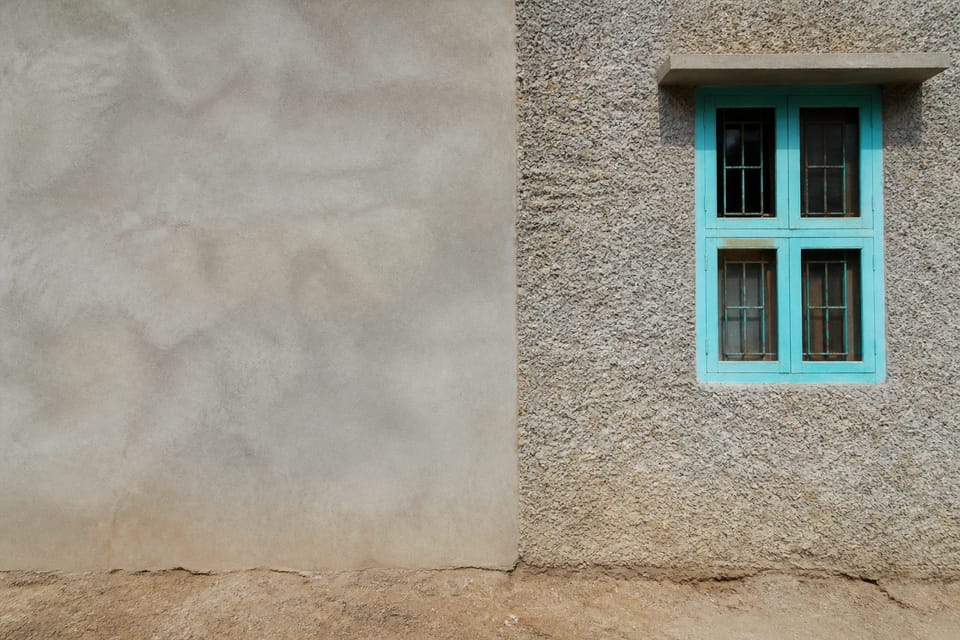
IS 2402 compares them. It says steel-trowelled finishes are “not recommended for external renderings” and that smooth floated finishes are the type most likely to develop crazing, cracking and patchiness. Scraped and textured finishes are generally less liable to crack and craze. Roughcast and dry-dash are particularly suitable for heavy rain, strong winds and severe exposure, though they are not suitable on weak types of brick or lightweight concrete, and they need little maintenance except for fungus growth. Machine-applied finishes often show dirt badly in industrial and dusty areas, and are mainly proprietary processes run by specialists. These are the code’s suitability statements, not a ranking.
IS 2402 also says renderings of Portland cement, or cement and lime, with properly graded aggregate “have sufficient durability and do not require any protective coating” when a suitable mix is carefully applied. For more on these finishes, see rough-cast, pebble-dash and scraped exterior plaster.
Trade names such as “sand-faced” and “stucco” cause confusion. We found no definition of “sand-faced” in IS 2402, IS 1661, IS 2394, IS 10403 or the CPWD specification we read. CPWD only says the surface is finished with a trowel or a wooden float, according to whether a smooth or a sandy, granular texture is required. IS 10403 defines stucco only as “a form of rough cast plastering”. The word is also used by makers for white gypsum finishing products. Ask the seller exactly what is in the bag.
What mistakes should I avoid?
These are practice, not code rules, unless the standard is named.
- Treating “type” lists as twelve different materials. Most differences are in the finish or the base.
- Using gypsum plaster on outside walls. IS 3630 says it is not suitable there.
- Choosing a smooth steel-trowelled finish for an outside wall. IS 2402 does not recommend it.
- Asking for “roughcast” or “pebble-dash” on weak or lightweight blocks without checking. IS 2402 says they are not suitable on weak brick or lightweight concrete.
- Buying a bagged product by its trade name (“stucco”, “ready mix”) without reading what it is made of and which standard it follows.
- Comparing quotes by plaster name instead of by wall, coats and finish.
Frequently asked questions
Is POP the same as gypsum plaster?
Plaster of paris is one class of gypsum plaster in IS 2547 (Part 1). Gypsum plaster also includes retarded hemihydrate types. See wall putty vs POP vs white cement for how the words are used on site.
Which plaster is used on outside walls?
IS 1661’s table lists cement and cement-lime plaster systems for external use, and IS 2402 covers external rendered finishes. Gypsum plaster is not suitable for external walls (IS 3630, the code for gypsum partitions), and lime plaster is not suitable for external surfaces in heavy rainfall (IS 2394).
Is lime plaster better than cement plaster?
The codes do not rank them. They describe different jobs. Lime is workable, slow to gain strength, and suited to internal surfaces. Cement and cement-lime are widely used for both inside and outside.
Are roughcast and pebble-dash separate plasters?
No. IS 2402 describes them as finishes of the final coat of a rendering, one with coarse aggregate in the wet mix and the other with pebbles thrown on to a fresh coat.
Does the type of plaster change the curing?
IS 1661 says cement-lime mixes need moisture to complete setting, so rapid drying in the early stages should be avoided. For days and method, see plaster curing.
Related guides
- How to plaster a wall: the steps from hacking to finishing
- Gypsum plaster vs cement plaster
- Rough-cast, pebble-dash and scraped exterior plaster explained
- Plastering terms: punning, screed, dubbing out, hacking and defects
This guide is general information. Read the disclaimer. Your engineer or site supervisor decides the plaster for each wall of your house.
Sources
- IS 1661:1972, Code of practice for application of cement and cement-lime plaster finishes (foreword 0.2, clauses 1.1, 2.1.4, 4.2, 7.1, 7.5 and Table 2, read from the rendered pages). BIS shows it not withdrawn.
- IS 2394:1984, Code of practice for application of lime plaster finish (foreword and clauses 1.3, 8.1.1, 8.1.2).
- IS 2547 (Part 1):1976, Specification for gypsum building plaster excluding premixed lightweight plasters (clauses 1.1, 3.1 and foreword 0.2) and Part 2:1976, premixed lightweight plasters (clause 1.1). Neither part says where gypsum plaster may or may not be used.
- IS 3630:1992, Construction of non-load bearing gypsum block partitions: Code of practice (clause 6.1.1 on gypsum plaster and external walls). BIS shows its validity ending 2026-12-31; re-check before relying on it.
- IS 2402:1963, Code of practice for external rendered finishes (clauses 1.1, 1.2, 2.3, 6.2.1 to 6.2.4, 6.5.3 and Table I, read from the rendered pages). It cites older editions of IS 1661.
- IS 10403:1983, Glossary of terms relating to building finishes (clauses 2.27.4 stucco and 2.30 gauging).
- CPWD Specifications 2019 Vol 2, plastering chapter 13 (clauses 13.1.4.2, 13.7, 13.8), a specification for government works used here as description only.
Change log
- : Added Related guides link to newly published article(s): plastering-terms-explained-punning-screed-dubbing-out-hacking-spatterdash-and-defects. No other text changed. Approved by the reviewing engineer.
General information only. It is not a structural design or professional advice. Ask a licensed structural engineer or architect to check your plans and site.