
Short answer
What do CG and RG on a tile grout pack mean? In IS 17190:2020, CG means cementitious grout and RG means reaction resin grout, the group epoxy grouts usually fall in. The standard has five types: CG1, CG2 (which may include polymer), RG1, RG2 and MRG (modified resin). It does not call any type better, and grout is not for movement joints.
On this page (12)
- What is tile grout, and what is it not?
- What do CG1, CG2, RG1, RG2 and MRG mean?
- What does the standard test?
- What must the pack say?
- What about white cement and the “cement grout” mixed on site?
- Cement grout or epoxy grout: how do they differ?
- Does grout waterproof a floor or hold tiles on?
- What should I check as an owner?
- What mistakes should I avoid?
- Frequently asked questions
- Related guides
- Sources
“Grout”, “white cement” and “epoxy” are used as if they were the same thing, and the pack in the shop may carry letters such as CG2 or RG1. This page explains what tile grout is and what those letters mean in the Indian Standard. It gives no brand ranking, price, mix ratio, joint width, working time or curing time. It does not say that epoxy is always better, because the standard does not.
What is tile grout, and what is it not?
IS 17190 defines tile grout as “any suitable product used to fill the joints between various types of tiles and stones with the exception of movement joints and expansion joints” (clause 3.20). So a grout fills the joints, and it is not the adhesive that holds the tile on and not the waterproofing under it. Movement and expansion joints are outside this definition, and the usual practice is to leave them as soft joints. For where those go, see expansion joints in a house.
The standard covers grouts for joints between tiles, stones and mosaics, indoors and outdoors, on floors and walls (clause 1).
What do CG1, CG2, RG1, RG2 and MRG mean?
IS 17190 has five types, not four.
| Type | What the standard says | Clause |
|---|---|---|
| CG1 | Cementitious grout: cement, optionally graded sand, and additives for water retention; uniformly coloured | 4.1 |
| CG2 | Like CG1 but with other ingredients, including re-dispersible polymer powder, or a liquid latex used in place of some or all of the mixing water | 4.2 |
| RG1 | Reaction resin grout that is essentially a 100 percent solid system, supplied in two or more parts mixed just before use; a suitable cleaner is used after application | 4.3 |
| RG2 | Reaction resin grout that is not essentially 100 percent solid, supplied in two or more parts and partially emulsified with water so it can be cleaned during application | 4.4 |
| MRG | Modified resin grout, made of materials other than cement and not covered by RG1 or RG2, with an extra deformability requirement for demanding, flexible substrates such as exterior work | 4.5 |
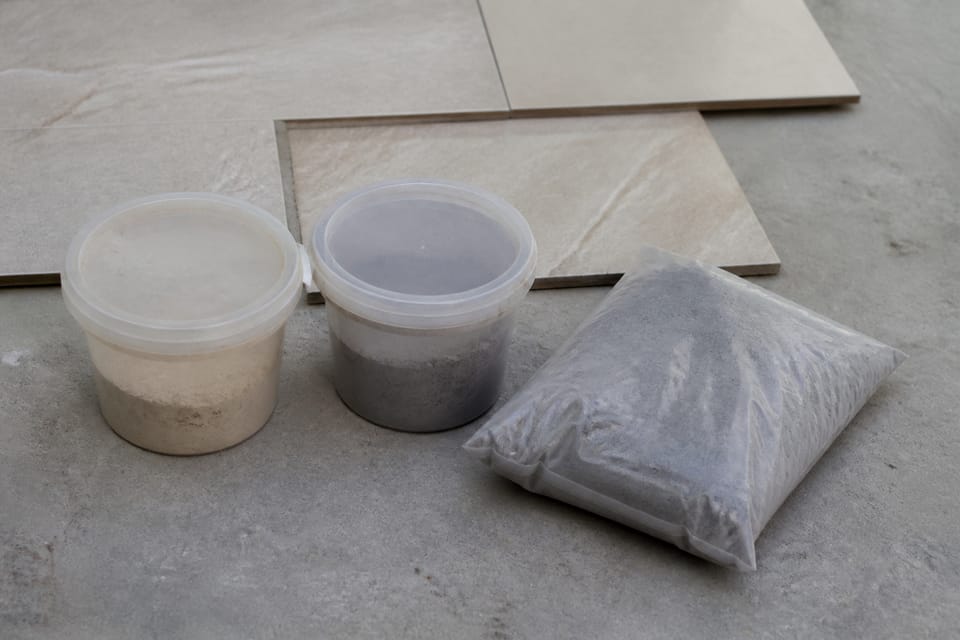
Cementitious grout is a “mixture of hydraulic binding agents, aggregates, inorganic and organic additives” mixed with water or liquid admixture just before use (3.4). Reaction resin grout is “a single or multi-component mixture of synthetic resin, aggregates, inorganic and/or organic additives in which hardening occurs by chemical reaction” (3.16). The standard never uses the word epoxy. Epoxy grouts are commonly sold as two-part resin grouts, so they fall in this group, but that link is practice and not wording of the standard.
The standard does not call CG1 “normal” or CG2 “improved”, and it does not rank the types. It defines no suffix letters such as W or F, though a note under clause 7.1 lets a maker add special-property information to the designation. Packs with extra letters often follow foreign (ISO or EN) marking, and we did not read those standards.
What does the standard test?
Table 1 sets limits for properties, which differ by type: linear shrinkage (not applicable to MRG), water absorption (after 30 minutes, and optionally after 240 minutes), compressive strength, flexural strength and abrasion resistance. Chemical resistance is optional for the resin types and not applicable to CG1 and CG2. Transverse deformation applies to MRG. We print no limits. In general, RG1 and RG2 have much lower water-absorption limits than CG1 and CG2, and MRG sits between them. That does not make one type right for every job.
The standard has no test for stain resistance, mould resistance, colour fastness, slip resistance or freeze-thaw. So a grout does not carry those properties because it meets IS 17190, and a pack that claims them is making the maker’s claim.
What must the pack say?
Clause 7.1 asks for the grout to be marked indelibly with the product name, the maker’s mark and place of origin, the date or code of production, shelf life and storage conditions, the type of grout, and instructions for use, such as mix proportions, pot life, mode of application and the delay for cleaning. Certification with the Standard Mark is optional (“may be certified”, clause 7.2). The standard does not set the exact form of the designation. So check that the pack names a type, and read the maker’s data sheet for the working time and cleaning.
What about white cement and the “cement grout” mixed on site?
IS 17190 does not mention white cement. It covers grouts as supplied products. A paste of white cement mixed on site is not a product the standard classifies. CPWD 2019 describes pointing ceramic tile joints flush with white cement, with pigment if needed to match, and keeping it wet (clauses 11.15.5 and 8.19.4); that is departmental practice, and it does not mention IS 17190. For white cement as a material, see wall putty vs POP vs white cement.
Cement grout or epoxy grout: how do they differ?
The standard does not choose. These points are practice, from general experience and maker literature, not from IS 17190.
| Point | Cementitious (CG1, CG2) | Reaction resin, usually epoxy (RG1, RG2) |
|---|---|---|
| Mixing | Powder plus water or liquid | Two or more parts mixed just before use |
| Absorption | More porous | Lower water absorption (see Table 1 limits) |
| Working | Easier to work and clean | Short working time; hard to clean if left on the tile |
| Cracks | Hairline cracks where the base moves | Does not fix a moving base either |
| Wet areas | Needs care in wet rooms | Still not waterproofing |
CPWD 2019 describes epoxy grout (item 11.29) as a waterless mix of a base and a hardener with very low water absorption, resistant to staining, and generally needing no additional sealer. That is a departmental specification, and it says the tiles must be firmly set and the adhesive or mortar dry before grouting.
Does grout waterproof a floor or hold tiles on?
No. The adhesive or bed holds the tile, and a waterproofing layer under the tiles keeps water out. A joint filled with grout, cement or epoxy, is only the top surface. Tap each tile before you grout, because grout does not fix a hollow tile: see epoxy flooring vs tiles for a house.
What should I check as an owner?
This is practice, not a standard.
- Ask which grout type is to be used (CG1, CG2, RG1, RG2 or MRG) and for the pack and data sheet for the area: dry room, bathroom, kitchen, exterior.
- Ask that the joints are cleaned of adhesive and mortar, the tiles are firmly set and the adhesive is dry before grouting.
- Check that the colour is chosen from a dry sample, since grout can dry lighter or darker.
- Ask for soft joints at the edges and at movement joints, not grout.
- For epoxy, ask whether the applicator has done it before and for the cleaning steps.
- Check the pack has the type, the production code and the shelf life, and do not accept an unlabelled bag.
What mistakes should I avoid?
These are practice, not code rules.
- Grouting before the adhesive or bed has set.
- Leaving adhesive or mortar in the joints so the grout has no depth.
- Expecting grout to fix hollow or loose tiles.
- Expecting epoxy grout in a wet area to act as waterproofing.
- Not cleaning off excess in time, especially epoxy.
- Grouting the movement joints or the edge joints with rigid grout.
- Too much water in a cement grout.
- Using plain white cement as grout in a wet room for the sake of colour.
Frequently asked questions
What do CG1, CG2, RG1 and RG2 mean?
CG is cementitious grout and RG is reaction resin grout. CG2 may include polymer powder or latex, RG1 is essentially 100 percent solids and RG2 is partly water-emulsified, per IS 17190 clauses 4.1 to 4.4. MRG is a fifth, modified resin type.
Is epoxy grout the same as reaction resin grout?
Epoxy grouts are the common resin grouts, but IS 17190 says “reaction resin” and never “epoxy”.
Is grout the same as white cement?
No. White cement is a material. Grout is a product made for filling tile joints, and IS 17190 does not name white cement.
Is epoxy grout better than cement grout?
IS 17190 does not rank them. They differ in absorption, working time and cleaning. The right one depends on the area and the installer.
Is the Standard Mark compulsory on tile grout?
IS 17190 says certification is optional (clause 7.2).
Related guides
- Epoxy flooring vs tiles for a house
- Exterior wall tiles: how to fix them so they do not fall off
- Wall putty vs POP vs white cement
- Grout vs mortar: what each is made of and where each is used
- How to regrout floor and bathroom tiles: raking out and refilling
This guide is general information. Read the disclaimer. Your tile contractor and engineer decide the grout for your floor.
Sources
- IS 17190:2020, Grouts for Filling of Joints of Tiles and Stones, Specification: clauses 1, 3.4, 3.14, 3.16, 3.20, 4.1 to 4.5, 6, 7.1, 7.2 and Table 1 (page images read). BIS lists it as in force, valid to 2030-11-30.
- CPWD Specifications 2019 Vol 1 (Central Public Works Department): items 11.15.5 and 11.29 on grouting tile joints (text read; departmental practice, not an Indian Standard).
Change log
- : Added Related guides link to newly published article(s): grout-vs-mortar-what-each-is-made-of-and-where-each-is-used, how-to-regrout-floor-and-bathroom-tiles-raking-out-old-grout-and-refilling. No other text changed. Approved by the reviewing engineer.
General information only. It is not a structural design or professional advice. Ask a licensed structural engineer or architect to check your plans and site.