
Short answer
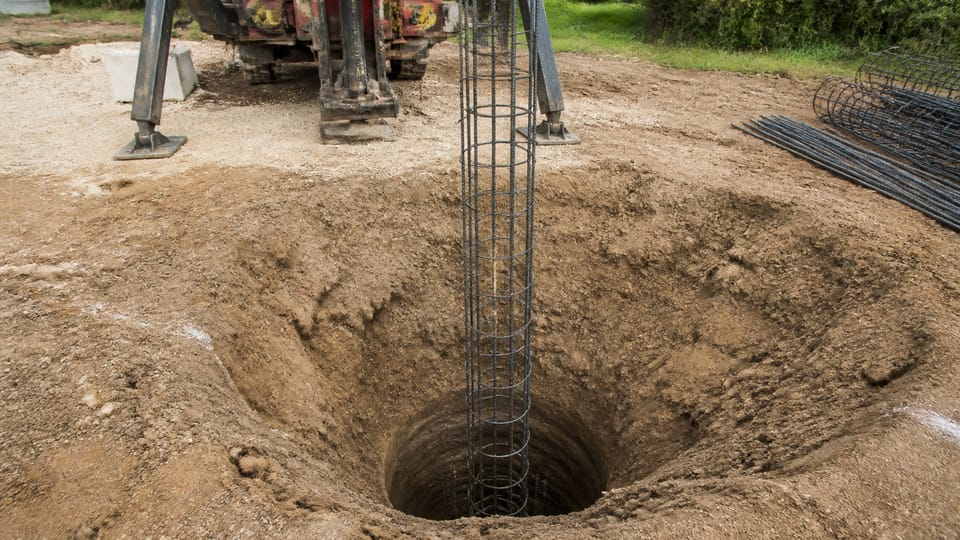
What are the types of pile foundation and which suits a house? IS 2911 covers driven cast in-situ, bored cast in-situ, driven precast, precast in prebored holes, under-reamed and timber piles. Bored piles remove soil, driven piles displace it, and under-reamed piles are bored piles with one or more bulbs, suited to expansive soils. No standard we read says which type suits a house: the soil report and the engineer decide.
On this page (11)
Piles are a deep foundation: they carry the load of a building past weak soil to firmer ground. A house usually does not need them, as pile foundations: when a house needs them and how piles are checked explains, and that page covers bored piles and the checks on site. This page does the other half: what the different types are, how each is made, and what the Indian Standards say about each. It gives no pile size, length, load, spacing, reinforcement or price, and it does not say which type your house should have. The engineer chooses, from the soil report.
What do the standards say a pile is?
The IS 2911 forewords say that piles transfer loads to subsurface strata of adequate capacity “either substantially by friction along its shaft and/or by the end-bearing”, that they are used “depending upon the subsoil stratification at a particular site”, and that building them “demands careful control on position, alignment and depth, and involve specialized skill and experience”. The standards define a load bearing pile (clause 3.12 in Sec 1, Sec 2 and Part 3, with a different number in Sec 3 and Sec 4) as one that transmits the load by resistance at its tip and/or along its surface. If it works mainly at the tip it is an end-bearing pile, and if mainly by friction along its surface it is a friction pile.
What types are there?
NBCS 2026, Part C Section 2, clause 6.1, lists the pile foundations it covers: driven cast in-situ, bored cast in-situ, driven precast, precast in prebored holes, under-reamed, timber and spun piles. IS 2911 has a part or section for each, apart from spun piles. The standards group them by how the pile is installed; we found no classification by material, function and method in NBCS, so the table below is ours.
| Type | How it is made, in the standard’s words | Where the standard says it suits |
|---|---|---|
| Bored cast in-situ (IS 2911 Part 1/Sec 2, 3.4) | “A pile formed by boring a hole in the ground by percussive or rotary method with the use of temporary/permanent casing or drilling mud and subsequently filling the hole with reinforced concrete” | The Foreword says these piles are “particularly applicable in certain subsoil conditions where penetration to a pre-determined depth is essential” |
| Driven cast in-situ (Part 1/Sec 1, 3.5) | “A pile formed within the ground by driving a casing of uniform diameter, or a device to provide enlarged base and subsequently filling the hole with reinforced concrete”; the casing is left (cased) or taken out (uncased) | Where the pile must go deeper to find bearing strata or develop skin friction, and “when the length of individual piles cannot be predetermined” |
| Driven precast, which the standard calls a precast driven pile (Part 1/Sec 3, 3.13) | “A pile constructed in concrete in a casting yard and subsequently driven into the ground when it has attained sufficient strength” | Examples given are wharves and jetties, or where conditions are unfavourable for cast in-situ piles |
| Precast in prebored holes (Part 1/Sec 4, 3.14) | “A pile constructed in reinforced concrete in a casting yard and subsequently lowered into prebored holes and the annular space around the pile grouted” | Where safety against chemically aggressive subsoil or groundwater is needed, in artesian conditions, or where obstructions or subsoil water flow are met |
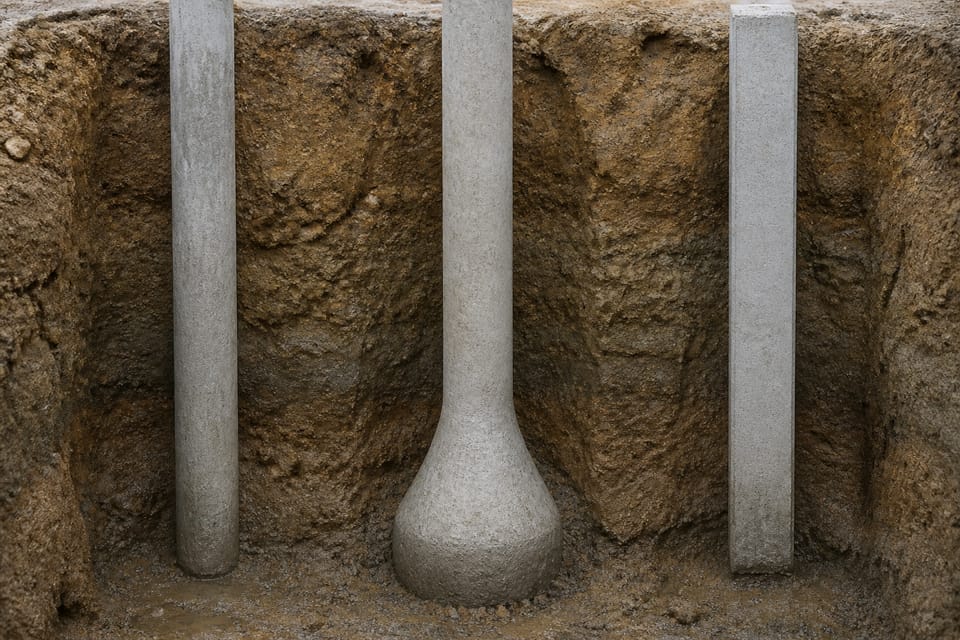
| Under-reamed (Part 3, 3.18) | “A bored cast in-situ or bored compaction concrete pile with an enlarged bulb(s) made by either cutting or scooping out the soil or by any other suitable process” | See below |
| Timber (Part 2:2021, 1.1) | Timber piles for earth retaining structures, shore protection, slope protection, compaction of ground or to support structures up to two storeys | The Foreword itself says timber piles “should be avoided” for environmental and durability reasons |
The main difference in practice is what happens to the soil. A bored pile removes soil by excavating, and a driven pile displaces it. The Sec 4 Foreword notes that precast piles in prebored holes “are not subjected to driving stresses”. The title of Sec 4 is “precast concrete piles in prebored holes”, although its Foreword still calls them bored precast piles.
What is an under-reamed pile?
IS 2911 (Part 3):2021 “covers the design and construction of under-reamed piles having one or more bulb(s) formed along the pile shaft”. Its Foreword says they are bored cast in-situ or bored compaction concrete piles with one or more bulbs formed by enlarging the borehole, and that “with the provision of bulb(s), substantial bearing or anchorage is available”. A pile with more than one bulb is a multi-under-reamed pile, and one with two is a double under-reamed pile (3.13).
The Foreword lists what the bulbs are for: to avoid the effect of seasonal moisture changes as in expansive soils, to reach competent strata, to get capacity for downward, upward and lateral loads and moments, or to take the foundation below scour level or liquefiable strata. NBCS 8.5.1 says these piles are suited to expansive soils, and that in expansive soil such as black cotton soil the bulb “provide anchorage against uplift due to swelling pressure, apart from the increased bearing”, provided the topmost bulb is formed close to or just below the bottom of the active zone. The Foreword also says they may be used where the vibration and noise of constructing piles are to be avoided, and that the feasibility of forming a bulb “should be examined as per soil characteristics, particularly in case of clean/river sands”. Where the bore needs drilling mud, NBCS and Part 3 limit the bulbs, and NBCS says forming a bulb in pure sands and very soft clayey strata is not advisable; we print none of the numbers. See black cotton soil: why houses crack and what the engineer checks for the soil side.
You cannot see a bulb once the pile is cast, so ask which piles are under-reamed, how many bulbs they have and where, and keep the record.
Where does a pile cap come in?
No standard we read defines a pile cap, but IS 2911 Part 3 has a clause on its design: the cap “shall be deep enough to allow for necessary anchorage of the column and pile reinforcement” and “should be rigid enough so that the imposed load could be distributed on the piles in a group equitably” (6.4). In practice, a footing rests on soil at a shallow depth, and a pile cap rests on the tops of piles and ties them, with the pile reinforcement embedded in it. If a drawing shows a pile cap, the house is on piles. See footing vs foundation: the difference and the common types for the shallow types.
How are piles tested?
IS 2911 (Part 4):2013 “covers the load test on all types of piles covered in” the other parts, with vertical (compression), lateral and pull-out tests. Its Foreword calls a pile load test “the most direct method for determining the safe loads on piles”. NBCS says non-destructive integrity testing “may be carried out prior to laying of beam/caps”, which is a “may”. The test counts, loads and criteria differ between the older 2010 sections and Part 4:2013, so we print none of them; the engineer specifies the test.
What does no standard say?
- Which type suits a house. IS 2911 and NBCS give selection in terms of subsoil, load characteristics, settlement limits and any special requirement of the project.
- Whether you need piles. See the published pile page.
- Pile cap or bulb definitions. Neither is defined as a term.
- Cost. NBCS 8.5.1 says only that under-reamed piles find wide application where “economics are favorable”.
- Micropiles and screw piles. We found no Indian Standard for them in this search.
What should I ask?
This is practice.
- Whether piles are needed at all, or whether a raft or shallow foundation will do: see raft foundation: what it is and what to watch on site.
- Which type the soil report and the engineer chose, and why.
- For driven piles near neighbours, a vibration and noise plan and a photo record of the neighbouring walls before work.
- The pile layout drawing with pile marks, the pile cap details, the load test plan and results, and the daily pile records.
- For under-reamed piles, a record of which piles have bulbs.
For the soil report itself, see soil test before building a house: what it is and why it matters.
What mistakes should I avoid?
These are practice unless a standard is named.
- Choosing piles because they feel safer, or copying a neighbour’s pile type.
- Assuming under-reamed piles suit every soil. NBCS and IS 2911 Part 3 limit their use in some strata.
- Using driven piles beside occupied houses without a vibration plan or a survey.
- Treating a pile cap as a bigger footing.
- Casting the cap before the pile records and load tests are reviewed.
- Not recording which piles are under-reamed.
- Quoting a pile depth, bulb size or spacing from a website or a neighbour.
- Taking the number of piles as a measure of safety: the engineer calculates it.
Frequently asked questions
What are the types of piles in India?
IS 2911 covers driven cast in-situ, bored cast in-situ, driven precast, precast in prebored holes, under-reamed and timber piles. NBCS 2026 also lists spun piles.
What is the difference between bored and driven piles?
A bored pile is formed by excavating a hole and filling it with concrete, so soil is removed. A driven pile is driven into the ground, so soil is displaced.
What is an under-reamed pile used for?
It is a bored pile with one or more bulbs. NBCS says it suits expansive soils such as black cotton soil, where the bulb gives anchorage against uplift.
Is a pile cap the same as a footing?
No. A footing rests on soil. A pile cap rests on piles and ties them together.
Which pile type is best for a house?
No standard we read says. The soil report and the engineer decide.
Related guides
- Pile foundations: when a house needs them and how piles are checked
- Black cotton soil: why houses crack and what the engineer checks
- Footing vs foundation: the difference and the common types
- Pile cap vs footing: what a pile cap is and what it does
This guide is general information. Read the disclaimer. Your geotechnical and structural engineers decide whether your house needs piles and of what type.
Sources
- IS 2911 (Part 1/Sec 1), (Part 1/Sec 2), (Part 1/Sec 3) and (Part 1/Sec 4):2010, Code of Practice for Design and Construction of Pile Foundations: driven cast in-situ, bored cast in-situ, driven precast and precast concrete piles in prebored holes: forewords and the definition clauses 3.4, 3.5, 3.13 and 3.14 (page images read). BIS lists all four as in force, valid to 2030-05-31.
- IS 2911 (Part 3):2021, Under-Reamed Piles (second revision): Foreword and clauses 1.1, 3.13, 3.18 and 6.4 (page images read). IS 2911 (Part 2):2021, Timber Piles: Foreword and clauses 1.1 and 1.2 (page image read). IS 2911 (Part 4):2013, Load Test on Piles: clause 1.1 (page image read). BIS lists these as in force.
- SP 7:2026, National Building Construction Standards (NBCS) 2026, Part C Section 2, Soils and Foundations: clauses 2.4, 6.1, 8.1, 8.5.1 and 8.5.5 (page images read). From an unofficial archive.org copy.
Change log
- : Added Related guides link to newly published article(s): pile-cap-vs-footing-what-a-pile-cap-is-and-what-it-does. No other text changed. Approved by the reviewing engineer.
General information only. It is not a structural design or professional advice. Ask a licensed structural engineer or architect to check your plans and site.