
Short answer
What is the difference between a bathroom, a toilet, a water closet and a washroom? In the Indian codes, a water closet is a flush fixture that receives human excrement, and the term is sometimes used for the room around it. A bath room group is a set of fixtures with a floor drain. The codes do not define toilet, washroom or restroom, and the model bye-laws treat bathrooms and water-closet compartments as non-habitable rooms.
On this page (9)
“Toilet”, “washroom”, “restroom”, “bathroom”, “WC”: the words are used for the same room in one house and for different rooms in the next, and a quote that mixes them can leave a bathroom without a toilet or a toilet without a shower. This page gives the few definitions the Indian codes contain, says which everyday words they never define, and suggests how to name rooms on a drawing and in a quote. It does not cover the types of WC pan, and it gives no room sizes, which the model bye-laws set out and a local bye-law may change: see room sizes, ceiling height and windows: what the model bye-laws say.
What do the Indian codes define?
| Term | What the code says | Source |
|---|---|---|
| Water closet (W.C.) | “A water flushed plumbing fixture designed to receive human excrement directly from the user of the fixture. The term is used sometimes to designate the room or compartment in which the fixture is placed.” The wording is the same in all three documents | NBCS Part E Sec 2, 2.105; MBBL definition 127; IS 2064, 3.2 |
| Bath room group | “Group of fixtures consisting of water closet, lavatories bath tub or shower and other fittings with a floor drain located together.” Section 1 words it with “lavatory” in the singular | NBCS Part E Sec 2, 2.6; Sec 1, 2.1.14 |
| Soil appliance | “A sanitary appliance for the collection and discharge of excretory matter” | IS 2064, 3.1.1 (NBCS 2.85 has the same sentence) |
| Waste appliance | A sanitary appliance for the collection and discharge of water after use for ablutionary, culinary and other domestic purposes | NBCS Part E Sec 2, 2.102; IS 2064, 3.1.2 |
| Habitable room | A room occupied or designed for occupancy by one or more persons for study, living, sleeping, eating, kitchen if it is used as a living room, “but not including bathrooms, water-closet compartments, laundries …” | MBBL definition 65 |
So in the codes a water closet is first a fixture, and only sometimes the room. A bath room group is a set of fixtures, which includes the water closet, together with a floor drain. NBCS also uses “wastewater (sullage)” for the discharge from wash basins and sinks, which holds no excreta, and “black water” for waste water from water closets, bidets, urinals, kitchen sinks, bed pan sinks and similar contaminated sources.
Which words do the codes not define?
We found no definition of these words in NBCS 2026, the model bye-laws or IS 2064:
- Bathroom. IS 2064 clause 7.2 describes it, without defining it: “Bath room is a space where washing of face, hands and hairs, bathing, eliminations and grooming and also such activities as hand laundering and infant care is carried out.” That includes elimination, so the code’s bath room is not only a bathing space. NBCS 4.2.4.1(a) treats the bathroom as a fitment with a tap and a floor trap.
- Toilet. Apart from the eco-toilet (NBCS 2.40, a dry composting toilet), the bare word is not defined. It is used as a plain word. NBCS speaks of a “toilet or sanitary room” for group housing. IS 2064 clause 7.5 uses “toilet” for a group of at least three fixtures, a shower stall or bath tub, a wash basin and a water closet. Common usage often means only the WC, which is the opposite. The word is safe in speech and unsafe in a contract.
- Washroom, restroom, powder room, latrine. None is defined. “Latrine” appears in NBCS in a list of fixtures to show on drainage plans and in the trench-or-pit-latrine clause. “Lavatory” is an undefined fixture word in NBCS (in the bath room group and fixture lists), and MBBL 4.5.4 uses it for a room use.
What do the codes require in a dwelling?
NBCS 2026 Part E Section 2, clause 4.2.4.1 says a dwelling with individual convenience “shall have at least the following fitments”: one bathroom provided with a tap and a floor trap; one water closet with flushing apparatus with an ablution tap; and one tap with a floor trap or a sink in the kitchen or wash place. Clause 4.2.4.1.1 says: “Where only one water closet is provided in a dwelling, it is desirable to have the bath and water closet separately accommodated.” The note under Table 4.17 of the model bye-laws goes further: where only one water closet is provided in a dwelling, the bath and water closet “shall be separately accommodated”. A local bye-law decides which wording applies to you. NBCS 4.2.2 asks for at least one water closet, one kitchen wash place or sink and one bathing place or shower for each dwelling unit on premises abutting on a sewer or with a private sewage disposal system.
The model bye-laws, clause 4.5, give separate sizes for a bathroom, a water-closet and a combined bath and water-closet, and clause 4.5.4 says no room containing water-closets shall be used for any purpose “except as a lavatory”, and shall not open directly into any kitchen or cooking space by a door, window or other opening. NBCS Part E Section 1, clause 3.1.12 says a room or compartment with a water closet “should be properly lighted and ventilated”. We print none of the sizes.
What does each word mean for the plumbing?
This is practice, based on the appliance classes above.
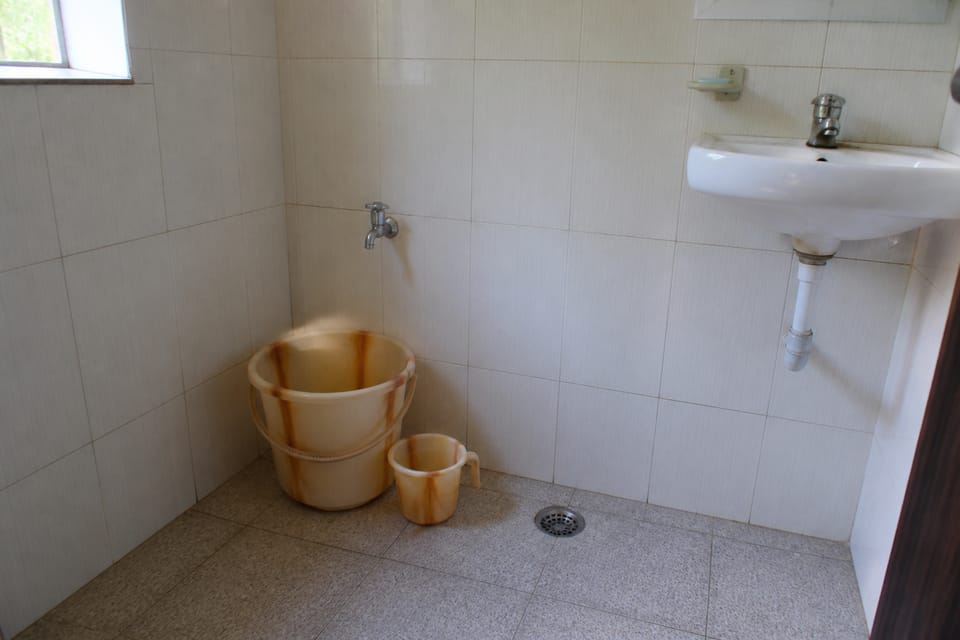
- Bath or bathroom points to water supply and a floor drain or trap and a waste line.
- WC points to a soil pipe to the drain or a septic tank. See house drainage system explained: soil, waste and rainwater pipes and septic tank size: how it is worked out, with a 10-user example, which sizes for toilet waste.
- Wash basin points to a waste line.
- Bath and WC together needs both sets of points.
A word therefore tells you which plumbing points the room has, not how big it is or what it costs.
How should I name rooms in a drawing and a quote?
This is practice, apart from the clauses named.
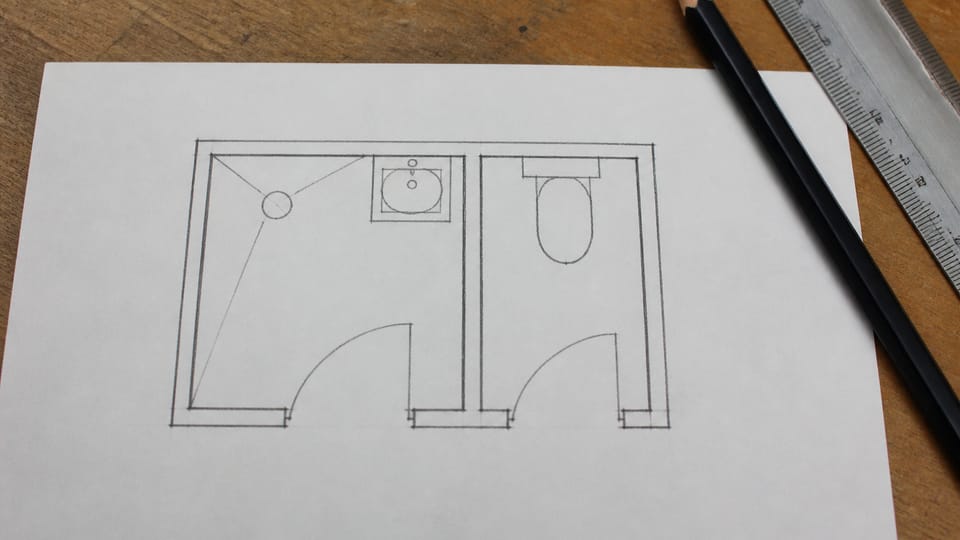
- On the drawing, label each room BATH, WC, or BATH + WC, and the basin separately, so the plumber can see which fixtures each room holds. Ask the architect to use one word for each kind of room.
- In the plan for approval, use the wording your authority uses on its sheet legend.
- In the quote, list fixtures per room, for example bath: shower, floor trap, wash basin; WC: pan, cistern. Do not accept “attached bathroom” or “toilet” as a fixture list.
- Decide whether the bath and WC are separate or combined, whether the wash basin is inside the room or outside it, and which bathrooms open off bedrooms and which from a passage. “Attached” has no single meaning: ask for it on the plan.
- Remember that the model bye-laws leave bathrooms and water-closet compartments out of “habitable room”, which matters for the room size and height rules. Carpet area is a separate question: see carpet area vs plinth area: what each term means for a house.
For waterproofing the wet area, see bathroom waterproofing: steps, wall height and the ponding test.
What mistakes should I avoid?
These are practice unless a clause is named.
- Assuming “attached bathroom” in a quote means a bath and a WC. It may mean only a room off the bedroom.
- A quote that says “toilet” and does not say whether it includes a shower, a floor trap and a basin.
- Counting “bathrooms” by the number in a listing when one may be a WC-only room.
- Using one word on the plan and another in the quote, so the plumber misses points.
- Sending WC waste and bathing water to the same place without the plumber’s design.
- Treating the bathroom as habitable room area.
- Assuming “washroom” or “restroom” has a code meaning.
Frequently asked questions
What is the difference between a bathroom and a toilet?
The codes do not define either. IS 2064 describes a bath room as a space for washing, bathing, elimination and grooming, and uses “toilet” for a group of at least three fixtures. In common speech a toilet is the WC or its room.
Is a water closet the room or the fixture?
Both. NBCS, the model bye-laws and IS 2064 define it as the fixture and add that the term is sometimes used for the room or compartment.
Is a washroom the same as a bathroom?
No code defines washroom. Say what fixtures the room has.
Do I need a separate bath and WC?
NBCS 4.2.4.1.1 says that where only one water closet is provided, “it is desirable” to have them separately accommodated, while the note under MBBL Table 4.17 says they “shall” be. A local bye-law decides which applies.
Does a bathroom count in the carpet area?
That depends on the definition used. The model bye-laws leave bathrooms out of habitable rooms, and IS 3861 lists “Bathroom and lavatory” among the parts not counted in carpet area, as the carpet area page explains; for a flat, ask how the RERA carpet area was measured.
Related guides
- House drainage system explained: soil, waste and rainwater pipes
- Room sizes, ceiling height and windows: what the model bye-laws say
- Bathroom waterproofing: steps, wall height and the ponding test
This guide is general information. Read the disclaimer. Your architect and plumber decide the rooms, the fixtures and the drainage for your house.
Sources
- SP 7:2026, National Building Construction Standards (NBCS) 2026, Part E Plumbing Services: Section 2 Drainage and Sanitation, definitions 2.6, 2.10, 2.102, 2.104 and 2.105 and clauses 4.1.1.1, 4.2.1, 4.2.2, 4.2.4.1 and 4.2.4.1.1; Section 1 Water Supply, definition 2.1.14 and clauses 3.1.5 and 3.1.12 (page images read). From an unofficial archive.org copy. Definitions 2.80 and 2.85 of Section 2 were unreadable on the page image and are taken from IS 2064.
- Model Building Bye-Laws 2016 (MBBL), TCPO, Ministry of Urban Development (now Housing and Urban Affairs), 2016: definitions of Habitable Room (65) and Water Closet (127); clauses 4.5.1 to 4.5.4; the note under Table 4.17 (page images read). A model: it binds only where a state or local body has adopted it.
- IS 2064:1993, Code of Practice for Selection, Installation and Maintenance of Sanitary Appliances (second revision): clauses 3.1, 3.1.1, 3.1.2, 3.2, 7.2 and 7.5 (page images read). BIS lists it as in force, valid to 2027-11-30.
General information only. It is not a structural design or professional advice. Ask a licensed structural engineer or architect to check your plans and site.