
Short answer
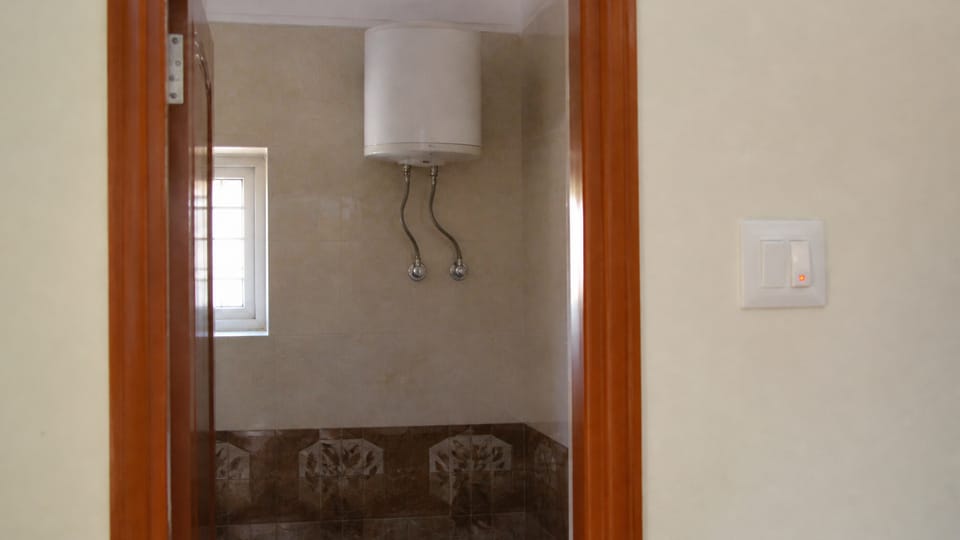
Where does the geyser switch go, and at what height is the geyser point? NBCS 2026 says the geyser switch should not be where a person in a bath or shower can reach it, and is preferably outside the bathroom near the entrance, with an indicator. NBCS limits how low a bathroom socket may be fixed but gives no other height for the geyser point. The rest comes from the heater's instructions, and the electrician fixes it before tiling.
On this page (9)
“What height should the geyser point be?” is the question electricians are asked most and answer from habit. The Indian code gives no height for the point beyond a floor-height limit for bathroom sockets. It gives a different and more useful answer: where the switch must not be, what the point connects to, and what protection the bathroom circuit needs. This page sets out what NBCS 2026 and the water heater standards say, what they leave to the maker and the electrician, and what to fix before the wall is tiled. It gives no wire size, breaker rating or wattage. For the types of geyser, see solar water heater vs geyser for a house.
What is a geyser point?
No code defines “geyser point”. NBCS 2026 Part D Section 2 describes three separate things:
| Thing | What NBCS says |
|---|---|
| The connection | Clause 5.8.3: “A socket or a connector block with suitable protection against water spray should be provided to connect the water heater.” Clause 13.4.1.1: “The electrical connection will be from a 16 A socket-outlet located at least 500 mm away from the plumbing connections.” |
| The control switch | Clause 5.8.3 and clause 13.4.1.1, below |
| The protective switch | Clause 6.3: “For controlling points for air conditioners and geysers, suitable MCB type switches shall be provided.” |
So the point is a connection for the heater, the switch controls it, and the MCB protects the circuit. Clause 13.4.1.1 also says the geyser or storage water heater is not a portable device, because it needs the electricity line and the water supply.
Where does the switch go?
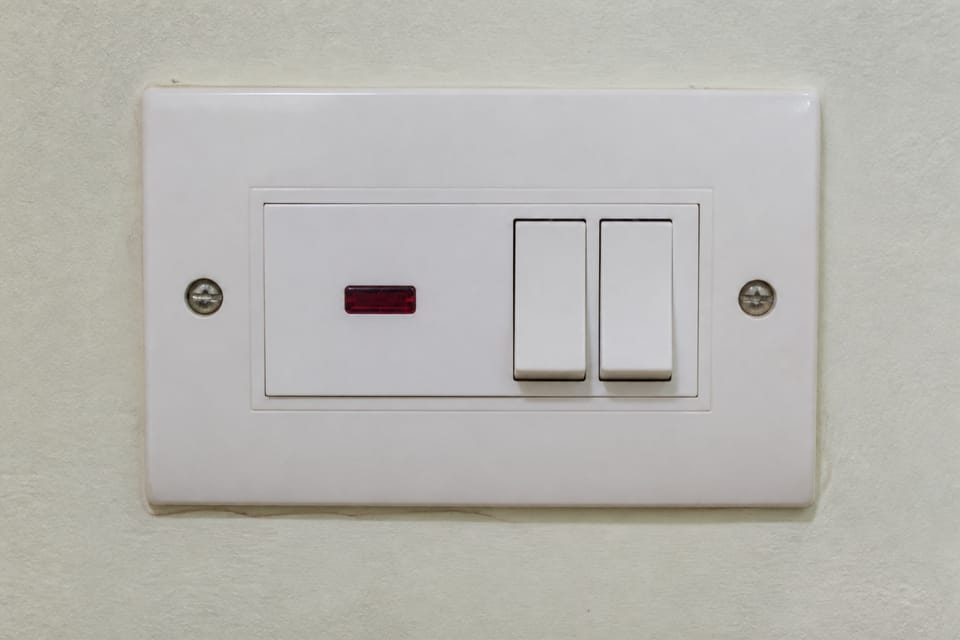
Clause 5.8.3: “Switch or isolator controlling a water heater or geyser should not be located within 1 m from the location of a shower or bath tub, to avoid a person in wet condition reaching the switch or isolator. It is preferable to provide the control switch outside the bath room near the entrance and provide an indication at the water heater.”
Clause 13.4.1.1 adds: “The switch for the geyser should not be accessible from the bath area or the shower area … The switch should be located away from the wet floor area of a bath room and preferably outside near the entrance to the bath room. This switch should have a built in indicator to display the status.”
The codes say “should” and “preferably” for the switch position. They give no height. IS 2064 asks that light switches be out of reach of the bath and shower.
What protection does the bathroom circuit need?
- Residual current device: clause 13.4.1.3 says “All circuits in bathrooms shall be protected by a RCCB/RCD with a sensitivity of” a value given in the clause, in compliance with the relevant Indian Standards. Clause 13.4.3, which is the kitchen clause, says an instant geyser is wired from a circuit with a different, higher sensitivity because the lower one may cause nuisance tripping. NBCS does not say which applies to an instant geyser in a bathroom, so the electrician or engineer decides; we do not print the values. See MCB vs RCCB vs RCBO: what each protects against at home.
- Bonding: clause 13.2.2 requires supplementary equipotential bonding of all simultaneously accessible exposed and extraneous conductive parts, including incoming metallic services and metal wastes. Clause 4.15.4.3 of Part E says the metal work of water heating appliances, other than current carrying parts, is bonded and earthed, and that screwing an immersion heater into a tank cannot be relied on as the earth connection.
- Earthing: IS 302 (Part 2/Section 21):2018, clause 27.1, asked that the sheath of the heating element of a Class I storage water heater is connected to the earthing terminal, unless other conditions are met. That part covers storage heaters, not instantaneous ones. See earthing for a house: what it is, earth vs neutral, and why it matters.
- Sockets in a bathroom: clause 5.8.4 says sockets in a kitchen, bathroom or toilet “should not be provided within a height of 1 m from the ground level”. That is a floor-height limit for the socket, and NBCS gives no other height for the geyser point.
What do the water heater standards say about installation?
IS 2082:2018 is the specification for stationary storage type electric water heaters, and it applies the safety and marking clauses of IS 302 (Part 2/Section 21). The 2018 edition of that part asked that closed water heaters be marked that a pressure-relief device is to be fitted unless it is part of the appliance (clause 7.1), and its instructions state that the discharge pipe of that device is left open to the atmosphere (clause 7.12). It also asks that water inlet and outlet be identified. These are for storage heaters. The NBCS lists a 2024 edition of that part, which we did not read, so ask the maker for the current instructions. No code we read gives a height or position for the point beyond the socket height limit: it depends on the heater model and the maker’s instructions, and the electrician and plumber fix it.
What should I decide before tiling? (practice)
This is practice, apart from the clauses named.
- Choose the geyser type and its position first: storage or instant, vertical or horizontal. The connection differs.
- Put the point near the geyser but outside splash reach, and not hidden behind it. Keep access to it after the tiles go on.
- Put the switch outside the bathroom with an indicator, as NBCS prefers.
- Ask for a dedicated circuit with its own protection, not shared with sockets. The electrician designs it.
- Ask the electrician to confirm the geyser body is earthed and the bonding is done, and to test and give a record.
- Fix the hot and cold pipe routes, mark them, and ask the plumber about a safety or relief valve and a shut-off. Use pipe rated for hot water on the hot line: see CPVC vs UPVC pipes: which one to use for home plumbing.
What mistakes should I avoid? (practice)
- A switch inside the wet zone or within reach of the shower.
- No earthing on the geyser.
- Plugging the geyser into any available socket or an extension board.
- A geyser on a circuit shared with sockets.
- A point hidden behind the geyser or sealed behind tiles with no access.
- Hot and cold lines not marked, or the wrong pipe on the hot line.
- No test and no record after the work.
Frequently asked questions
What is the standard height of a geyser point?
No Indian code we read gives one. NBCS 5.8.4 says bathroom sockets should not be within a height of 1 m from the ground, and 5.8.3 gives a distance of the switch from the shower. The rest comes from the heater maker’s instructions and the electrician.
Can the geyser switch be inside the bathroom?
NBCS says it should not be within the stated distance of a shower or bath, should not be reachable from them, and is preferably outside near the entrance with an indicator.
Does a geyser need earthing?
NBCS 4.15.4.3 asks for the metal work of water heating appliances to be bonded and earthed. For a Class I storage heater, IS 302-2-21:2018 clause 27.1 asks for the heating element sheath to be connected to the earthing terminal.
Can I plug a geyser into any socket?
NBCS 13.4.1.1 describes a 16 A socket-outlet for the connection, located at least 500 mm from the plumbing connections, and 5.8.3 a socket or connector block protected against water spray. NBCS does not describe an ordinary socket on an extension board as the connection (practice reading).
Related guides
- MCB vs RCCB vs RCBO: what each protects against at home
- Earthing for a house: what it is, earth vs neutral, and why it matters
- Electrical work in a house build: stages and inspection points
This guide is general information. Read the disclaimer. Your licensed electrician and plumber decide the geyser connection in your house.
Sources
- SP 7:2026, National Building Construction Standards (NBCS) 2026, Part D Section 2, Electrical and Allied Installations: clauses 5.8.3, 5.8.4, 6.3, 13.2.2, 13.4.1.1 and 13.4.1.3 (page images read). Part E Section 1, Water Supply: clause 4.15.4.3 (page image read). From an unofficial archive.org copy.
- IS 302 (Part 2/Section 21):2018, Safety of Household and Similar Electrical Appliances, Particular Requirements for Storage Water Heaters: clauses 7.1, 7.12 and 27.1 (page images read). BIS lists this 2018 edition as valid to 2023-10-31 and a 2024 edition, which the NBCS lists, as valid to 2029-08-31; the 2024 text was not read. It does not cover instantaneous water heaters.
- IS 2082:2018, Stationary Storage Type Electric Water Heaters, Specification (fifth revision): clauses 7 and 8.1 (page images read). BIS lists it as in force, valid to 2031-01-16.
- IS 2064:1993, Selection, Installation and Maintenance of Sanitary Appliances, Code of Practice: clause 7.2.5 (text read). BIS lists it as in force, valid to 2027-11-30.
General information only. It is not a structural design or professional advice. Ask a licensed structural engineer or architect to check your plans and site.