
Short answer
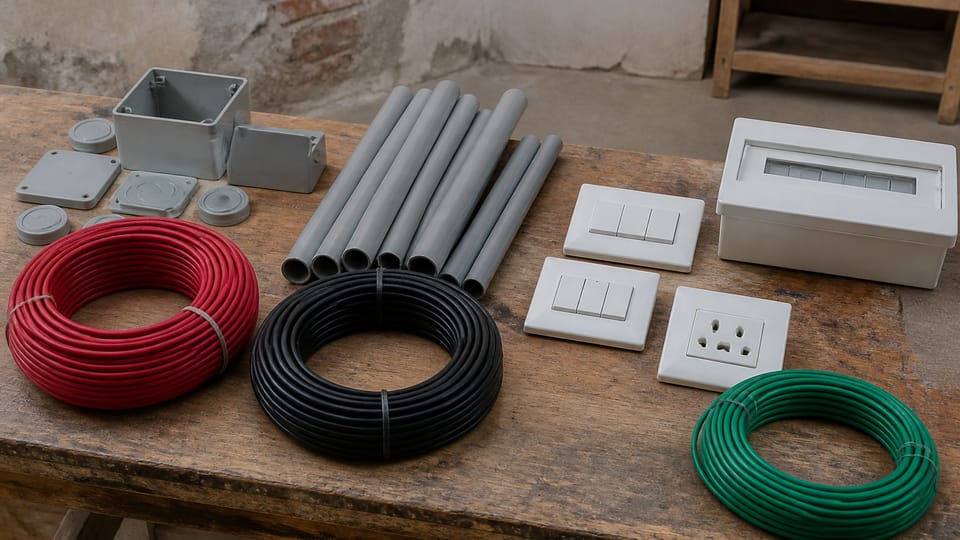
What materials are needed for house wiring, and which IS covers each? Wires and cables follow IS 694 (up to 1 100 V); conduits IS 9537 and IS 16205; boxes and enclosures IS 14772; switches IS 3854; plugs and sockets IS 1293; MCBs IS/IEC 60898; RCCBs and RCBOs IS 12640. IS 732 is the code that tells the electrician how to wire. The electrician's design decides sizes and circuits, not the owner.
On this page (8)
Before an electrician starts, there is usually a shopping list. This page lists the materials of a house wiring job and the Indian Standard that covers each, with what the standard says about marking the product and the edition we could read. It gives no wire size, rating, quantity, price or brand: the sizes and circuits come from the electrician’s design under IS 732, and the owner should not choose them from a shop’s suggestion. For who may do the work and the stages, see electrical work during house construction: stages and inspection.
What materials go into a wiring job, and which standard covers each?
| Material | Standard | What the standard covers | Marking wording we read |
|---|---|---|---|
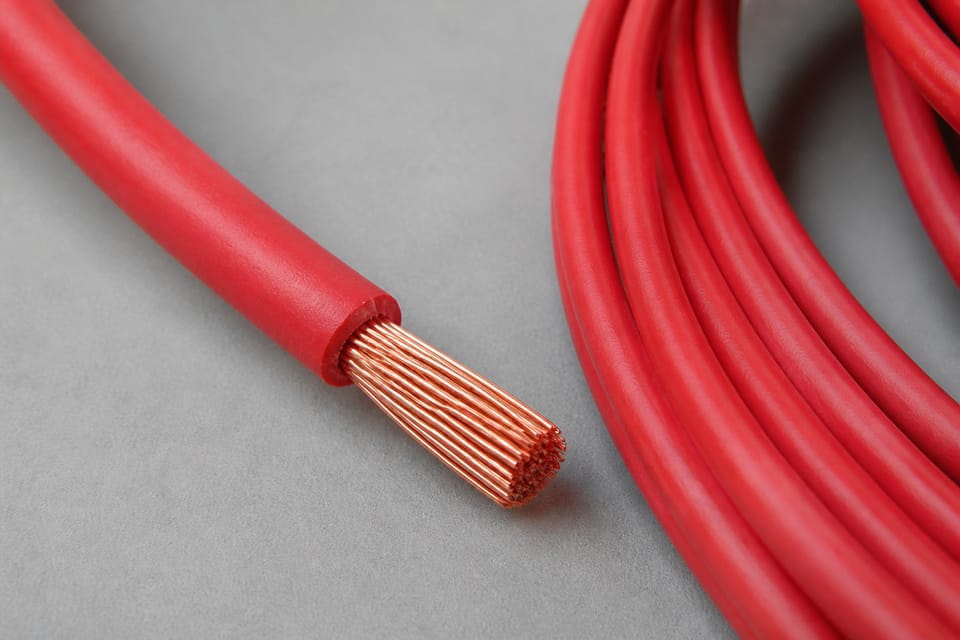
| PVC insulated wires and cables | IS 694:2010 with amendments (title: up to and including 1 100 V) | Single and multicore cables and cords with copper or aluminium conductors, PVC insulated, unsheathed and sheathed, for electric power and lighting | Maker identified along the length; the reel or label shows the IS, the maker, voltage grade, cores, length and year, and “FR” where it applies; “may also be marked with the Standard Mark” (clauses 11, 15.2) |
| Halogen-free flame-retardant cables | IS 17048:2018 | Single and multicore cables for up to 1 100 V in halogen-free flame-retardant material | Not read for marking |
| Conduits | IS 9537 (Parts 1 to 3 and others) and IS 16205 | Conduit systems and fittings for protecting and managing insulated conductors, in plain rigid plastic, steel and other types | IS 9537 Part 3 says the product “may also be marked” with the Standard Mark |
| Conduit fittings | IS 3419:1988 | Fittings for rigid plain conduits of insulating materials | Not read for marking |
| Boxes and enclosures for switches and sockets | IS 14772:2020 | Boxes and enclosures for electrical accessories in household and similar fixed installations | Maker’s name, trademark or identification, and type (clause 8.1); may be certified and marked with the Standard Mark (8.3) |
| Switches | IS 3854:2023 | Manually operated general-purpose switches for alternating current in household and similar installations | Rated current and voltage, nature of supply and the maker’s name or trademark (8.1); “may also be marked with the Standard Mark” (8.10) |
| Plugs and socket-outlets | IS 1293:2019 in force (the 2005 edition was read) | Plugs and socket-outlets for household and similar use up to 250 V and 16 A | 2005 edition: rated current and voltage, maker’s name or trademark, type; “may also be marked with the Standard Mark” (8.8) |
| MCBs (miniature circuit-breakers) | IS/IEC 60898 (Part 1):2015 (IS 8828 has been replaced) | Circuit-breakers for overcurrent protection in household and similar installations | Not read |
| RCCBs and RCBOs | IS 12640 (Part 1):2024 and (Part 2) | Residual current devices without and with overcurrent protection | Not read |
| Distribution board (the consumer unit) | IS/IEC 61439 (Part 3):2024 | Distribution boards for operation by ordinary persons | Not read |
| Ceiling roses, lampholders, fan regulators | IS 371, IS 1258 (2024 edition in force), IS 11037 | The named accessories | IS 11037 says its product “may be marked with the Standard Mark” |
We print no cable size, because sizes are for the designer. IS 732 says “every item of electrical equipment used in electrical installations shall comply with such Indian Standards as are appropriate” (clause 4.1.4.1). The earlier standard for MCBs, IS 8828, and the standard for conduits IS 14930 have been replaced, although IS 732 still names IS 14930 in clause 5.2.4.6, so check the current edition. NBCS 2026 lists the cable and accessory standards above in its materials part.
Is the BIS Standard Mark compulsory on wiring materials?
The standards themselves make the mark optional: they say products “may also be marked” with it. Whether a product must carry it comes from a separate Quality Control Order. The BIS page “Products under compulsory certification, Scheme I”, read on 2026-10-29, lists PVC insulated cables up to 1 100 V (IS 694), switches (IS 3854), RCCBs and RCBOs (IS 12640), HFFR cables (IS 17048), plugs and socket-outlets (IS 1293, shown there as the 2005 edition) and boxes (IS 14772:2020), and a circuit-breaker row (IS 8828, noted there as ”* Since revised as IS/IEC 60898”). Bayonet lampholders (IS 1258, shown there as the 2005 edition) and cable trunking also appear on that page, without a Quality Control Order printed against them. We did not find conduits, conduit fittings, ceiling roses, fan regulators or distribution boards on that page, and we could not confirm their status. NBCS 2026 lists IS 1293:2019 and IS 1258:2024, while that page shows the 2005 editions. We did not open the Gazette orders, so we cannot confirm dates or exact coverage. See IS codes for house construction for how a code becomes binding, and do not rely on a web claim that all, or none, of these must carry the mark.
A mark tells you that the maker holds a licence for that standard. It does not rank the product, and it does not replace the electrician’s design.
What is the colour of the wires?
IS 694 Table 2 lists the core colours in which fixed-wiring cables are made: for example a two-core cable has red and black cores and a three-core cable has red, yellow and blue cores. The table does not say which colour is the phase, the neutral or the earth for single wires, and we found no Indian standard text in these sources that does. IS 694 refers to yellow-green cables used for earthing (clause 12.1.1), but its fixed-wiring colour list has no earth colour, and IS 732 asks that neutral and protective conductors are identified as in IEC 60446 (5.1.4.3.1). Green-and-yellow is the colour reserved for the earth conductor (IS 3043, as the earthing page says). Ask your electrician which scheme the design uses, and have it applied the same way throughout. See earthing for a house.
What should I check when the materials arrive?
This is practice, not a standard, unless a clause is named.
- Coils and packs are factory sealed, not loose repacks, and the length on the label matches the bill.
- The cable has the maker’s name printed or embossed along its length, and the reel or label gives the IS number, the voltage grade, the number of cores and the year (IS 694 clauses 11 and 15.2). Compare the IS number with the drawing.
- The BIS Standard Mark and licence details appear where the maker uses them. Ask the dealer for the licence details and check them on the BIS site; the Standard Mark does not rank a product.
- Conduits, boxes, switches and sockets carry the maker’s name or trademark, and the packs show the IS number and the edition.
- Breakers and residual current devices carry the BIS mark: see MCB vs RCCB vs RCBO.
- The goods match the electrician’s list and drawing, not a shop’s suggestion, and they are from one batch.
- You keep the bills and batch numbers. Agree in the contract who buys the materials and who checks them on delivery.
In practice, who supplies the service cable up to the meter and the meter differs by State: ask your electricity company.
What mistakes should I avoid?
These are practice, not code rules, unless a clause is named.
- Picking wire sizes yourself, or buying thinner wire to save money.
- Buying everything before the electrician’s drawing is ready.
- Mixing wire colours at random.
- Using unmarked conduits or boxes.
- No earth conductor in a circuit (IS 732 asks for a protective conductor in every circuit).
- Switches and sockets for wet areas chosen by price, with no check of what the maker says they are for.
- Skipping the RCCB.
- Believing “fire retardant” or “ISI” claims without reading the marking. A flame-retardant cable is not fireproof.
- Accepting loose coils with no bill.
Frequently asked questions
What is the IS standard for house wiring cable?
IS 694, for PVC insulated cables and cords up to and including 1 100 V. The wiring itself follows IS 732.
How do I check that wire is genuine?
Check that the coil is sealed, the maker’s name is printed along the insulation, and the label gives the IS number, voltage grade, cores, length and year. Ask the dealer for the BIS licence details.
Is the ISI mark compulsory on switches and wires?
The BIS compulsory certification list shows PVC cables, switches, residual current devices and others, but we could not confirm every item or the dates. The standards themselves say the mark “may” be used.
Who decides the wire size?
The electrician’s design under IS 732, not the owner or the shop.
What does FR on a wire mean?
IS 694 has flame-retardant categories marked “FR” or “FR-LSH” on the label. It does not mean fireproof.
Related guides
- Electrical work during house construction: stages and inspection
- MCB vs RCCB vs RCBO
- Earthing for a house: earth vs neutral
- Plumbing materials list for a house: pipes, valves, traps, IS marks
This guide is general information. Read the disclaimer. A licensed electrical contractor decides the materials and circuits for your house.
Sources
- IS 694:2010, PVC Insulated Cables/Cords for Rated Voltages up to and Including 1 100 V (fourth revision), with Amendments 1 to 4: clauses 1.1, 11, 12, 15.2 and Table 2 (text read). BIS lists it as in force, valid to 2030-11-24.
- IS 732:2019, Code of Practice for Electrical Wiring Installations (fourth revision): clauses 1, 4.1.4.1, 5.1.4.3.1 and 5.2.4.6 (text read). BIS lists it as in force, valid to 2029-12-31.
- Scope and marking clauses read from IS 9537 (Part 3):1983, IS 16205 (Part 1):2017, IS 14772:2020, IS 3854:2023, IS 3419:1988 and IS 1293:2005 (text read; IS 1293:2019 is the edition in force and was not readable). BIS standards database and BIS list of products under compulsory certification, Scheme I, read on 2026-10-29.
- SP 7:2026, National Building Construction Standards (NBCS) 2026, Part 5 Building Materials, sections on conductors and cables and on electrical wiring, fittings and accessories: lists of standards (text read). From an unofficial archive.org copy.
Change log
- : Added Related guides link to newly published article(s): plumbing-materials-list-for-a-house-pipes-fittings-valves-traps-and-the-is-mark. No other text changed. Approved by the reviewing engineer.
General information only. It is not a structural design or professional advice. Ask a licensed structural engineer or architect to check your plans and site.