
Short answer
What is the difference between a lightning arrester, a lightning conductor and a surge protector? NBCS 2026 does not call the rooftop rod an arrester. The whole system is a lightning protection system, whose external part is an air-termination system, a down-conductor system and an earth-termination system. A surge protective device (SPD) is a separate unit in the wiring that limits transient overvoltages. One does not replace the other.
On this page (9)
Search for “lightning arrester vs lightning conductor” and you find the same words used for three different things: the rod on the roof, the whole lightning system, and a unit fitted in the electrical board. The Indian codes are more careful. This page says what the codes call each part, what each does, and why having one does not replace the others. It gives no ratings, sizes, earth resistance or brands, and it does not design a system: that is for an engineer or a lightning protection designer.
What do the codes call each part?
| Common term | What the codes call it | Source |
|---|---|---|
| Lightning arrester or arrestor, or lightning rod, used for the rooftop rod (common usage, not code usage) | Air-termination system: rods, mesh conductors or catenary wires “intended to intercept lightning flashes” | IS/IEC 62305-1, 3.45; NBCS 11.6.1 |
| Lightning conductor, lightning protection tape (the whole installation) | The whole installation is a lightning protection system (LPS). Its external part is “an air-termination system, a down-conductor system and an earth-termination system” | NBCS 2.1.130 and 2.1.130.1 |
| Down conductor | Down-conductor system, “to conduct lightning current from the air-termination system to the earth-termination system” | IS/IEC 62305-1, 3.46 |
| Lightning earth, earth pit | Earth-termination system, “to conduct and disperse lightning current into the earth” | IS/IEC 62305-1, 3.47 |
| Surge protector, surge arrester (in a building’s wiring) | Surge protective device (SPD): “A device intended to limit transient overvoltages and divert surge currents” | NBCS 2.1.177; IS 732 3.178 |
| Surge arrester (utility equipment) | A separate product family for power systems | IS 15086 series (titles only) |
The old Indian code IS 2309:1989 defined the whole “lightning protective system” (clause 3.3) and the “air termination”, the part that intercepts the flash (3.4), and used “lightning conductor” loosely in its text. BIS has withdrawn it, and the IS/IEC 62305 series is its in-force replacement. NBCS 2026 uses “lightning arresters” in a solar-plant safety regulation and “lightning arrestor” in a cold-storage safety list, neither about a house roof, and never uses “lightning conductor”. So the rooftop rod is not an arrester in the codes. In NBCS’s SPD list, “Surge Arresters” is the bracketed name for Type 1 SPDs at the service entrance. NBCS itself spells the word both ways.
What does each part do?
External lightning protection (the rod, the down conductor and the earth). NBCS defines a lightning protection system as a “complete system used to reduce physical damage due to lightning flashes to a structure”. It gives the flash a controlled path to earth. IS 2309:1989 clause 6.1 said a lightning conductor is incapable of discharging a thundercloud without a lightning stroke, and that its function is to divert to itself a lightning discharge which might otherwise strike a vulnerable part of the structure. NBCS 11.1 says there are no devices or methods capable of modifying the natural weather phenomena to the extent that they can prevent lightning discharges. So a rod does not make a house immune.
Internal protection (bonding). The internal lightning protection system consists of lightning equipotential bonding and/or electrical insulation of the external system. NBCS 11.2 says equipotential bonding with the main earth terminal of the electrical installation and termination of SPDs shall be done, and says a lightning protection system without equipotential bonding at ground level to the electrical installation “is a safety hazard and shall be avoided”. In practice, bonding is for the electrician and the designer.
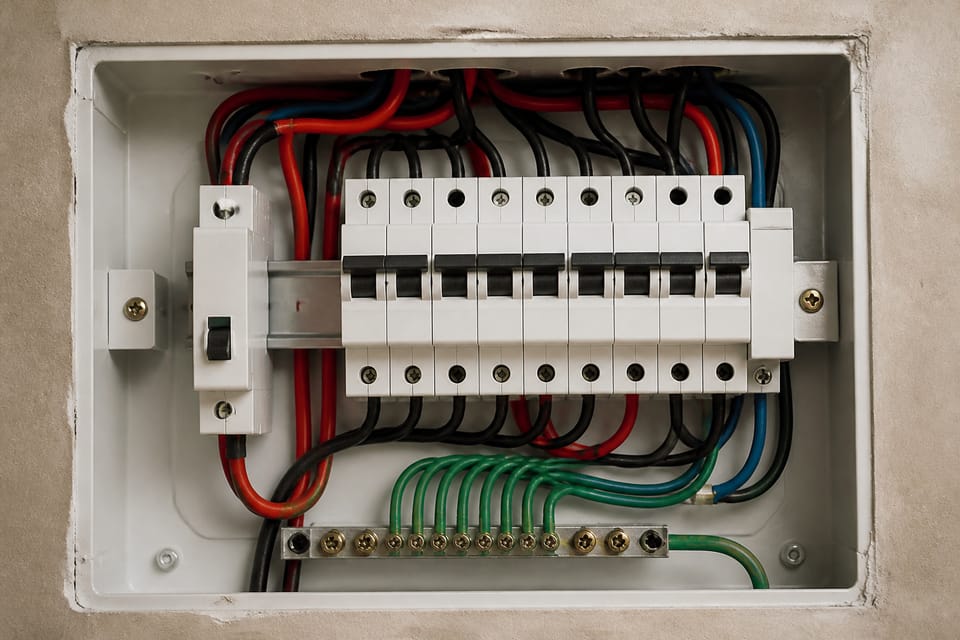
Surge protective devices. NBCS 2.1.176 defines a surge as a transient created by LEMP (lightning electromagnetic impulse) that appears as an overvoltage and/or an overcurrent. NBCS 2.1.177 lists three types: Type 1, for high-energy surges from direct lightning strikes or utility switching, at the service entrance near the main distribution board; Type 2, for secondary surges, in the distribution panel or sub-distribution board; and Type 3, plug-in surge protectors, for localised protection of sensitive electronic equipment near the point of use. NBCS 11.7.4.6 says that in a small residential building a power-line SPD at the mains incoming panel “will enhance the life” of electronic equipment such as televisions, refrigerators and LED lights; for large buildings an SPD is required (11.7.4.7). NBCS also says the SPD shall be installed at the entrance (11.7.4.13), and that SPDs should have a status indication (11.7.4.3 and 11.7.4.12). SPD ratings are not given here.
Why does one not replace the other?
The rod and its earth deal with the flash itself. In practice, they do not stop surges that reach the house on incoming power, telephone and TV cables, which is one way electronics are damaged. An SPD limits the voltage on the line it is fitted to. It does not protect the structure or people from a direct strike. NBCS treats the lightning protection system and coordinated SPDs together in one risk-based approach (clause 11.2). A plug-in surge protector is a Type 3 device, and an ordinary extension board is not an SPD. Neither is a substitute for protection at the incoming panel.
Does my house need lightning protection?
We did not find a list of building types in NBCS. Clause 11.2 says to assess the need and the level of protection from a risk and frequency-of-damage assessment under IEC 62305-2, and clause 11.4 says the system should be designed and installed by designers experienced in lightning protection. It also says the lightning protection system should be considered and designed before construction starts, so that columns and foundation steel can serve as part of it. NBCS cites the 2024 edition of IEC 62305 and says it is “likely to be adopted by Bureau of Indian Standards shortly”, while BIS lists the IS/IEC 62305:2010 parts as in force. For air terminals, NBCS 11.6.1 names the Franklin rod (conventional) type, rods, catenary wires and meshed conductors, says radioactive air-terminals shall not be allowed, and says dissipation, ESE and CSE terminals and any air terminal not approved by IEC 62305-3:2024 shall not be acceptable. So treat claims for “active” or “bigger radius” rods with caution.
NBCS asks that rooftop solar panels, water heaters and water tanks be protected and bonded as part of the system. See solar water heater vs geyser for what sits on a roof.
What should I ask and check?
This is practice, not a standard, unless a clause is named.
- Ask the engineer whether a risk assessment was done for your house, and who designed any lightning protection. Settle it before the structure is cast.
- Ask that the lightning earth be bonded to the electrical earth as the designer specifies. See earthing for a house.
- Ask the designer which SPDs are needed. NBCS 11.4 says equipotential bonding of electrical services by SPD is mandatory to complete lightning protection. Ask that the status indicator be checked after a big storm (practice). See MCB vs RCCB vs RCBO for what the other devices in the board do.
- Check that the conductor path and the earth pit are not painted over, cut or boxed in during finishing, and that the earth pit location is recorded. See electrical work during house construction.
- Stay indoors in a storm, away from the conductor, taps and plugged-in appliances, and do not work on the terrace. The pre-monsoon checklist already says to stop work at heights in lightning.
What mistakes should I avoid?
These are practice, not code rules.
- A rod on the terrace with no continuous path to an earth termination.
- Metal tanks, solar frames and railings left unbonded.
- An SPD fitted without an earth connection, or without the protection the electrician specifies.
- Relying on plug-in strips for lightning.
- Ignoring the telephone, broadband and TV cable that can carry surges into the house.
- Buying on a seller’s claim of “active” or “maintenance-free” protection without asking who designed it.
- Treating an SPD as fit-and-forget.
Frequently asked questions
Is a lightning arrester the same as a lightning conductor?
In common talk, yes. In NBCS and IS/IEC 62305 the rod is an air-termination system, the whole installation is a lightning protection system, and an SPD is a separate device in the wiring.
What is the difference between a lightning arrester and a surge protector?
Usually the “arrester” is the rooftop rod and the surge protector is the SPD in the electrical board. They do different jobs, and NBCS asks for both parts to be considered together.
Does a lightning rod protect my TV and fridge?
Not by itself. In practice, surges can reach a house on incoming cables, and NBCS says a power-line SPD at the mains incoming panel will enhance the life of equipment such as televisions and refrigerators.
Does a surge protector plug protect against a direct strike?
No. A plug-in surge protector is a Type 3 device for localised protection of sensitive equipment, and it does not replace protection at the incoming panel.
Does my house need lightning protection?
NBCS asks for a risk assessment under IEC 62305-2. Ask your engineer.
Related guides
- Earthing for a house: earth vs neutral
- MCB vs RCCB vs RCBO
- Electrical work during house construction: stages and inspection
This guide is general information. Read the disclaimer. Your engineer and a lightning protection designer decide the system for your house.
Sources
- SP 7:2026, National Building Construction Standards (NBCS) 2026, Part D Section 2: clauses 2.1.128, 2.1.130, 2.1.130.1, 2.1.130.2, 2.1.176 and 2.1.177 (page images read); clauses 11.1, 11.2, 11.4, 11.6 and 11.6.1 on lightning protection (page images read for 11.6 and 11.6.1; the other clauses from the text layer). From an unofficial archive.org copy.
- IS/IEC 62305 (Part 1):2010, Protection against Lightning, General Principles: definitions 3.42 to 3.53 (read from the text). BIS lists Parts 1 to 4 of the series as in force.
- IS 2309:1989, Code of Practice for the Protection of Buildings and Allied Structures against Lightning: terms and clause 6.1 (text read). BIS lists it as withdrawn on 2022-03-14.
- IS 732:2019, Code of Practice for Electrical Wiring Installations: clause 3.178 (text read).
General information only. It is not a structural design or professional advice. Ask a licensed structural engineer or architect to check your plans and site.