
Short answer
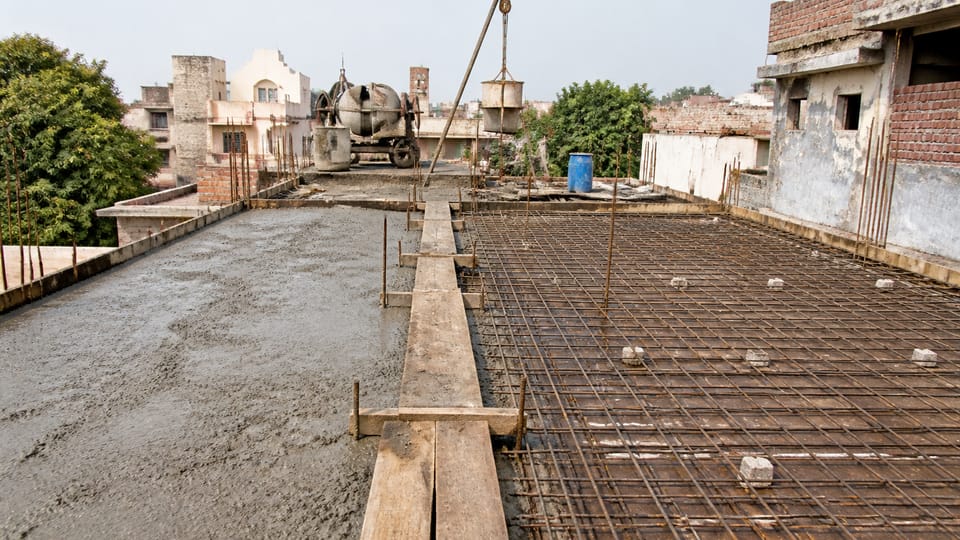
What happens on the day of chhat dhalai? Chhat dhalai means casting the roof slab. The engineer or supervisor gives the go-ahead, concrete is mixed and carried quickly, placed close to its final position, compacted and levelled, and cubes are taken through the pour. Someone must watch the props below all the time. Stops go only where the designer says. Then the slab is covered and kept wet.
On this page (14)
- What is the order of work on casting day?
- What must be ready before the first batch?
- How is the concrete mixed and carried?
- How is concrete placed on the slab?
- How is the concrete compacted and finished?
- Can more water be added if the concrete is stiff?
- When are the cubes taken?
- Who watches the props during the pour?
- What if rain or a breakdown stops the pour?
- What happens after the last batch?
- What mistakes should I avoid?
- Frequently asked questions
- Related guides
- Sources
Chhat dhalai is the day your roof slab is cast. It is usually done in one long push, and mistakes made that day are hard to undo. IS 456, the concrete code, says it is “exceedingly difficult and costly to alter concrete once placed”. This page walks through the day in time order: what happens, who does it, and what you can ask. It does not give a mix, a bag count or a slab thickness, and it says nothing about when the shuttering comes off. Your drawing and your engineer decide those. For the checks before this day, see our slab pour checklist. If you came here for cement quantity, see cement bags for a slab.
What is the order of work on casting day?
The table is the outline. Each stage is explained below.
| Stage | What happens | Who is responsible | Main source |
|---|---|---|---|
| Go-ahead | Steel and centering are checked and permission is given | Engineer or supervisor | IS 14687 9.4(g), IS 456 13.6.1 |
| Mixing | Concrete is mixed in a machine, or ready-mix arrives | Contractor | IS 456 10.3 |
| Carrying | Concrete moves to the slab quickly | Labour | IS 456 13.1 |
| Placing | It goes down near where it will stay | Mason | IS 456 13.2 |
| Compacting | The vibrator removes air | Vibrator operator | IS 456 13.3.1 |
| Levelling | The top is brought to level and finished | Mason | CPWD 5.4.3.3 |
| Cubes | Samples are taken through the pour | Supervisor | IS 456 15.2.1 |
| Watching props | Someone below watches all the time | Form watcher | IS 14687 9.4(j) |
| Covering | The new surface is protected | Contractor | CPWD 5.4.6 |
The “who” column is usual practice on a house site. Your contract may divide the work differently.
What must be ready before the first batch?
Permission must come first. CPWD says concreting starts only after the centering, shuttering and reinforcement are inspected and passed. IS 14687, the guideline on falsework, says the reinforcement and falsework should have been checked and “permission to commence the placement of concrete” given. Falsework means the temporary support under the shuttering. IS 456 says “adequate notice shall be given to the construction supervisor” before concreting starts.
The following items are practice unless a code is named:
- A spare vibrator or a backup. IS 3558 asks for stand-by equipment so that placing can continue during repairs.
- Spare props and wedges. IS 14687 asks for extra shores to be ready.
- Plank walkways over the steel.
- A tarpaulin and gunny bags in case of rain and for covering.
- Lighting if the work may run late. IS 14687 lists this too.
- A clear plan for where a stop would go.
- Enough people. A ready-mix truck should not have to wait.
In practice, many sites start in the morning, because it leaves daylight for the work. No standard we read sets a clock time, though IS 7861 says that in critical heat placing may be restricted to the evening or night. Bookings for labour or a truck are not a reason to start before the checks are done.
How is the concrete mixed and carried?
IS 456 says “Concrete shall be mixed in a mechanical mixer”. It makes no exception for a house. If a site proposes hand mixing, ask your engineer first. Mixing goes on until the colour and consistency are uniform, and as a guide IS 456 gives at least 2 minutes for a usual drum mixer. For choosing between the routes, see ready-mix vs site-mix concrete.
After mixing, concrete goes to the formwork “as rapidly as possible” without separating. There is no single time limit, and the texts use different clocks:
- IS 456 gives no minutes. It says concrete is placed and compacted “before initial setting of concrete commences”.
- The CPWD specification for government works writes 30 minutes between mixing and placing.
- For ready-mix, IS 4926’s general requirement is discharge within 2 hours of loading, with exceptions such as retarding admixtures, and it asks the buyer to plan so that a full load can be discharged within 30 minutes of arrival.
So keep each batch moving, and let your engineer set the plan. For ready-mix, CPWD works use a delivery ticket, so check it against your order before unloading. If a truck has to reverse in a lane, IS 8989, a safety code for concrete frames, wants a signalman.
How is concrete placed on the slab?
Concrete is deposited “as nearly as practicable in its final position to avoid rehandling” (IS 456). It should not be dragged across the slab. As a general guide, IS 456 says the maximum free fall may be taken as 1.5 m. It also warns against moving the steel or the formwork.
Nobody should walk on the steel. CPWD says planks or catwalks are provided, and “Labour shall not be allowed to walk over the reinforcement”. In practice, walking on bars can push them out of the position on the drawing, which can change both the cover and the depth of the steel.
The route across the slab is for the engineer. An ILO training manual for rural masons says to start at one end of the shuttering. IS 14687 says the sequence and rate follow the design brief, and it warns that loading one area can lift the forms at another. IS 14687’s sample watchers’ report mentions checking whether deep beams or drops are placed before the main deck, but it is a report format, not a rule. We found no Indian text that fixes the order for a house slab, so ask.
Someone should also watch that pipes, conduits and fan boxes are not crushed or shifted. NBCS 2026, the national building standard, asks for conduits to be tied to the steel before concreting. The watching is practice.
How is the concrete compacted and finished?
Concrete is compacted with mechanical vibrators, says IS 456, and both over vibration and under vibration “are harmful”. CPWD gives a plain sign of enough compaction: the mortar fills the gaps and begins to “cream up to form an even surface”. It also says not to shake the steel for compaction. See our needle vibrator guide. If the vibrator fails, see compacting without a vibrator. IS 3558 says an electric vibrator must be adequately earthed to protect the operator from shock.
In practice, the top is levelled with a straight edge to marks set beforehand, then floated. For roof slabs on its own works, CPWD says the top is finished with a wooden trowel before the concrete begins to set, and “Sprinkling of dry cement while finishing shall not be resorted to”. IS 456 says to avoid overworking the surface and adding water or cement to help finishing.
Can more water be added if the concrete is stiff?
No, not on the mason’s word. IS 456 says it is important to keep the water-cement ratio “constant at its correct value”, and a training manual for masons says additional water “should never be added when a mix is drying up”. See why extra water weakens concrete.
Ready-mix has its own rule. IS 4926 says no additional water, beyond the amount needed for the specified workability, goes into the truck drum before discharge unless “specifically requested and signed for by the purchaser”. Do not sign for it alone. Call your engineer, and have any addition recorded on the ticket. A slump test checks how stiff or fluid the mix is.
When are the cubes taken?
Cubes are taken through the pour, not all at the start. IS 456 says sampling “should be spread over the entire period of concreting”. The 28-day strength decides acceptance, not the 7-day result. See how many cubes to take and the cube test guide.
Who watches the props during the pour?
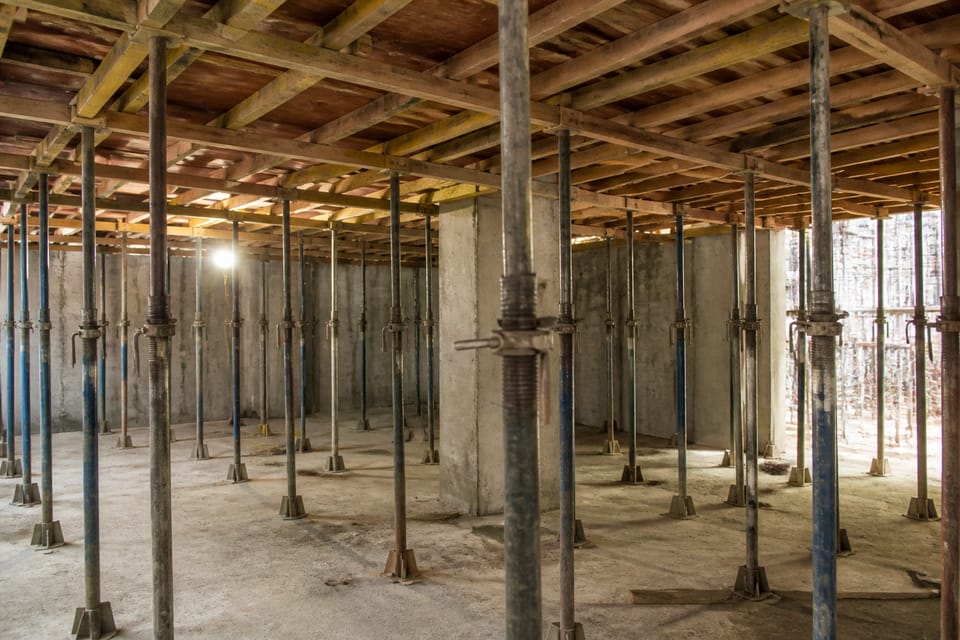
Someone must, the whole time. It is easy to skip when everyone is busy on the slab. IS 14687 says “The props and bracings should be watched during the placement of concrete and its vibration”. Loose members are to be attended at once. It also asks for “An agreed system of communication between the man below and the man in charge of concrete operations”, so that concreting can be stopped instantly.
IS 8989 says that during pouring the centering “shall be constantly inspected and strengthened, if required”, with wedges tightened as needed. IS 14687 calls for “experienced form watchers”. Its sample report format also lists a pre-arranged stop signal and two exit routes for the watcher.
News reports from Goa in 2023 and Haryana in 2026 describe collapses while a slab was being cast. Those reports did not establish why. They are a reminder that a slab can come down while it is being cast.
Three things follow:
- Ask before the pour: who is the watcher, and what is the stop signal?
- Keep everyone else out from under the slab. IS 14687 says to keep unauthorised people away. That includes you, your family and children.
- Keep water away from the props’ base. IS 8989 warns that dry clay can turn plastic after rain and lose bearing capacity, and it asks for drainage of rain and curing water.
What if rain or a breakdown stops the pour?
Tell the engineer at once, because a stop is a joint. IS 456 says joints are “a common source of weakness”, that concreting is carried on continuously up to joints, and that their position is “indicated by the designer”. So the mason should not choose the spot alone. CPWD says a slab stops at a stop board with slots for the bars, and “Inclined or feather joints shall not be permitted”. See construction joints.
IS 456 has no rule on rain in its placing clauses, and we found no rainfall figure for stopping. CPWD says fresh concrete “shall be protected from rain by suitable covering”. Keeping tarpaulins ready, and not starting if heavy rain is expected unless your engineer agrees, is practice. See the pre-monsoon checklist. For extreme weather, IS 456 points to IS 7861: see hot weather and cold weather concreting.
What happens after the last batch?
The new slab is covered, then kept wet. Do not let it dry out in between. The sources differ on when the cover goes on, so follow your engineer:
- CPWD covers the surface with moist gunny bags or similar about 1 to 2 hours after laying, and ponds it after 24 hours. This is for CPWD works.
- IS 7861 asks for protection straight after finishing in hot weather, using wet bags that do not drip.
- Our curing guide says to start as soon as the surface is firm enough to take water or cloth without being marked.
IS 456 sets the period. It says the surface is kept wet “for at least seven days from the date of placing concrete” for ordinary Portland cement, and at least 10 days with blended cements such as PPC or mineral admixtures. It is not less than 10 days in dry and hot weather, and for blended cements IS 456 recommends extending to 14 days. See how many days to cure a slab. Agree who waters the slab, including on holidays.
Concrete “should not be subsequently disturbed” (IS 456). IS 14687 says no construction load goes on a partly built structure unless shown on the drawings or cleared by the engineer. So do not stack bricks or steel on the new slab until your engineer agrees. No text we read gives a safe number of hours.
Keep a record of the date, cement type, cube marks and ready-mix tickets. The props stay until your engineer says otherwise: see shuttering vs centering vs staging.
What mistakes should I avoid?
These are practice points, except where a code is named above.
- Starting because the truck is booked, before the go-ahead.
- Having nobody below to watch the props.
- Letting family or visitors stand under the slab.
- Letting anyone add water at the mixer or on the slab.
- Dumping concrete in one heap and dragging it. A heap puts extra load on one part of the formwork.
- Stopping wherever the concrete ran out.
- Leaving the top bare in sun and wind.
- Instructing the workers yourself. Speak to the engineer or contractor.
Frequently asked questions
How much cement does chhat dhalai need?
That depends on the area, the thickness and the mix on your drawing. See cement bags for a 1000 sq ft slab for a worked example.
Can dhalai be done in the rain?
We found no code rule that sets a limit. CPWD says fresh concrete must be protected from rain. Ask your engineer before starting if rain is likely.
Can we stop and finish the next day?
Only at a joint the designer has fixed or agreed. An unplanned stop leaves a weak line, so call the engineer.
Is the vibrator needed for a small house slab?
IS 456 says concrete is compacted with mechanical vibrators and has no small-job exception. See our guide on compacting without a vibrator for what happens if one fails.
When can the shuttering be removed?
Your engineer decides. This page gives no time.
Related guides
- Before the slab pour: an owner’s checklist for formwork and steel
- Construction joints in concrete: where a pour stops and restarts
- How many days to cure a concrete slab?
- Sariya, gitti, balu, bori, dhalai, lintar: Hindi site words in English
- Corrosion of steel in concrete: why bars rust inside a slab
This guide is general information. Read the disclaimer. Your structural engineer and site supervisor decide the method for your slab.
Sources
- IS 456:2000, Plain and reinforced concrete, Code of practice: clauses 8.2.7, 10.2.5, 10.3, 13.1 to 13.6, 14.1, 15.1.1 and 15.2.1, read with Amendments 1 to 6. The linked text is the unamended 2000 copy.
- IS 14687:1999, Falsework for Concrete Structures, Guidelines: clauses 7.3.2.1, 9.1, 9.4 and Annex C (Annex C is a typical report format).
- IS 8989:1978, Safety code for erection of concrete framed structures: clauses 3.3.1, 4.10, 4.11 and 4.13.
- CPWD Specifications 2019, Volume 1: clauses 4.2.10.3, 5.4.2.1, 5.4.2.2, 5.4.2.7, 5.4.3.2, 5.4.3.3, 5.4.4.3, 5.4.6 and 5.9.6.5. Written for CPWD works, not private houses (copy on the IIT Bombay website).
- IS 3558:1983, Code of practice for use of immersion vibrators for consolidating concrete: clauses 4.1 and 4.3.1.
- IS 4926:2003, Ready-mixed concrete, Code of practice: clauses 5.2.1.1, 5.2.2.1 and 10.2.1.6. BIS lists one amendment, which we did not read.
- IS 7861 (Part 1):1975, Code of practice for extreme weather concreting, Part 1, Recommended practice for hot weather concreting: clauses 8.1 and 8.2.
- SP 7:2026, National Building Construction Standards 2026, Part D Section 2: clause 6.1.2 (unofficial archive.org copy).
- ILO, Training rural masons, Learning Unit 4, Concrete works, New Delhi, 2017: pp. 29 and 35 (training guidance, not a standard).
- The Goan, report on a slab collapse at Mapusa, 2023 (news report; cause not established in it).
- UNI, report on a collapse at Dhulkot, Ambala, September 2026 (news report; cause not established in it).
General information only. It is not a structural design or professional advice. Ask a licensed structural engineer or architect to check your plans and site.