
Short answer
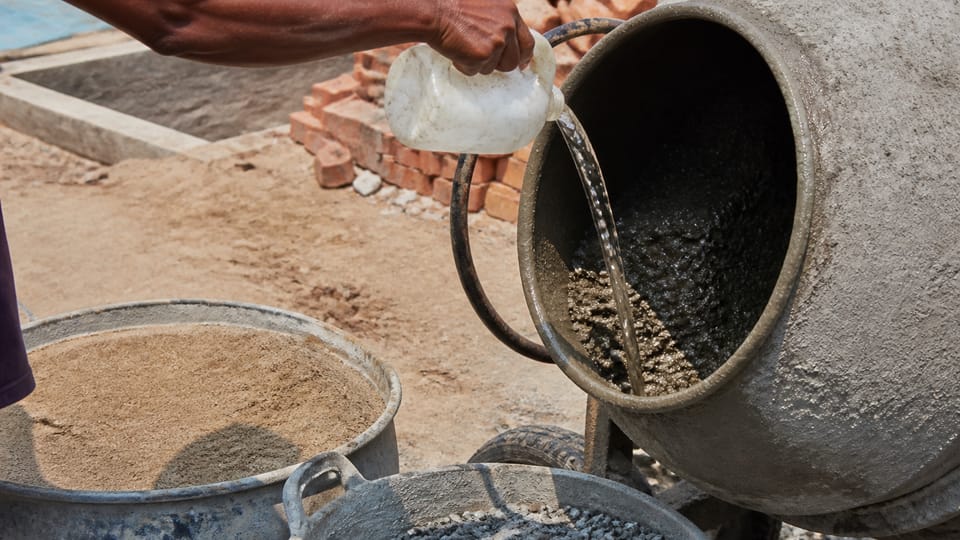
What is an admixture in concrete? IS 9103 defines an admixture as a material other than water, aggregate and cement that is added to the batch just before or during mixing to modify the concrete's properties. It covers five types: accelerating, retarding, water-reducing, air-entraining and superplasticizing. It does not fix a weak mix. IS 456 asks for trial mixes and for the chloride content to be checked.
On this page (11)
- What is an admixture?
- How does an admixture differ from an additive?
- What are the five types in IS 9103?
- How is an admixture tested?
- What must the manufacturer tell you?
- What does IS 456 ask when an admixture is used?
- Do I need one for a house?
- What mistakes should I avoid?
- Frequently asked questions
- Related guides
- Sources
“Admixture”, “additive”, “plasticiser” and “waterproofing compound” are used loosely on site and by sellers. The Indian standard that tests concrete admixtures, IS 9103, is more careful. This page says what it defines, the five types it covers, what it asks of a manufacturer, and what IS 456 asks of whoever uses one. It gives no brands, dosages or prices. An admixture is a tool for a mix designed by an engineer, and it does not repair a weak mix. For the water-cement relation, see water-cement ratio: why extra water weakens concrete.
What is an admixture?
IS 9103 clause 3.1 defines it as “A material other than water, aggregates, and hydraulic cement and additives like pozzolana or slag and fibre reinforcement used as an ingredient of concrete or mortar and added to the batch immediately before or during its mixing to modify one or more of the properties of concrete in the plastic or hardened state.” The scope (clause 1.1) covers “chemical and air-entraining admixtures including superplasticizers, solid or liquid or emulsion, to be added to cement concrete at the time of mixing”.
How does an admixture differ from an additive?
The Indian standards do not use the words one way, so say which standard you mean:
- IS 9103 calls pozzolana and slag “additives” and keeps them out of “admixture”.
- IS 456 clause 5.2 and NBCS 2026 call pozzolanas, fly ash, silica fume and similar materials “mineral admixtures”, and NBCS separates these from “chemical admixtures”.
- IS 4845, the cement terminology standard, uses “additive” for material interground with the clinker at the cement factory. We read the 1968 edition of that standard, and a newer one is in force.
So an additive in cement terms is added at the factory, and an admixture in IS 9103 terms is added at the mixer. The cement you buy as PPC or PSC already contains fly ash or slag: see OPC vs PPC vs PSC.
What are the five types in IS 9103?
IS 9103 clause 1.2 lists five types, and clauses 3.2 to 3.7 define them.
| Type | What the standard says it does (IS 9103) | Clause |
|---|---|---|
| Accelerating | “increases the rate of hydration of a hydraulic cement, shortens the time of set, or increases the rate of hardening or strength development” | 3.2 |
| Retarding | “delays the setting of cement paste, and hence of mixtures, such as mortar or concrete containing cement” | 3.3 |
| Water-reducing (workability aid) | “either increases workability of freshly mixed mortar or concrete without increasing water content or maintains workability with a reduced amount of water” | 3.4 |
| Air-entraining | “causes air to be incorporated in the form of minute bubbles in the concrete or mortar during mixing” | 3.5 |
| Superplasticizing | “imparts very high workability or allows a large decrease in water content for a given workability” | 3.6 |
Clause 3.7 adds a retarding superplasticizing admixture, which has prolonged workability retention and retards setting. “Plasticiser” is common usage and is not an IS 9103 term: the water-reducing admixture of clause 3.4 is the nearest. Our plain-words reading: a plasticiser does not give permission to add water. The definition says the same workability with less water, or more workability at the same water. IS 9103 does not cover waterproofing compounds, which have their own standard, IS 2645: see integral waterproofing compound: what IS 2645 says. NBCS lists other kinds, such as shrinkage-reducing and corrosion-inhibiting admixtures, but IS 9103 has no test regime for them.
How is an admixture tested?
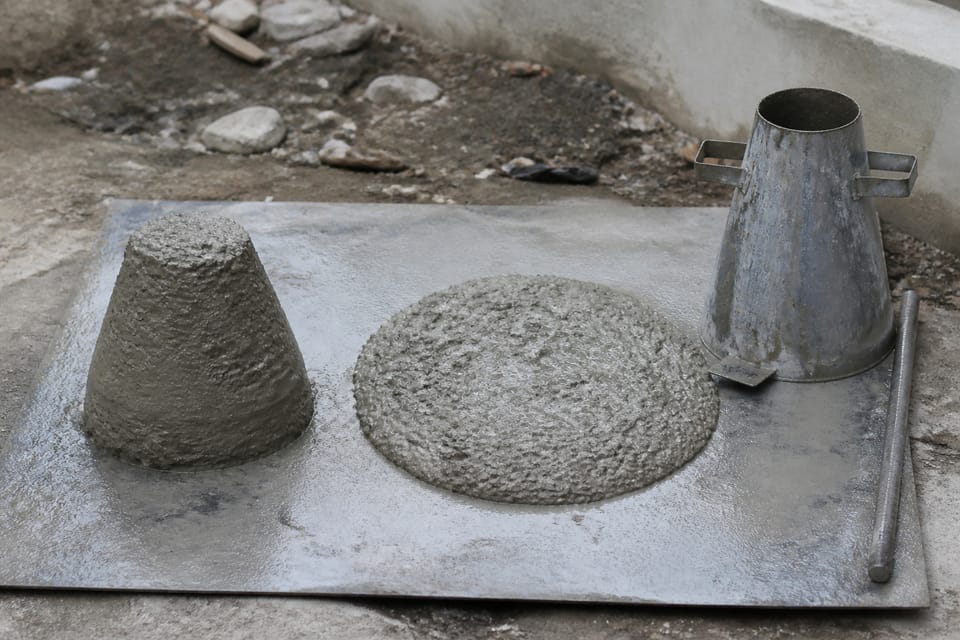
IS 9103 judges an admixture by comparison. Clause 4 says concrete made with the admixture, “when compared with identical concrete made without the admixture”, has to meet the requirements for its type in Tables 1A and 1B; for air-entraining admixtures the control concrete uses a reference admixture instead. The criteria include the water content, setting time, compressive and flexural strength, length change, bleeding and, for some types, workability loss, all measured against the control. The standard sets no absolute strength, and states no dosage: the dosage is declared by the manufacturer. We print none of the table values. A test on the standard’s reference mix does not show that the admixture suits your cement and your site: the Foreword says performance depends on the admixture, the cement and “their compatibility”, the mix proportions and the field conditions, and that it is necessary to evaluate an admixture with the materials and mix proportions to be used on the work.
What must the manufacturer tell you?
IS 9103 clause 10 asks for each container to be marked with the source and date of manufacture, the type, the batch number and the chloride content. The printed information includes the physical state, the composition, the chloride contributed at the recommended dosage, the storage conditions and maximum storage time, any known incompatibility with other admixtures or cements, the recommended dosage, the effect of under- and overdosing, and the expiry date. Clause 1.3 says the chloride content “shall be declared by the manufacturer” and that superplasticizers are expected to be chloride free. IS 9103 gives no numeric chloride limit for an admixture. The limit that matters is on the total chloride in the concrete, in IS 456 clause 8.2.5.2 and its Table 7, which clause 1.3.1 of IS 9103 points to. As practice, not a clause, ask for the datasheet and the batch label, and check that it names IS 9103. Clause 11 makes the BIS Standard Mark optional.
What does IS 456 ask when an admixture is used?
IS 456 clause 5.5 (retitled “chemical admixture” by an amendment) says:
- Admixtures “shall comply with IS 9103” (5.5.1).
- They “should not impair durability of concrete nor combine with the constituent to form harmful compounds nor increase the risk of corrosion of reinforcement” (5.5.2).
- “The workability, compressive strength and the slump loss of concrete with and without the use of admixtures shall be established during the trial mixes before use of admixtures” (5.5.3).
- The relative density of liquid admixtures is checked for each drum (5.5.4), and the chloride content is “independently tested for each batch before acceptance” (5.5.5).
- If two or more admixtures are used together, data should be obtained to assess their interaction and compatibility (5.5.6).
In CPWD works, clause 4.1.2.9 says no admixture is accepted unless it is tested in accordance with IS 9103 and the test results are approved by the Engineer-in-Charge. That is an acceptance rule for CPWD contracts and does not replace the trial mixes IS 456 asks for. For heat and cold, see hot weather concreting, where retarders and water reducers are one option, and cold weather concreting, where calcium chloride as an accelerator is a corrosion risk for steel.
Do I need one for a house?
That is a mix-design decision and not a default. An admixture is optional: IS 456 5.5.1 says “Admixture, if used”. In practice, a ready-mix supplier may use one, and IS 4926 mentions retarding admixtures as a condition allowing a longer discharge time. See ready-mix vs site-mix concrete. Ask your engineer whether the mix design calls for one, which type, and who will do the trial.
What mistakes should I avoid?
These are practice, not code rules, unless a clause is named.
- Dosing by guess or by bucket, and adding it at the wrong time. Follow the maker’s instructions and the engineer.
- Skipping the trial mix with your cement and aggregate (IS 456 5.5.3).
- Adding water after a plasticiser “because it looks stiff”. It defeats the water reduction.
- Using an admixture to cover poor sand, poor aggregate or a weak mix.
- Mixing two admixtures without data on their compatibility (IS 456 5.5.6).
- Using calcium chloride or any chloride-bearing admixture in reinforced concrete without the engineer’s written approval.
- Taking “strength booster” or “waterproof” claims on a can as proof. Ask for the IS number and the test report.
- Treating a retarded set as a reason to skip curing.
Frequently asked questions
What is the difference between admixture and additive?
IS 9103 uses admixture for a material added at mixing and calls pozzolana and slag additives. IS 4845 uses additive for material interground with cement clinker. IS 456 calls fly ash and silica fume mineral admixtures. Check which standard is meant.
What are the types of admixtures?
IS 9103 covers five: accelerating, retarding, water-reducing, air-entraining and superplasticizing, with a retarding superplasticizing variant.
Is a plasticiser the same as a superplasticiser?
IS 9103 defines the water-reducing admixture and the superplasticizing admixture as separate types. A superplasticizing admixture allows a large decrease in water for a given workability.
Does a plasticiser make concrete stronger?
Not by itself. IS 9103’s Foreword says a water-reducing admixture can raise strength only by cutting the water at the same workability. Strength depends on the water-cement ratio and the mix, and an admixture does not strengthen a weak mix.
Can I use an admixture without a trial?
IS 456 asks for the workability, strength and slump loss with and without the admixture to be established in trial mixes before use.
Related guides
- Water-cement ratio: why extra water weakens concrete
- Hot weather concreting in an Indian summer
- Ready-mix vs site-mix concrete: which suits a house
- Micro silica (silica fume) in concrete: what IS 15388 asks of it
This guide is general information. Read the disclaimer. Your structural engineer decides the mix and any admixture for your house.
Sources
- IS 9103:1999, Concrete Admixtures, Specification (first revision, reaffirmed 2004): clauses 1.1 to 1.3, 3.1 to 3.7, 4, 9, 10 and the Foreword (page images read). BIS lists it as not withdrawn; the BIS record shows no newer edition.
- IS 456:2000, Plain and Reinforced Concrete: clauses 5.2, 5.5.1 to 5.5.6 and 8.2.5.2 (page images read; Amendment 1 retitles clause 5.5 as chemical admixture).
- SP 7:2026, National Building Construction Standards (NBCS) 2026, Part C Section 5, Annex A clause A-4; and CPWD Specifications 2019 Vol 1 clause 4.1.2.9. Both read from text only. IS 4845:1968 (definitions of additive) was read; BIS lists it as withdrawn and IS 4845:2026 as in force, which we did not read. IS 4926 is cited through the published ready-mix page.
Change log
- : Added Related guides link to newly published article(s): micro-silica-silica-fume-in-concrete-what-it-is-and-what-is-15388-asks. No other text changed. Approved by the reviewing engineer.
General information only. It is not a structural design or professional advice. Ask a licensed structural engineer or architect to check your plans and site.