
Short answer
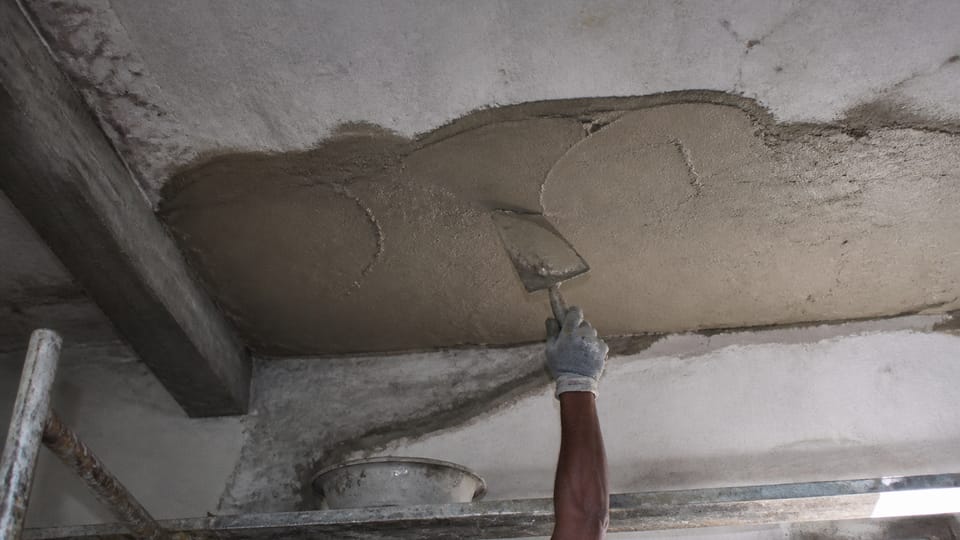
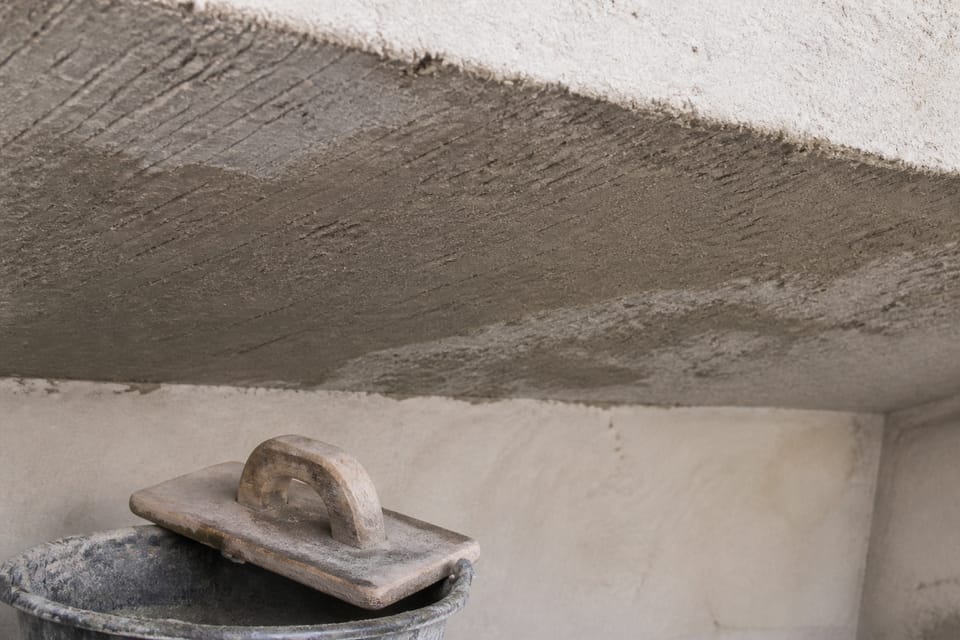
How is an RCC ceiling plastered, and why does the plaster fall off? Cement plaster on an RCC ceiling needs the concrete cleaned, laitance removed, the surface roughened and evenly wetted before the coat goes on. IS 1661 is the Indian code for plaster finishes. Peeling is the loss of large areas from the background, and poor bond, moisture and ceiling movement are common causes. Ask the engineer if a ceiling is cracking or sagging.
On this page (11)
- What does IS 1661 cover for ceilings?
- What must be done to an RCC soffit before plaster?
- How wet should the background be?
- What is different about a ceiling?
- Why does ceiling plaster fall off?
- What should I do with a loose patch?
- What about curing and coats?
- What mistakes should I avoid?
- Frequently asked questions
- Related guides
- Sources
A ceiling plaster job fails in one of two ways. It may never bond to the slab in the first place, or it may bond well and then lose its grip after a few years of moisture or movement. Both can be traced to the same few things: the concrete underside, the wetting, the coats and the water above. This page explains what IS 1661 says about preparing and plastering a concrete background, and what the research and the defect definitions say about why plaster lets go. It gives no thickness, no mix, no curing period and no bonding product. Those are in the standards and in the engineer’s specification.
What does IS 1661 cover for ceilings?
IS 1661 is the Indian code of practice for applying cement and cement-lime plaster finishes. Clause 1.1 says it covers the work on “walls, columns, ceilings and similar surfaces”, on backgrounds such as brick, stone or concrete, plain or reinforced. It says lime plasters, mud plasters and other special plasters are not covered.
It has no separate chapter for ceilings. Ceilings appear in the clauses on preparation, sequence and defects, and this page follows those clauses.
What must be done to an RCC soffit before plaster?
The concrete underside is the background. Five steps are set out before the first coat, some required and some conditional, and they are the ones a plasterer can check by eye.
| Step | What the standard says | Source |
|---|---|---|
| Remove dust and laitance | “A freshly cast concrete surface is often covered by laitance and this shall be removed”. Dust is cleared from masonry | IS 1661 cl 12.1.1 |
| Remove formwork residue | Where a chemical retarder was applied to the formwork, care is needed that none is left on the concrete, as it may interfere with the set of the plaster | IS 1661 cl 12.3.2.1 |
| Remove fins | Ridges or fins left by shuttering on soffits are removed before cleaning down | IS 1661 cl 12.3.3 |
| Roughen the surface (may) | A hard smooth surface may be roughened by hacking or bush-hammering; a surface that is not hard may be wire-brushed | IS 1661 cl 12.1.2 |
| Clean and wet | The RCC surface is hacked, the laitance removed completely, then cleaned and wetted before plaster | CPWD 2019 cl 5.4.7(d) |
Hacking is defined as “the roughing of solid backgrounds, by hand or mechanical methods, to provide a suitable key” (IS 10403 cl 2.34). The key is the reason. Practice point: a smooth hard soffit gives the coat little to grip, and a coat that does not key into the concrete is more likely to lift.
Practice point: the standards read here do not set a rule for a bonding agent on a concrete ceiling. A product’s maker and the engineer decide whether one is used, and the product’s own data governs it.
How wet should the background be?
IS 1661 cl 8.2.1 says the suction of the background matters. A dry background draws water out of the plaster and makes it weak, porous and friable. Too much water stops the mortar staying in position until it sets, and the bond fails.
Cl 8.2.2 says the wall “shall not be soaked but only damped evenly”, and that a fog spray is recommended. The clause is written for walls. Using it for a soffit is practice, and the same rule of even dampness is what a plasterer would apply overhead.
What is different about a ceiling?
Four points from the standard matter more overhead than on a wall.
- Inspect first. IS 1661 cl 9.4 asks for a preliminary inspection of the surfaces for planeness and dryness before plastering. If dubbing out is needed, it should be done in advance.
- Ceilings before walls. Cl 10.4 says it is an advantage to plaster the ceilings first, to allow the scaffolding to come down before the walls are plastered. Cl 10.5 says the finishing coat may be applied to the ceilings first.
- The wall-to-ceiling line. Cl 12.1.7.1 treats the change from wall to ceiling as a discontinuity that can crack. It allows a cornice that moves slightly without cracking, or a straight cut through the plaster at the junction.
- Fall-off risk. Practice point, not a standard clause: a coat that has not bonded falls on people below, so keep the area under the work closed off while the coat is wet.
Why does ceiling plaster fall off?
IS 1661 defines the defects by what the surface looks like. These are the ones a homeowner will see.
- Peeling. “The dislodgement of substantial areas of plaster work from the background” (cl 2.4.7; IS 10403 cl 2.38).
- Flaking. “The scaling away of patches of plaster surface due to lack or loss of adhesion” (cl 2.4.5).
- Blistering. “One or more local swellings on the finished plaster surface” (cl 2.4.1).
- Popping. “Conical hollows (pops or blows)” in the coats (cl 2.4.8).
The standard then names the causes. Three are in IS 1661 itself, and the fourth comes from BMTPC guidance.
- Bond failure. Cl 18.2.2 says bond failure gives hollow patches, flaking of the top coats, or peeling of large areas. It says moisture must be kept out of the plaster from the outside, “as otherwise peeling will eventually occur”.
- Ceiling movement. Cl 18.1.1 says plastered ceilings may crack because the ceiling construction permits excessive deflection, and that no plaster repair could be expected to be effective in preventing it.
- Popping. Cl 18.2.8 says unslaked lime is frequently the source of popping. Coal or other oxidizable particles in the sand may also cause it. Popping is a separate defect, with cone-shaped pops in the surface.
- Water. BMTPC House Building Digest 12 says water seeping through walls leads to peeling of plaster and paint. This is BMTPC guidance, not an IS 1661 clause.
A research paper from LNEC, Portugal, lists the causes of plaster detachment on ceilings and walls. It is a research abstract, not an Indian standard, and it names:
- the background: dust, demoulding oil, and poor or excessive suction;
- the mix: hydrophobic admixtures;
- the application: a thick coat, no adhesion coat, and drying periods between coats not respected.
The abstract does not say which of these caused any particular case.
| What you see | Possible cause | Where it comes from |
|---|---|---|
| Large sheets lifting or peeling | Bond failure, moisture, poor preparation | IS 1661 cl 2.4.7, 18.2.2; LNEC research |
| Hollow sound when tapped | Hollow patch, no bond | IS 1661 cl 18.2.2; how to check plastering work |
| Cone-shaped pops | Unslaked lime or coal in the sand | IS 1661 cl 18.2.8 |
| Cracks along the ceiling | Excessive deflection of the ceiling structure | IS 1661 cl 18.1.1 |
| Stain or drip below a bathroom or terrace | Water from above | BMTPC HBD 12; bathroom leaking into the ceiling below |
Practice point, not a source’s finding: where the slab underside is wet from a leak above, and the steel in the slab has rusted, the engineer should check whether the concrete cover is breaking up. That is a structural question, and the engineer decides it.
What should I do with a loose patch?
These are practice points, not standard clauses.
- Keep people and furniture away from a bulging or sagging area, and do not pull at loose plaster.
- Find the water before you repair. Practice point: a patch is unlikely to last while the leak above is still there.
- Tap the patch to see how far the hollow goes. The how to check plastering work page explains the test.
- If the ceiling is cracking along lines or sagging, ask the engineer. IS 1661 cl 18.1.1 says cracking from excessive deflection of the ceiling construction cannot be prevented by plaster repair.
What about curing and coats?
IS 1661 cl 16.1 says each coat is kept damp until the next coat is applied, with a fine fog spray, and that the wall is not soaked. Cl 8.5 says the drying shrinkage of the first coat should be materially complete before the next coat is applied. The clause gives no period for the interval, which depends on site conditions. This page does not repeat any period, so read the plaster curing page and the engineer’s specification.
What mistakes should I avoid?
These are practice points, not standard clauses.
- Plastering a dusty or greasy soffit. Dust and laitance are removed first (cl 12.1.1).
- Skipping the roughening on a smooth hard slab. The coat has nothing to grip.
- Leaving formwork residue on the concrete. Retarder residue can interfere with the set (cl 12.3.2.1). The LNEC research lists demoulding oil as a background cause.
- Putting one thick coat on the underside. The research lists a thick coat as a cause of detachment.
- Repairing the surface and not the water. A leak from above will lift new plaster too.
Frequently asked questions
Why does ceiling plaster peel?
The standards name poor bond with the background and moisture from outside as causes of peeling (cl 18.2.2). Popping, a separate defect, is linked to unslaked lime or coal in the sand (cl 18.2.8), and ceiling movement cracks the plaster (cl 18.1.1). The table above matches what you see to the clause.
How many coats does a ceiling need?
Ask the applicator which coats and thicknesses the work follows, and ask the engineer. This page does not give a count.
Can I plaster over an old painted ceiling?
IS 1661 cl 12.1.1 says old layers “shall be completely removed and made good”, and that crumbled and frost-damaged parts “shall be cut out and patched”. The standards read here do not address paint on old plaster. Test a small area and ask the applicator and the engineer.
Is it dangerous to be under a falling ceiling?
It can be. Keep people and pets out of the area below a bulging or sagging ceiling, and call the engineer before the work starts. This is practice, not a standard clause.
Related guides
- Plaster curing: how many days and how to do it
- How to check plastering work: hollow patches, line, level and finish
- Hairline cracks in plaster: causes and what to do
- How to plaster a wall: the steps from preparation to finish
- False ceiling vs POP ceiling: differences, damp problems and repair
- Bathroom leaking into the ceiling below: how to find the source
- Corrosion of steel in concrete: why bars rust inside a slab
This guide is general information. Read the disclaimer. A qualified engineer decides the plaster and repair work for your house.
Sources
- IS 1661:1972, Code of Practice for Application of Cement and Cement-Lime Plaster Finishes (first revision), cl 1.1, 8.2.1, 8.2.2, 8.5, 9.4, 10.4, 10.5, 12.1.1, 12.1.2, 12.1.7.1, 12.3.2, 12.3.2.1, 12.3.3, 16.1, 18.1.1, 18.2.2, 18.2.8, and the defect definitions in cl 2.4. Read from an archive copy; some clause headings (including 12.1.2 and 12.1.7.1) are garbled in that copy and should be checked against the print.
- IS 10403:1983, Glossary of Terms Relating to Building Finishes, cl 2.34 (hacking), 2.38 (peeling) and 2.42 (popping). Read from an archive copy.
- CPWD Specifications 2019, Vol 1, sub head 5.0 (RCC work), cl 5.4.7(d).
- BMTPC House Building Digest 12, Prevention of Dampness (government guidance, not a code).
- Veiga, M. do Rosario and Malanho, S. (LNEC), Detachment of plasters applied on ceilings and walls: a safety problem, XXXVII IAHS World Congress on Housing, Santander, 2010 (research abstract, not an Indian standard).
Change log
- : Added Related guides link to newly published article(s): corrosion-of-steel-in-concrete-why-bars-rust-inside-a-slab-and-how-the-code-guards-against-it. No other text changed. Approved by the reviewing engineer.
General information only. It is not a structural design or professional advice. Ask a licensed structural engineer or architect to check your plans and site.