
Short answer
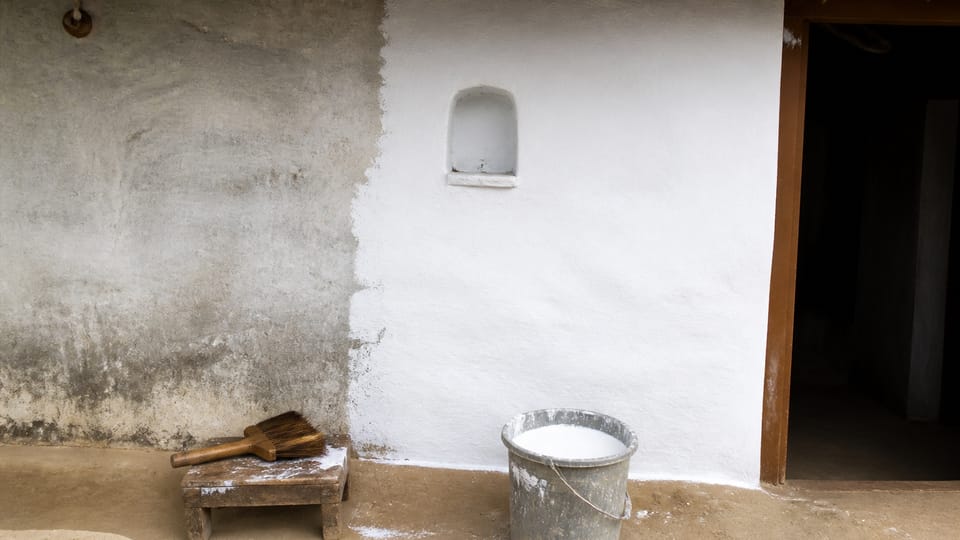
What is the difference between whitewash, colour wash and cement paint? Whitewash, or chuna, is lime slaked in water and brushed on. Colour wash is the same wash with mineral colours added. Cement paint is a powder based on Portland cement that you mix with water. It needs a wetted wall and keeping damp afterwards. None of them stops a leak. Old lime wash must be removed before you repaint with other paint.
On this page (13)
- What is the difference between the three?
- How is whitewash made?
- How is whitewash applied?
- How is colour wash different?
- How is cement paint applied?
- Where does each one suit?
- What about a damp wall, salts or mould?
- Can I paint over old whitewash?
- How often should it be redone?
- What mistakes should I avoid?
- Frequently asked questions
- Related guides
- Sources
Chuna on a village wall, safedi in a rented flat, cement paint on a compound wall: these are the older finishes, and many owners still choose them or inherit them. This page explains what each one is, how it is applied under the Indian codes, where it suits, and what to do with old wash before new paint. It gives no prices and names no brands. For a choice among distemper, emulsion and enamel, see distemper vs emulsion vs enamel.
What is the difference between the three?
They differ in what binds them to the wall.
| Finish | What it is | How it is prepared | Where the codes place it |
|---|---|---|---|
| Whitewash (chuna, lime wash) | Slaked fat lime in water | At site, a day ahead | Concrete, masonry and plaster |
| Colour wash | Whitewash with mineral colours | At site, in one batch for the job | Same as whitewash |
| Cement paint | Powder of Portland cement with lime, pigments and other ingredients | Mixed with water, used within an hour | Porous masonry, concrete, rough plaster; not gypsum |
Whitewash and limewash are one thing in the Indian texts. IS 6278, the code for this work, uses both words. Brand blogs often treat them as two products, and a tin sold as “limewash” may not be the same thing, so read the tin. CPWD also lists a wash made with whiting, or ground white chalk, which has no lime. So “safedi” on a quote may not mean lime. Ask.
Lime wash hardens by carbonation, IS 6278’s word. In chemistry terms, the lime takes up carbon dioxide from the air. Cement paint hardens in a different way. IS 5410 says its drying time means “hydration and hardening of the paint film and not for evaporation of moisture”. That is why cement paint needs water after it is applied.
How is whitewash made?
IS 6278 says the lime is freshly burnt class C fat lime, white in colour, slaked at site. It is mixed with about 5 litres of water for 1 kg of unslaked lime to make a thin cream, left to stand for 24 hours, and screened through a clean coarse cloth. CPWD then thins it further to a milky solution.
The other ingredients do small jobs. We give no amounts here: the gum figure differs between sources, and the mix is for the person making the wash.
- Gum, dissolved in hot water, is part of the mix. IS 2395 and CPWD use more than IS 6278.
- Salt “may be added”. IS 6278 says it helps make the coat hard and rub-resistant.
- Neel or ultramarine blue is a small quantity in the white wash. CPWD says indigo is not added to colour wash.
Slaking is dangerous. IS 1635 says quicklime “reacts violently with water”, and its particles can burn skin, particularly moist skin. Freshly slaked lime can burn while hot. IS 1635 lists goggles, respirators, rubber gloves and gum boots for workers. The L V Prasad Eye Institute reports chuna as the most common agent in a large study of eye burns. Its note mentions both lime eaten with paan and whitewashers who work without protective eyeglasses. Keep children away from the tub. If lime gets in an eye, wash it with plenty of clean water at once and go to an eye hospital. That first aid is general advice, not code text. In practice, leave slaking to experienced workers, or use a ready product and follow its pack. It may not be the wash IS 6278 describes, so wear eye protection either way.
How is whitewash applied?
The steps below are from IS 6278. CPWD agrees on the brushing, ceiling-first order, drying between coats and the finish test, but says less on preparing the surface.
- Protect doors, windows, floors and furniture from splashes.
- Prepare the surface. Clean new work of dirt and mortar drops. On old work, broom it and remove loose scales. Where heavy scaling has taken place, scrape the entire surface clean.
- Treat defects first. Scrape and wash smoke stains. Remove oil and grease. Cut out unsound plaster and replaster it. Fill holes. Do not wash over mould or salts: see the section on damp below.
- Do the ceiling before the walls.
- Brush. A moonj or similar brush goes on with one stroke down, one up, one from the right and one from the left, before it dries.
- Let each coat dry before the next, and leave no part to patch later.
- Check. The finish must not crack or peel, and it must not come off readily on your hand when rubbed.
How many coats? The sources differ, so agree the number in writing. On new work, IS 6278 asks for at least two coats. The IS 2395 schedule shows a first coat plus two. CPWD asks for three or more, until the plaster no longer shows. On old work, the patches get a coat first, then one or more coats go over the whole surface.
Lime is not used on hessian ceilings, because CPWD says it rots the cloth.
How is colour wash different?
Colour wash uses only mineral colours not affected by lime. IS 6278 asks for three things:
- One batch. Make enough for the whole job in one operation, so the shade does not change.
- A trial patch first. Small areas look lighter than the same shade on a large wall.
- A white first coat on new work. After that, at least two coats of colour. IS 2395’s schedule starts with colour wash instead, so ask.
To change colour, the old colour wash is “entirely removed”, then two coats of whitewash go on before the new shade.
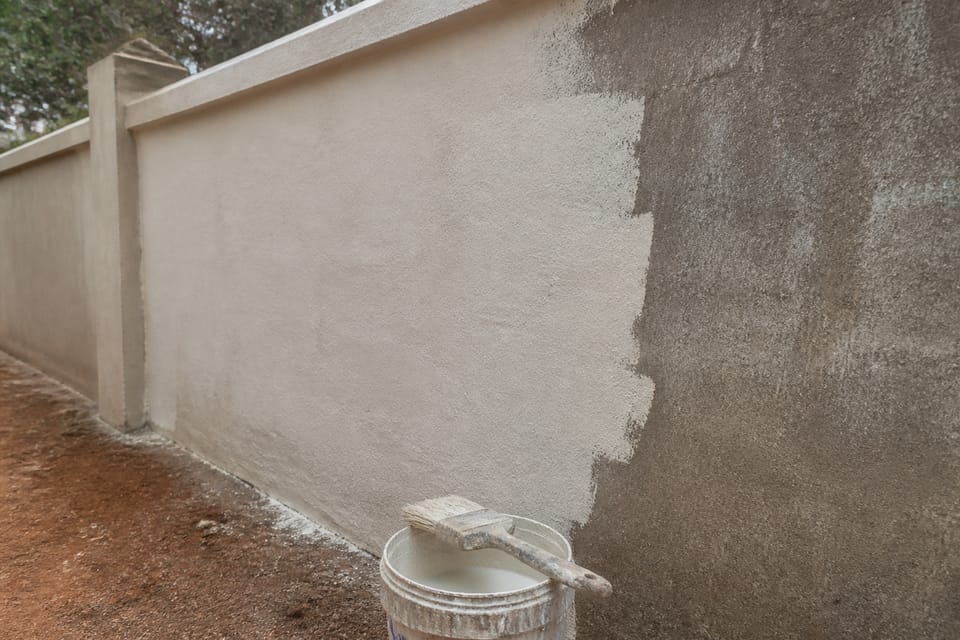
How is cement paint applied?
IS 5410 is the product standard, and IS 2395 gives the method. Follow the maker’s pack as well, because CPWD says its instructions are to be followed.
- Check the surface. IS 5410 says it must be free from chalking. Cement paint is for porous surfaces, and not for gypsum plaster.
- Wet the wall. IS 5410 says the surface is wetted before application. IS 2395 says “moist but not dripping wet”.
- Mix. Add the powder to the water, not the other way round (CPWD), and keep stirring.
- Use it within 1 hour of mixing (IS 5410).
- Work in the shade when it would dry fast (IS 2395). CPWD keeps to the shady side, out of direct sun.
- Brush it in. On concrete masonry meant to resist moisture, IS 2395 says both coats are scrubbed on, to work the paint into the voids.
- Wait at least 24 hours before the next coat, until the first resists marking by the brush.
- Keep it damp. IS 2395 recommends a fine spray two or three times a day, between coats and for at least two days after the last coat, starting about 12 hours after application.
How many coats? On new work, IS 2395 Part 1 says two coats, its schedule shows a first coat plus two, and CPWD asks for three or more for a uniform shade. On old work, CPWD says one or more. There is one open conflict: in hot dry weather IS 2395 says to moisten the first coat before the second, while CPWD says not to wet it. Follow the maker’s sheet.
Where does each one suit?
- Walls still drying. IS 2395 lists lime wash, colour wash and cement paint among the porous finishes that allow drying to go on through the film.
- Outside walls. IS 2395 recommends cement paint for porous exterior concrete walls, such as concrete block, and IS 5410 says it does better outdoors than distemper. It reduces water passing through. It does not stop a leak. See waterproofing exterior walls.
- Walls that get scrubbed. IS 2395 says cement paint is not well suited to interior surfaces needing frequent cleaning, because it tends to erode with vigorous scrubbing. In practice the same goes for whitewash.
- Gypsum plaster. No cement paint (IS 5410, IS 2395).
- Lime plaster. The codes differ. IS 2394 calls cement-based paints not suitable on lime plaster, while IS 2395 lists cement paint for early use. Ask your engineer. See lime mortar and lime plaster.
- Old or heritage buildings. Ask a conservation architect.
What about a damp wall, salts or mould?
A wash does not cure damp. IS 2395 says that if a surface stays damp, “the cause shall be examined” before decorating. IS 2395 Part 2 says cement paint, lime wash and colour wash “tolerate a certain amount of dampness”, but that is all.
For white salts, or efflorescence, IS 2395 says “Dry brushing of the growth as it appears is the only remedy”, and that washing can carry salts back into the pores. CPWD allows washing and then drying before whitewash. We follow the standard: brush it off dry, and find the water. For mould, IS 2395 says to remove the source of dampness, dry the wall and improve ventilation. IS 6278 and IS 2395 then have the growth scraped or removed and the surface treated with a fungicidal wash, left to dry before any coat. Ask your engineer which chemical to use: we give no recipe. A wall that keeps rubbing off, flaking or peeling needs the cause found, as our guide on why paint peels explains.
Can I paint over old whitewash?
No, not directly. IS 2395 says “Dry distempers and lime wash shall be totally removed prior to repainting”, and it applies the same preparation to cement plaster, concrete and brickwork. It adds that the wall may be wetted before scraping, but not too much, and must be perfectly dry before any primer. CPWD agrees for cement paint, which it says must not go on whitewash or colour wash unless the wash is scraped off completely, followed by a cement primer.
This rule is about repainting. Under IS 6278, a new coat of the same wash only needs loose material brushed off, unless scaling is heavy. Choose with the future in mind: if you want emulsion later, whitewash today means scraping it all off first. CPWD also says a whitewash coat is not a primer for distemper. For the paint steps after that, see painting interior walls and painting exterior walls.
How often should it be redone?
No code we read says how long these finishes last on your wall. IS 5410 has an outdoor exposure test for cement paint, but that is a product test on panels, not a repaint date. CPWD’s maintenance manual works on a two-year cycle for whitewash and colour wash, and three years for exterior waterproof cement paint, in the government buildings it maintains. That is a work schedule, not a promise for your wall. Redo it when it rubs off or looks poor.
What mistakes should I avoid?
These are practice points, except where a code is named above.
- Painting emulsion or cement paint over old lime wash.
- Applying cement paint to a dry wall, then letting it dry out.
- Mixing more cement paint than you can use in an hour.
- Thick coats of wash, which tend to crack and flake.
- Patching only the marks. IS 6278 has a coat over the patches, then coats over the entire surface.
- Washing white salts off with water.
- Slaking quicklime near children, or without eye protection.
- Whitewashing in rain or harsh sun.
Frequently asked questions
Is whitewash the same as limewash?
In the Indian codes, yes. IS 6278 and CPWD use both words for slaked lime wash. Decorative “limewash” tins may be different products, so read the label.
Why does whitewash come off on my clothes?
A good finish should not. IS 6278 says it must not come off readily on the hand. If it does, ask your painter to check the wash and the surface before adding more.
Is cement paint waterproof?
Not in the sense of stopping a leak. IS 2395 says it reduces the water passing through porous concrete. CPWD’s item name uses the word waterproof, but a crack or leak needs its own repair.
Is cement paint the same as white cement?
No. IS 5410 says Portland cement with other ingredients, and it does not require white cement. In practice, some products use it. White cement alone is a different thing.
Can I whitewash over emulsion?
IS 6278 does not cover this. In practice lime will not hold on a plastic paint film, so ask your painter.
Do I need a permit to whitewash?
The model bye-laws list white-washing as needing no permit, where your authority has adopted that list. Listed heritage buildings need permission first. Check your local rule. See which house works need a building permit.
Related guides
- Distemper vs emulsion vs enamel paint: which goes on which surface
- Painting exterior walls: preparation, primer and coats
- Lime mortar and lime plaster: what they are and how they are made
- How painting area is measured: IS 1200 door, window and grill factors
This guide is general information. Read the disclaimer. The product’s own instructions and your engineer decide what suits your wall.
Sources
- IS 6278:1971, Code of practice for whitewashing and colour-washing: clauses 0.2, 1.1, 2.1, 4.1, 4.2, 5.1, 5.2, 6.1, 6.2 and 7.1. BIS shows validity to 2027-01-31: re-check after that date.
- IS 5410:2013, Cement paint, Specification (second revision): foreword, clauses 1, 4.2, 4.3, 4.6 and Annexes D-4 and K. BIS lists Amendment No. 1 of 2024, not read; BIS guidelines say it changes a sieve test only.
- IS 2395 (Part 1):1994, Painting concrete, masonry and plaster surfaces, Code of practice, Part 1 Operations and workmanship: clauses 5.2.3, 5.6.3, 7.1.1, 7.1.3.4, 7.2, 7.4, A-2, B-1.1, B-2.1, B-2.3.1, B-2.4, B-2.5.2, B-2.5.4, B-2.5.6, B-2.6 and C-3.1.
- IS 2395 (Part 2):1994, Part 2 Schedule: Tables 1 and 2 and clause 5.1.
- IS 2394:1984, Code of practice for application of lime plaster finish: clause 8.3.
- IS 1635:1992, Field slaking of building lime and preparation of putty: clause 8.
- CPWD Specifications 2019, Volume 2, Sub Head 13: clauses 13.14, 13.16, 13.17, 13.18.3 and 13.21. Written for CPWD works (copy on the IIT Bombay website).
- CPWD Maintenance Manual 2019, section 4.3 and Annexure 10 (copy on the NDMC website; for government buildings).
- L V Prasad Eye Institute, news note on acute ocular burns.
General information only. It is not a structural design or professional advice. Ask a licensed structural engineer or architect to check your plans and site.