
Short answer
How do you waterproof an exterior wall, and what do the standards say? Find where the water enters, repair cracks and the parapet top first, then coat. IS 2402 says water enters through the pores of a rendering or through cracks. IS 2395 says to cut major cracks in a V and make them good. IS 13435 is only a set of laboratory test methods for acrylic materials, so no standard we read sets an acrylic wall coating.
On this page (11)
- How does rain get through an outside wall?
- What is IS 13435?
- What do the standards say about cracks?
- What do the standards say about coatings and water repellents?
- What about the parapet top?
- What about AAC and other block walls?
- What order should the work go in?
- What mistakes should I avoid?
- Frequently asked questions
- Related guides
- Sources
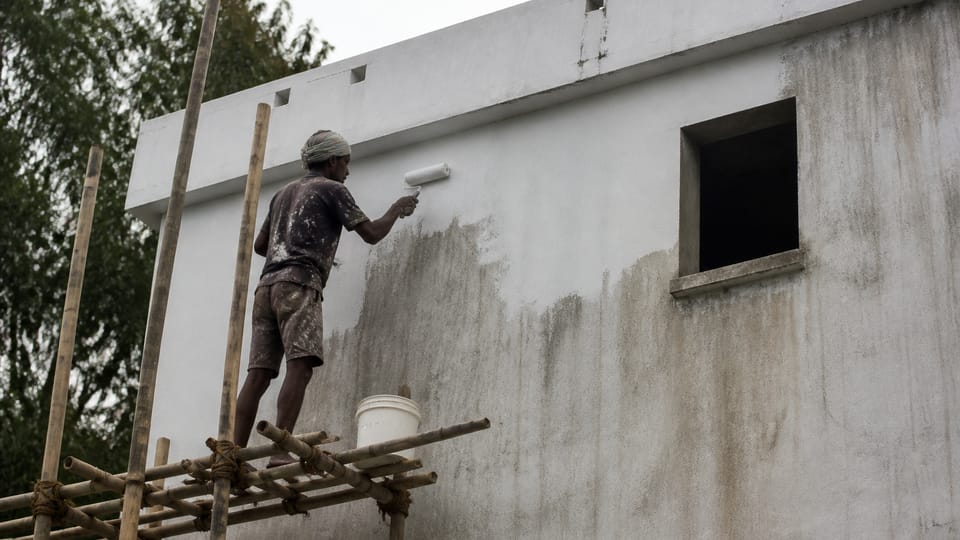
A damp patch on an outside wall after rain sends most owners to a “waterproof paint”. The standards say something less simple: water gets in through the pores of the rendering, through cracks, and through the weak points of the wall, and the cure starts with the entry point. This page explains how rain gets through an outside wall, what the Indian Standards say about cracks, water repellents and the parapet top, and what IS 13435 is. It gives no coat count, no coating thickness, no crack width, no brand and no “lasts so many years”, because no standard we read gives them for a wall. For the paint steps once the wall is sound, see painting exterior walls: preparation, primer and coats.
How does rain get through an outside wall?
IS 2402:1963, the code for external rendered finishes, says: “Water may penetrate either through the pores of a rendering or through cracks or both” (6.4.1). It adds that where cracks occur, “particularly in a dense and impermeable rendering”, water may enter and find its way between the rendering and the background, or into the background, and lead to loss of adhesion, more cracking or dampness inside (6.4.3).
IS 2212 says much the same for brickwork: rain-water penetrates solid brickwork through cracks or through the bricks and mortar, and rendering increases the resistance (6.6.2). It also warns that a rich cement rendering on exposed brickwork can crack from shrinkage and let water in, while its close texture keeps it from drying out (13.2.1). So, as an inference from those clauses, a stronger, denser coat is not automatically a drier wall; IS 2212 13.2.3(g) also warns that a dense facing on porous brickwork may cause prolonged dampness.
The usual entry points are the same ones a house has everywhere: cracks, the top of the parapet, window sills and frame joints, the joint under a chajja, and pipes or gutters that spill on the wall. If the water comes from a leak or from the roof above, no coating on the outside will fix it. See damp walls: rising damp, seepage or condensation, and the fix to find the source, and windows leaking in rain: frame, sill and drip, and where to start for the window side.
What is IS 13435?
IS 13435 is often quoted as “the acrylic waterproofing standard”. It is not. The series is titled “Acrylic Polymer Based Waterproofing Materials, Methods of Test”. Part 1:2021 describes only “the method of determination of solid content” of such materials, as a laboratory test, and it has no requirements, no application rules, no coat count and no statement about where a coating may be used, on walls or roofs. Parts 2 to 4 (1992, also in force) are titled as test methods for coarse particles, capillary water take-up and pH; we did not read them. So a bag or tin that says “as per IS 13435” tells you only that a test method exists. Ask for the maker’s data sheet instead.
We did not find an in-force Indian Standard that sets requirements for an acrylic or elastomeric exterior-wall waterproofing coating. What a coating can bridge, how many coats it takes and how long it lasts are therefore the maker’s claims and the engineer’s judgement.
What do the standards say about cracks?
| Source | What it says, in words |
|---|---|
| IS 2395 (Part 1) 7.2 | On cement concrete and plaster: loose or uneven areas and major cracks are “cut out in V shape and made good and the repairs allowed to dry thoroughly before painting”; minor repairs may be made with cement mortar |
| IS 2395 (Part 1) 7.1.2 | On old plaster: the source of dampness is removed and painting is deferred until dry; fine cracks may be primed and filled |
| IS 2402 10.2.1 | Inconspicuous cracks in walls that remain dry and sound are usually best left alone |
| IS 2402 10.2.2 | Cracks in the rendering only: tap for hollow areas, cut out the hollow areas and repair, with the edges left square or preferably undercut |
| IS 2402 10.2.2.1 | Where only very fine cracks are present and the work appears sound, coating the whole rendered finish with cement paint or other decorative treatment “may be adequate to close and conceal the cracks” |
| IS 2402 10.2.3 | Cracks through the rendering and the base: deal with the cause first; the repair “may not entirely prevent further cracking but it will reduce its severity” |
| IS 2212 13.6 and 14 | Shrinkage cracks in brickwork do not affect the strength and do not recur after the first season of drying out if the walls are generally water-tight; judge the cause before repairing |
The sizes in those clauses (how far to cut back, how wide) are repair details for the engineer, and we do not print them. For when a crack is more than cosmetic, and how to track one, see hairline cracks in plaster: causes and what to do. In practice, a crack that moves, widens or runs diagonally is not a coating job.
What do the standards say about coatings and water repellents?
- Cement paint. IS 2395 Annex B-2.1 says Portland cement paints are suitable for exterior and interior concrete and stucco “not subjected to mechanical abrasion”, are recommended “where it is desired to decorate or reduce the water permeability of exterior walls built of porous, open textured concrete, such as concrete block masonry”, and may be used where the surface is damp when painted. This is the standard’s own words for the water side of a cement paint; it refers to concrete block, not to AAC. Cement paint is not for gypsum plaster (IS 5410).
- Colourless water repellents. IS 2402 11.5.1 says cracks are dealt with as in 10.2 and rain-runs from defective design are remedied, and only where penetration cannot be assigned to those causes is a treatment from 11.5.2 or 11.5.3 used. Clause 11.5.2 says the surface of rendering “can be made water-repellent by treatment with appropriate colourless solutions”, either silicones or waxes, which are proprietary and “shall be applied in accordance with the manufacturers’ instructions”, and that all types need renewal after a period of some years. It also says paint treatments, regularly applied, “will effectively prevent rain penetration through renderings” (11.5.3). The older IS 12054:1987 on applying silicone water repellents says cracks wider than hair cracks and defective mortar joints should be repaired first and the surface must be clean and dry. That edition is withdrawn: IS 12054:2025 is the edition in force, and we have not read it.
- Do not seal in moisture. On efflorescent walls, IS 2395 Annex C-3.1 says “it is useless to attempt to seal the moisture by the paint film on the surface”, that sealing coats may not hold back strong efflorescence, and that dry brushing is the remedy (it adds that treating an old wall with a hydrofuge silicone will frequently stop the efflorescence); IS 2212 13.5 says efflorescence is scrubbed out dry and not washed. See why wall paint peels, bubbles or flakes, and how to fix it.
- Persistently damp walls. IS 2395 5.2.3 says if a surface remains persistently damp, the cause shall be examined and the surface suitably treated before attempting to decorate. IS 2402 11.2.2 says where water penetration is an obvious or suspected cause of failure, it shall first be remedied.
What about the parapet top?
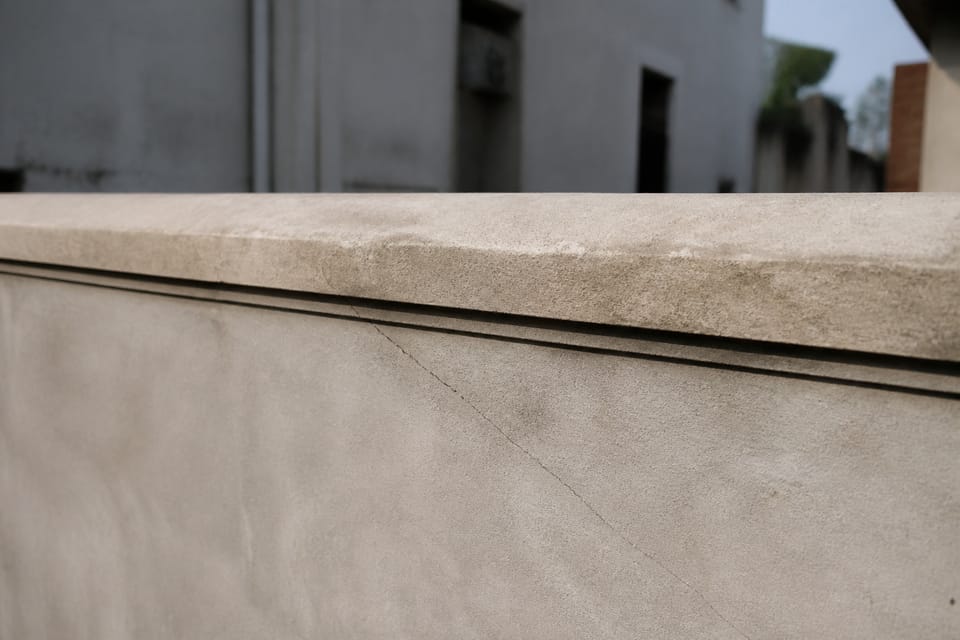
The top of a parapet is exposed to rain from above and from both faces, so it is a frequent source of seepage into the wall below. IS 2212 says:
- Copings “may be of stone, concrete, brick or terracotta and throated on the underside of the projection. The top of the coping shall be slightly sloped so as to allow rain-water to drain off” (6.12.2).
- Where the coping is of an impervious material like stone or dense concrete, no damp-proof course may be necessary across the wall; where it is pervious, a flexible damp-proof course may be needed above the finished roof level (6.8.6).
- The junction of the roof slab and the parapet wall is to be effectively treated against leakage of rain-water (6.12.1).
- Parapet walls “shall not be sealed on both faces by impervious rendering; this reduces the rate of evaporation and may ultimately result in a wet-condition of the brickwork” (13.2.3(c)), while the code’s Table 1 says parapets should preferably be finished on all sides with a water-tight plaster. The code gives two instructions, so the engineer decides the finish; do not coat every face of a parapet without asking. See parapet wall: purpose, the model bye-law height rule and coping.
For where the wall meets the terrace waterproofing, see terrace leakage and waterproofing: methods, slope and ponding test. The roof coating figures there are for roofs and do not carry over to walls.
What about AAC and other block walls?
IS 6041:1985, the code for autoclaved cellular concrete block masonry, says in clause 12.1 that the exterior surface of all cellular concrete block walls “shall be made waterproof by treating the walls with different types of renderings, depending upon the intensity of rainfall, nature of exposure, etc.” It says the renderings follow IS 2402, and are not applied on wet walls or in the monsoon, only after the walls have fully dried (12.1.1). The clause gives rendering schemes by rainfall, which we do not print: the rendering for your wall is for the engineer to specify. No standard we read gives an acrylic or elastomeric coat for AAC. The published guide to AAC cracks is why AAC block walls crack and how to avoid it.
What order should the work go in?
This is practice, unless a clause is named.
- Find the source: rain through cracks, parapet top, sills, chajja joints, pipes and gutters, or a leak inside.
- Ask the engineer about any wide, growing, diagonal or stair-step crack, or cracks with leaks or sticking doors.
- Repair the entry points: crack repair as IS 2395 7.2 and IS 2402 10.2 describe, the coping top and its throating, and cleared gutters and outlets. IS 2212 13.2.3(b) warns that cement fillets and renderings used to protect horizontal surfaces are unlikely to be satisfactory, so ask about flashings and not only a cement fillet.
- Let the wall dry, and deal with salts by dry brushing, not washing.
- Apply a primer and a coating from one system, as the maker’s data sheet says: the number of coats comes from the data sheet, not from a website. Choose a coating that can follow small crack movement only if the engineer agrees; a rigid cement coat suits a stable wall (engineering judgement, not a clause).
- Try a test patch on the real wall and let it dry. Work only in a dry spell.
- Keep the data sheet, the batch number and the date. Before each monsoon, clear gutters and outlets and look at the parapet top and the outer plaster for cracks.
What mistakes should I avoid?
These are practice, not code rules, unless a clause is named.
- Sealing a damp wall under a non-porous coat: IS 2395 5.2.3 says a persistently damp surface needs its cause examined first, and that for new walls any paint system that seals in moisture should be avoided.
- Painting over cracks without repairing them. Paint does not close a moving or wider crack; for very fine cracks in sound work, IS 2402 10.2.2.1 says a coat may be enough.
- Treating only the inside face when the water comes from outside.
- Waterproofing a wall without checking the parapet top, sills and pipes.
- Sealing a window or chajja joint without asking what the joint is for: see what is a chajja? Chajja, sunshade, lintel and balcony.
- Putting a rich, dense cement coat on exposed brickwork (IS 2212 13.2.1).
- Sealing a parapet on both faces without the engineer (IS 2212 13.2.3(c)).
- Using a roof coating or an interior paint on an outside wall.
- Believing “one coat is enough” or “more coats last longer” without reading the data sheet.
Frequently asked questions
Does waterproof paint stop seepage in a wall?
Not by itself. On a wall with efflorescence, IS 2395 Annex C says it is useless to seal the moisture by the paint film, and a persistently damp wall needs its cause examined and treated first (5.2.3). Paint does not close a moving crack.
Is IS 13435 the standard for acrylic waterproofing coatings?
No. IS 13435 is a series of laboratory test methods for acrylic polymer waterproofing materials. Part 1 covers solid content. It sets no requirements and no application rules.
Do I fill the cracks before waterproofing?
Yes for major cracks: IS 2395 7.2 says to cut them in a V and make them good, and let the repair dry, before painting. In practice, cracks that move or widen need the engineer.
How many coats does an exterior wall need?
The standards we read give no single number. The maker’s data sheet states it for its system.
Can I waterproof an AAC wall from the outside?
IS 6041 clause 12.1 asks that the outside of AAC block walls be made waterproof by a rendering suited to the rainfall and exposure, applied to a dry wall. We read no standard for an acrylic coat on AAC. Ask the engineer for the rendering and the block maker for its advice, and repair cracks first.
Related guides
- Painting exterior walls: preparation, primer and coats
- Damp walls: rising damp, seepage or condensation, and the fix
- Parapet wall: purpose, the model bye-law height rule and coping
This guide is general information. Read the disclaimer. Your engineer decides how the walls of your house are repaired and protected.
Sources
- IS 13435 (Part 1):2021, Acrylic Polymer Based Waterproofing Materials, Methods of Test, Part 1 Determination of Solid Content (first revision): clause 1 and foreword (page images read). BIS lists it as in force, valid to 2031-03-18. Parts 2 to 4 (1992) are also test methods and were not read.
- IS 2402:1963, Code of Practice for External Rendered Finishes: clauses 6.4, 10.2, 11.2.2 and 11.5.1 to 11.5.3 (page images read; the code is old and expires soon unless reaffirmed). BIS lists it as in force (reaffirmed 2001), valid to 2027-01-31.
- IS 2395 (Part 1):1994, Painting of Concrete, Masonry and Plaster Surfaces, Operations and Workmanship: clauses 5.2.3, 7.1.2, 7.2 and Annexes B-2.1 and C-3.1 (page images read). BIS lists it as in force, valid to 2029-09-30.
- IS 2212:1991, Brickwork, Code of Practice: clauses 6.6.2, 6.8.6, 6.12.1, 6.12.2, 13.2.1, 13.2.3, 13.5, 13.6 and 14 (page images read). BIS lists it as in force, valid to 2029-09-30.
- IS 12054:1987, Application of Water Repellents (silicone based), Code of Practice (page images read; the 1987 edition is withdrawn and IS 12054:2025 is in force but was not readable).
- IS 6041:1985, Construction of Autoclaved Cellular Concrete Block Masonry, Code of Practice: clauses 12.1 and 12.1.1 (text read). BIS lists it as in force, valid to 2030-08-01.
General information only. It is not a structural design or professional advice. Ask a licensed structural engineer or architect to check your plans and site.