
Short answer
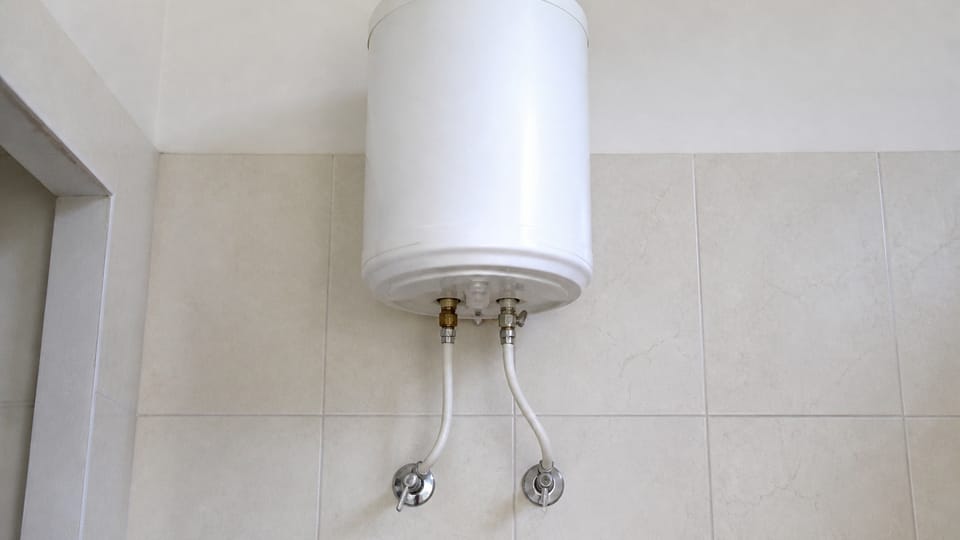
What is the difference between instant, storage and gas geysers? A storage geyser heats and stores water in a tank (IS 2082). An instantaneous electric geyser heats water while it flows (IS 302 Part 2 Section 35). A gas geyser heats it with a burner as it flows, and IS 16093 says to install one in a well cross-ventilated room, in open space if the ventilation or area is insufficient, and does not recommend it inside a bathroom unless those conditions are met. Each needs different pipes, power or gas planned early.
On this page (10)
“Geyser” in India covers three different machines, and a house needs different things for each. A storage geyser needs a tank, a power point and, for a closed type, a pressure-relief arrangement. An instant electric geyser needs a heavier electrical connection. A gas geyser needs a gas line, ventilation and a place to put it. This page explains how each heats water, what the Indian Standards say about each, and what to plan before the walls close. It gives no brand, no price, no kilowatt rating as a recommendation, no star-rating saving and no wire or breaker size: those come from the maker’s manual and your electrician. For the solar option, see solar water heater vs geyser: flat plate, evacuated tube and the roof.
How does each type heat water?
| Type | How it heats | What the standard says |
|---|---|---|
| Storage geyser | Heats water in a tank and keeps it hot until it is used | IS 2082 and IS 302-2-21: a “stationary appliance for heating and storing water in a container and incorporating devices to control the water temperature” |
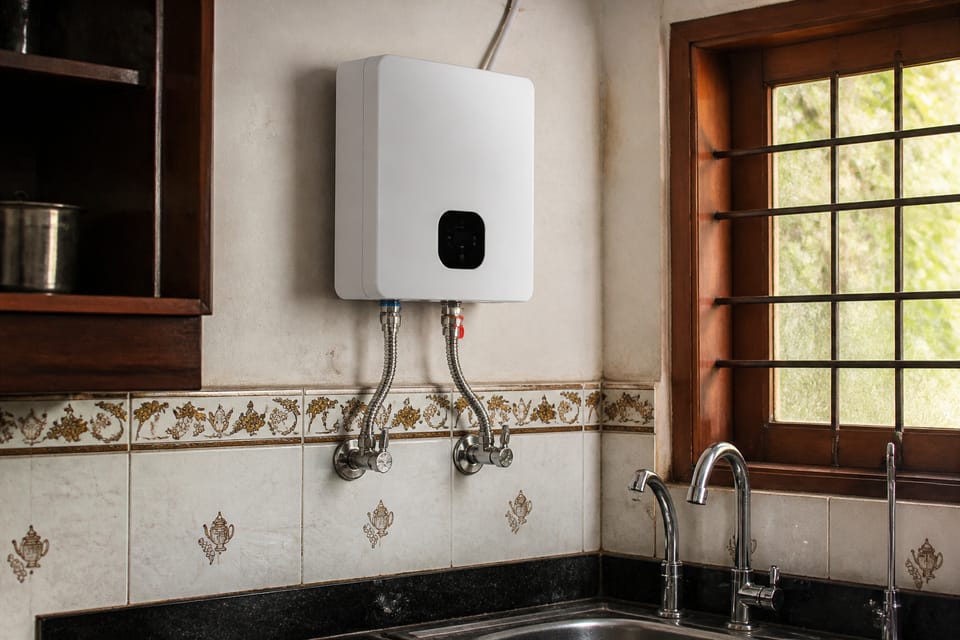
| Instant electric geyser | Heats the water as it flows through | IS 302-2-35: a “stationary appliance for heating water while it flows through the appliance” |
| Gas geyser | A gas burner heats the water as it flows | IS 15558:2005 (instantaneous type; gas storage heaters also exist, under IS 5115): an appliance “where the heating of water is directly dependent on the draw off” |
NBCS 2026 (Part E Section 1, 2.1.40) defines a geyser as “an apparatus for heating water with supply control on the inlet side and delivering it from an outlet”. NBCS 4.14.1.1 says the accepted method of electric water heating for domestic purposes is to use storage heaters, and that heating a large quantity of water, such as a hot bath, in the time taken to run it “requires a heater of too high a rating to be practicable in normal domestic premises”. The standards do not rank the types.
What do the standards say about each?
Storage electric (IS 2082:2018 and IS 302-2-21).
- IS 2082 adds the rated capacity, the standing loss (the energy a filled heater uses in 24 hours when no water is drawn, 3.3) and performance tests; most other requirements are those of IS 302-2-21.
- Types in IS 302-2-21 include closed (unvented, at the water system pressure), open-outlet, cistern-fed, cistern-type, low-pressure and heat exchange heaters. A closed heater is marked with a statement that a pressure-relief device is to be fitted unless one is built in, and its instructions say the relief discharge may drip and the pipe “must be left open to the atmosphere”. An open-outlet heater is marked with a warning that its outlet acts as a vent and must not be connected to a tap, and cistern-fed and low-pressure heaters carry a warning not to connect a pressure-relief device to the vent pipe.
- Safety: a thermal cut-out that disconnects all poles (the neutral need not be disconnected for fixed wiring) and works independently of the thermostat (22.106); for a Class I heater, the sheath of the heating element is connected to the earthing terminal, with stated exceptions (27.1); and, for heaters other than open-outlet and cistern-feed types, an inner container of copper or stainless steel, or a vitreous-enamelled tank to IS 13273 with cathodic protection if the enamel coverage is incomplete (an unnumbered paragraph after 22.110).
- NBCS 4.14.10.1 says a pressure-type storage heater shall be fed from a cold water storage tank and under no circumstances connected directly to the water main, except the cistern type or a non-pressure type. IS 2065 8.2.4 gives a related rule, as the plumbing page explains.
- We read the 2018 edition of IS 302-2-21. A 2024 edition is in force, and it may differ.
Instant electric (IS 302 Part 2 Section 35:2017).
- It does not allow bare-element heaters: “Manufacturing and use of bare-element water heaters are not allowed for safety reason.”
- It also covers closed and open-outlet types. The open outlet must not be connected to any tap or fitting other than those specified, and, for closed types where a pressure-relief device is required, it must be fitted during installation unless it is built in. For an appliance without a flow switch, the warning is not to switch on if the water in the heater may be frozen.
- The standard names no supply circuit.
Gas (IS 16093:2013 and IS 15558).
- IS 16093 names the hazard as asphyxia: clause 1.3 says that if its instructions are not followed exactly, “it may result in asphyxia, fire or explosion causing personal injury or damage to the property”. IS 15558:2005 requires a safety device that cuts off the gas if water does not flow, a flame failure device and overheat protection, limits the carbon monoxide to carbon dioxide ratio of the exhaust gases in a factory test (clause 17; we print no value), and requires the front of the appliance to be marked “For use in well ventilated areas only” in red.
- Where to install (IS 16093): the heater is installed in a well cross-ventilated room with a minimum volume and air inlet area stated in clause 4.1 (we do not print them). Clause 4.1 adds that where ventilation or area is insufficient, the gas water heater “shall be installed in other open space and hot water pipeline shall be provided in the intended area”. Installation inside the bathroom “is not recommended, unless condition specified in 4.1 are complied with” (4.2), and a bathroom has to meet those conditions itself. It “shall not be installed in bed rooms and any occupied space normally kept closed” (4.3), nor in a small poorly ventilated or air-tight room with an air conditioner (4.4), nor below ground level (4.7). No electrical wiring, point or equipment goes above it (4.11), and the cylinder is kept outside the bathroom (5.1). The plumbing is done by qualified and trained personnel only (7.13).
- If gas is smelt, IS 16093 10.1 says to close the gas supply, ventilate by opening doors and windows, and “Do not activate any electrical switches or operate the water heater”, and to call the emergency number or the installer.
- IS 15558:2005 is withdrawn and covers LPG only; a newer edition and a separate product standard for piped natural gas heaters exist and were not readable, and IS 16093 as read applies to instantaneous heaters. NBCS Part E Section 4 on gas supply says it does not cover safety rules for gas burning appliances. IS 16093 does not recommend installing a gas geyser inside a bathroom unless the clause 4.1 ventilation conditions are met; we found no clause that bans one outright. In practice, many bathrooms will not meet those conditions. Ask the gas supplier or installer, and follow the maker’s manual.
What does the house need for each type?
This is practice, unless a clause is named.
| Need | Storage | Instant electric | Gas |
|---|---|---|---|
| Power | A power point and a switch, with the heater earthed | A heavier connection: NBCS 6.1.1 assumes 3 000 W for an instant geyser against 2 000 W for a storage one, for load estimation only | Depends on the model (some have automatic ignition): ask the maker; no wiring or point above the heater (IS 16093 4.11) |
| Water | Cold feed from a tank where it is a pressure type (NBCS 4.14.10.1); hot-water-rated pipe; a relief outlet or vent as the type needs | Cold feed and hot-water-rated pipe; flow and pressure as the maker states | Cold feed and hot-water-rated pipe; IS 15558 asks for the minimum water head needed for operation to be marked |
| Gas and air | None | None | A gas point fitted by a qualified person, ventilation, and a place that meets IS 16093 (practice) |
| Space | A wall that carries the tank, with the pipes below | A small wall space close to the taps | A well-ventilated spot, away from bedrooms and closed rooms |
NBCS 6.1.1 gives the storage figure as 2 000 W and the instant figure as 3 000 W as values to be used in estimating the current to be carried by any conductor “unless the actual values are known or specified”; they are not the rating of your heater. See electrical work in a house build: stages and inspection points for the electrical stages.
Where does the geyser’s switch go?
NBCS Part D Section 2, clause 5.8.3 says: “Switch or isolator controlling a water heater or geyser should not be located within 1 m from the location of a shower or bath tub, to avoid a person in wet condition reaching the switch or isolator. It is preferable to provide the control switch outside the bath room near the entrance and provide an indication at the water heater. A socket or a connector block with suitable protection against water spray should be provided to connect the water heater.” Clause 13.4.1.1 adds that the geyser switch should not be accessible from the bath or shower area and should have a built-in indicator. NBCS 6.3 asks for suitable MCB-type switches for controlling points for air conditioners and geysers. Whether the geyser gets its own circuit is the electrician’s design, to be checked against the NBCS table of circuits: see MCB vs RCCB vs RCBO: what each protects against at home and earthing for a house: what it is, earth vs neutral, and why it matters.
What pipe carries the hot water?
Hot water needs a pipe whose standard names hot water, and the pipes differ by type. See CPVC vs UPVC pipes: which one to use for home plumbing, which also says to keep CPVC away from the flue of a gas water heater. NBCS 4.14.6.1 forbids ungalvanised black mild steel pipes in any part of a domestic hot water installation. For the supply rules on connections to a hot-water system, see plumbing work during house construction: stages and inspection points.
What should I decide before the walls close?
- Which bathrooms and the kitchen get hot water, and whether one central heater or one per bathroom suits: a long pipe run means a longer wait for hot water.
- Which type for each place, and the capacity from the maker’s rating for the number of users. We give no litres figure from a website.
- A power point at each electric geyser position, with the switch outside the shower’s reach, and earthing.
- The hot-water lines in hot-water-rated pipe, and the cold feed. Ask the plumber and the maker whether the heater is a pressure type or an open-vent type, since the plumbing differs.
- For a gas geyser, the gas point and the pipe route, the ventilation, and the position chosen with the gas supplier or installer, not inside a closed bathroom.
- The wall that carries a storage tank.
- Keep the maker’s manual and the drawing.
What mistakes should I avoid?
These are practice, not code rules, unless a clause is named.
- Fixing the geyser switch within reach of the shower (NBCS 5.8.3) or the point where it is accessible from the bath area (NBCS 13.4.1.1).
- Deciding the hot and cold supply positions after tiling.
- Using a pipe that is not for hot water, such as UPVC or HDPE, or black steel (NBCS 4.14.6.1 forbids ungalvanised black mild steel in domestic hot water installations).
- Skipping the earthing, or the pressure-relief arrangement on a closed heater.
- Planning a gas geyser in a closed bathroom or a room without ventilation (IS 16093 4.1 to 4.4).
- Letting an unqualified person fit gas piping (IS 16093 7.13).
- Plugging a heavy-load geyser into any socket; follow the maker’s manual and the electrician’s design.
- Blocking the relief outlet of a closed heater.
Frequently asked questions
What is the difference between a geyser and a water heater?
In everyday use, nothing. NBCS 2026 defines a geyser as an apparatus for heating water with supply control on the inlet side. The standards use the names storage water heater, instantaneous water heater and gas instantaneous water heater.
Is an instant geyser cheaper to run than a storage geyser?
The standards give no verdict. IS 2082 measures the standing loss of a storage heater, and the running cost depends on use. Ask the maker, and rely on no website figure.
Is a gas geyser safe in a bathroom?
IS 16093 does not recommend installation inside the bathroom unless its ventilation conditions are met, and says the heater “shall not be installed in bed rooms and any occupied space normally kept closed”. Ask your gas supplier or installer, follow the maker’s manual, and if you smell gas, follow clause 10.1.
Can one geyser serve the whole house?
NBCS 4.14 covers centralised hot water design, and the small storage heaters are noted for one or two points of draw-off. The plumber and engineer decide, since the pipe run and the wait for hot water change with the layout.
Does a geyser need earthing?
IS 302-2-21 27.1 has the sheath of the heating element of a Class I heater connected to the earthing terminal, with stated exceptions, and NBCS 4.15.4.3 says the metalwork of water heating appliances shall be bonded and earthed. See the earthing page.
Related guides
- Solar water heater vs geyser: flat plate, evacuated tube and the roof
- CPVC vs UPVC pipes: which one to use for home plumbing
- MCB vs RCCB vs RCBO: what each protects against at home
This guide is general information. Read the disclaimer. Your plumber, electrician and gas installer decide the heater and its connections for your house.
Sources
- IS 2082:2018, Stationary Storage Type Electric Water Heaters, Specification (fifth revision): clauses 1, 3.2, 3.3 and 15.2 (page images read). BIS lists it as in force, valid to 2031-01-16. Most of its safety and marking requirements are taken from IS 302 (Part 2/Sec 21):2018, read on page images (clauses 3.101 to 3.108, 6.1, 7.1, 7.12, 22.106, 24.101 and 27.1); BIS now lists a 2024 edition in force that was not readable.
- IS 302 (Part 2/Sec 35):2017, Electric Instantaneous Water Heaters: clauses 1, 3.101 to 3.104, 6, 7.12 and 7.102 (page images read). BIS lists it as in force, valid to 2029-12-31.
- IS 16093:2013, Installation of Gas Based Instantaneous Water Heater, Code of Practice: clauses 1.3, 4.1 to 4.14, 5.1, 7.13, 9.2 and 10.1 (page images read). BIS lists it as in force, valid to 2028-12-31. IS 15558:2005, Mini Domestic Water Heater for Use with LPG (withdrawn; the 2024 edition titled Instantaneous Domestic Water Heater for Use with LPG is in force and was not readable): clauses 3.2, 4.1.10, 9, 11, 17 and 27.1 (page images read).
- SP 7:2026, National Building Construction Standards (NBCS) 2026, Part E Section 1 (clauses 2.1.40, 4.14.1.1, 4.14.3, 4.14.6.1 and 4.14.10.1; Section 4 clause 1.2) and Part D Section 2 (clauses 5.8.3, 6.1.1, 6.3 and 13.4.1.1) (page images read). From an unofficial archive.org copy.
General information only. It is not a structural design or professional advice. Ask a licensed structural engineer or architect to check your plans and site.