
Short answer
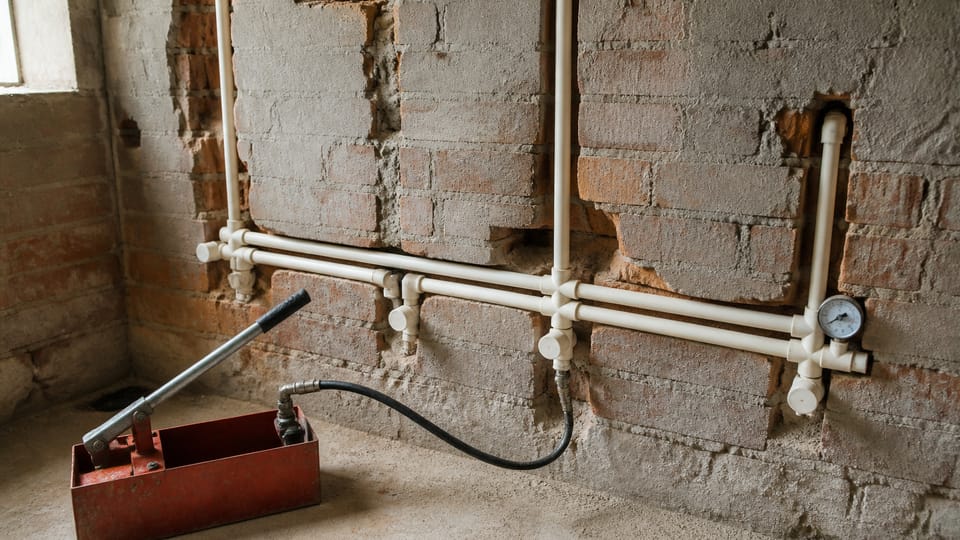
What pressure should house water pipes be tested at before tiling? No Indian code we read sets one figure for cold-water pipes inside a house wall. IS 2065 gives a test pressure for mains only. For the service pipe from the main it asks for a watertight check under working pressure, and it gives no test for tank-fed pipes. Pipe makers differ, so get your maker's written figure before the test. Test with water, not air, and close the chases only after a recorded pass.
On this page (12)
- What does IS 2065 actually ask?
- Which pipes have test wording, and what does it cover?
- Why does no one number fit every pipe?
- Can the test be done with air?
- How long should I wait after the joints are made?
- How is the test done?
- What if the gauge moves?
- What should the test record show?
- What mistakes should I avoid?
- Frequently asked questions
- Related guides
- Sources
The plumber says “pressure test done”, and the mason is ready to tile. What was tested, at what pressure, and for how long? This page explains what the Indian codes really say. They say less than most websites claim, and IS 2065 ties no test to tiling. It also explains what to ask for before the chases are closed. It gives no single test figure, because no code we read sets one for your house pipes. For the rest of the checks, see concealed plumbing before tiling.
What does IS 2065 actually ask?
IS 2065, the Indian code for water supply in buildings, has two different tests. People often mix them up.
| Clause | Applies to | What it says |
|---|---|---|
| 14.2 | Mains, after laying | “The test pressure shall be 0·5 N/mm² or the maximum working pressure plus 50 percent, whichever is the greater”, held “for at least half an hour” |
| 14.3 | Service pipe from the main (cl 2.48), not tank-fed branches | “The service shall then be inspected under working conditions of pressure and flow. When all draw-off taps are closed, the service pipe shall be absolutely watertight.” |
Clause 14.3 gives no number. Clause 2.48 defines a service pipe as the pipe from the street main, under the main’s pressure. Most bathroom lines are fed from a tank, so 14.3 does not strictly cover them either. Clause 14.2 is for mains, so do not treat its figure as the rule for a bathroom wall. NBCS 2026, the national building code, uses different wording for mains: “0.5 N/mm2 or double the maximum working pressure, whichever is greater”, “for at least 5 min” (clause 4.15.2). The two texts do not match, and we found nothing that explains the difference. Neither is a house figure.
NBCS 3.1.10 adds a general duty with no figure: “The plumbing system shall be subjected to required tests to effectively disclose all leaks and defects in the work or the material.”
Which pipes have test wording, and what does it cover?
The nearest texts are below. Read the scope column before you use any of them.
| Pipe or system | Text | What it says | Scope |
|---|---|---|---|
| CPVC | CPWD 18.9.9.1 and 18.9.10 | “pressure tested prior to concealing the chases”. The test is “similar to the test pressure used for other plastic/metal pipes” | CPWD contracts; no figure |
| PPR | CPWD 18.8.8 | A stepped test with its own figures, not printed here | CPWD contracts |
| PE-AL-PE | CPWD 18.10.5 | “specially designed test plugs” “before covering the pipes in chases” | CPWD contracts |
| UPVC | IS 7634 (Part 3) cl 9 | Test method, with the pressure limited by the “lowest rated component” | Written for pipelines; not a house figure |
| Polyethylene | IS 7634 (Part 2) cl 9 | Test method for laid pipelines | Not a house figure |
| Hot water system | NBCS 4.15.4.1 | “0.5 N/mm2 or twice the working pressure, whichever is greater, for a period of at least 30 min after a steady state is reached” | Hot water systems, heaters included |
Is the timing in any code? Yes, in part. IS 13182:2020, on wet areas, says: “In case of concealed pipes, before plastering the joints and connection shall be tested according to IS 1742.” IS 1742 is the drainage code, so this supports the timing and gives no supply pressure. CPWD’s CPVC clause gives the same timing for its own contracts.
So a test before closing the wall is sound practice with support from these texts. It is not a test figure set by IS 2065.
Why does no one number fit every pipe?
The test has to suit the pipe, its class, its joints and the weakest part on the line. For UPVC, IS 7634 (Part 3) says the test pressure must “not exceed 1.5 times the maximum rated pressure of the lowest rated component”. So a valve or mixer may limit the test, not only the pipe.
Pipe makers also differ. The Ashirvad CPVC manual says to test “at 10 bar for one hour”. The Astral CPVC Pro catalogue says “at design pressure x 1.5 times for one hour”. Each is one maker’s instruction for its own product. Neither is a code, and we name them only to show the difference. Ask for your maker’s written figure, and write it into the record before the test starts.
Can the test be done with air?
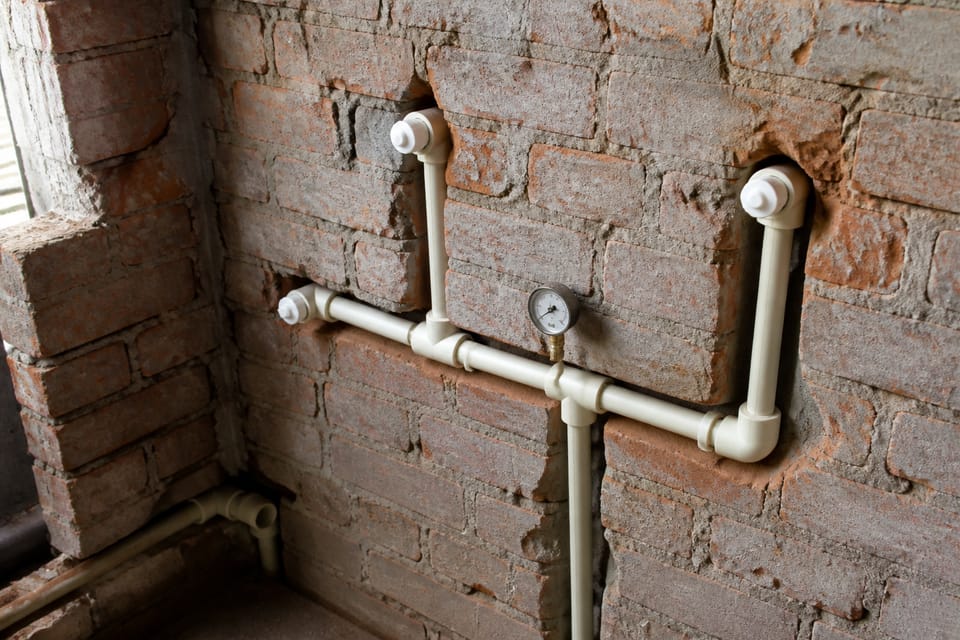
Do not test water pipes with air. IS 7634 (Part 3), for UPVC, has a printed warning: “Pressure tests should never be carried out using compressed air or gasses.” IS 7634 (Part 2), for polyethylene, says: “Under no circumstance, air is to be used instead of water for testing.” For CPVC, the Astral CPVC Pro catalogue says: “Pressure testing with compressed air is dangerous and can result in injury or death.”
You may see an air test named for drains in IS 5329. That is a very low-pressure test for a different system, and it does not carry over to supply pipes.
How long should I wait after the joints are made?
IS 7634 (Part 3), for UPVC, says: “Solvent cemented joints must be allowed to harden for a minimum of 24 h before being subjected to test conditions.” IS 7634 (Part 1) says solvent welded lines “should not be pressure tested until at least 24 hours after the last solvent welded joint has been made”.
IS 15778, the CPVC pipe standard, gives no site waiting time. Its only 24-hour set is in a laboratory test (Annex C). Maker charts differ. As a practical line, not a code rule for CPVC, wait at least 24 hours after the last glued joint. Wait longer if the maker’s written instructions say so, as they may for cold or humid weather or larger pipes. PPR joints are fused, so follow the maker’s method.
How is the test done?
This is the general order, as practice. The clause references show where a step comes from. Your plumber follows the pipe maker’s method.
- Prepare. Cap every outlet except the farthest and highest, and isolate the tank, geyser and cisterns. IS 7634 (Part 1) says “All control valves shall be positioned ‘open’ for the duration of the test”. IS 7634 (Part 3) adds: “Testing against closed valves is not recommended, unless there is no alternative.”
- Fill slowly. IS 2065 14.3 says the line is “slowly and carefully charged with water, allowing all air to escape and avoiding all shock or water hammer”. That clause is about service pipes, but the idea carries over. Cap the last outlet once water runs free of air.
- Pump up gradually to the written figure. Check that no part on the line is rated lower.
- Note the reading and the time. Leave the line for the written period, then read the gauge again.
- Walk every joint. A visible leak fails, whatever the gauge shows.
- Release slowly. IS 7634 (Part 3) says the pressure “should be released slowly and in a carefully controlled manner”.
- Retest after any repair or added pipe. CPWD’s PPR clause says: “Piping required subsequent to the above pressure test shall be retested in the same manner.”
What if the gauge moves?
A moving needle is a question, not a verdict. IS 7634 (Part 1) notes that “Thermoplastic pipes expand under pressure”, and that this can cause an “initial fall of pressure even though there is no leakage”. IS 7634 (Part 3) adds that “a slight rise in pressure is also, possible due to changes in ambient temperatures”.
We print no allowed drop, because none we read is a house rule. In practice, a fall that continues must be traced, and a visible leak fails the test. Ask the plumber to show you why the reading moved.
What should the test record show?
No text we read prescribes a record, so this is practice. Ask for a signed note with:
- Date, floor and bathroom or section tested.
- Pipe type and maker.
- Date and time of the last joint.
- Test pressure and its source, such as the maker’s manual.
- Gauge readings and times at start and end.
- Repairs and any retest.
- Name of the plumber, and the person who saw it.
- Photos of the gauge and of the pipe routes before closing.
Put the test in your written agreement with the plumber, and say who pays to open and refinish a wall if a line fails later.
What mistakes should I avoid?
These are practice points unless a code is named.
- Asking “what pressure?” without naming the pipe.
- Using the IS 2065 mains figure as the house figure.
- Testing with a compressor.
- Testing the same day the joints were glued.
- Leaving air in the line. It makes the reading unreliable.
- Testing only the cold line. In practice, test the hot line too before closing the wall. NBCS 4.15.4.1 has its own test for hot water systems, done after the heaters are in, so it is not the same step.
- Adding pipe after the test and not retesting.
- Pumping the line yourself. Let the plumber do it.
- Treating this test as a check on drains or waterproofing. They have their own tests.
Frequently asked questions
Is a pressure test compulsory before tiling?
IS 2065 does not say so. IS 13182 asks for concealed joints to be tested before plastering, by reference to the drainage code. For a private house, write the test into your agreement.
How long should the test last?
We found no house figure. Mains figures in the codes differ, and pipe makers state their own. Use the time in your maker’s written instructions.
Does a small drop on the gauge mean a leak?
Not always in plastic pipe, because the pipe expands under pressure. But do not accept a drop without an explanation. Check every joint, and take the reading again.
Should the test be repeated after tiling?
We found no code clause on this. Drilling and tile fixing can damage a hidden pipe, so many owners ask the plumber to check the lines again at the end. This is practice.
Is a pressure test the same as a ponding test?
No. A pressure test checks the supply pipes. A ponding test checks the waterproofed floor.
Related guides
- Plumbing work during house construction: stages and inspection points
- IS 2065 explained: the water supply code, clause by clause
- CPVC vs UPVC pipes: which one to use for home plumbing
- Plumbing materials list for a house: pipes, valves, traps, IS marks
This guide is general information. Read the disclaimer. Your plumber and engineer decide the test for your pipes, using the pipe maker’s written instructions.
Sources
- IS 2065:1983, Code of practice for water supply in buildings: clauses 2.48, 14.2 and 14.3. BIS shows validity to 28 February 2027.
- SP 7:2026, National Building Construction Standards (NBCS) 2026, Part E Section 1, Water Supply: clauses 3.1.10, 4.15.2 and 4.15.4.1. From an unofficial archive.org copy.
- IS 7634 (Part 1):1975, Laying and jointing of plastic pipes, choice of materials and general recommendations: clauses 7.1, 7.2 and 7.4 Note. As amended.
- IS 7634 (Part 2):2012, Laying and jointing of polyethylene pipes: clause 9(e).
- IS 7634 (Part 3):2003, Laying and jointing of UPVC pipes: clause 9 warning and clauses 9.1.2, 9.1.4, 9.2.1, 9.4.3 and 9.4.4.
- IS 13182:2020, Waterproofing and damp-proofing of wet areas in buildings: clause 5.3.2(c).
- IS 15778:2007, CPVC pipes: Annex C (laboratory test) and Annex E (installation). No site test or site waiting time.
- IS 5329:1983, Sanitary pipe work above ground: clause 7.2.2 (air test for drains).
- IS 1742:1983, Building drainage: named because IS 13182 refers to it. It is a drainage code.
- CPWD Specifications 2019, Volume 2: clauses 18.8.8, 18.9.9.1, 18.9.10 and 18.10.5. For CPWD contracts, used here as a reference.
- Astral CPVC Pro catalogue, May 2024, pp. 52-53: air warning and test instruction for that product. One maker's document, not a ranking.
- Ashirvad CPVC technical manual, pp. 35-36, undated copy on a seller's site: test instruction for that product. One maker's document, not a ranking.
General information only. It is not a structural design or professional advice. Ask a licensed structural engineer or architect to check your plans and site.